Wild Bull Dies After Trapped in Snare at Khao Sam Roi Yot
A large male wild bull died at Khao Sam Roi Yot National Park after its leg was severed by an animal snare, with authorities finding the animal collapsed in a water channel on July 28 and determining death was caused by blood infection from
On July 29, 2569, Mongkol Chaiyaphakdi, director of Khao Sam Roi Yot National Park, revealed that a tragic incident occurred in the Khao Sam Roi Yot World Heritage area after officials discovered a male wild bull, approximately 5–7 years old and weighing 800–900 kilograms, with severe injuries to its right front ankle, where its leg had been severed by a tightened animal trap or snare before it collapsed and died.
The incident occurred on July 28 at approximately 09:00 AM, when park rangers at checkpoint 1 (Khao Hin Lad) were informed by a local landowner operating under Section 64 of the National Parks Act B.E. 2562 near Baan Huai Sai, Village 6, Tambon Huai Mae Pring, Kaeng Krachan District, Phetchaburi Province, that an injured bull had entered the area. The park director ordered rescue personnel, special task force rangers from the central patrol division 2, park rangers, and border patrol officers from Unit 144 to investigate and closely monitor the situation.
At approximately 11:30 AM, the bull collapsed in a water channel within the farming plot, and died peacefully at approximately 16:00 PM. Officials then relocated the carcass to the Khao Sam Roi Yot National Park headquarters.
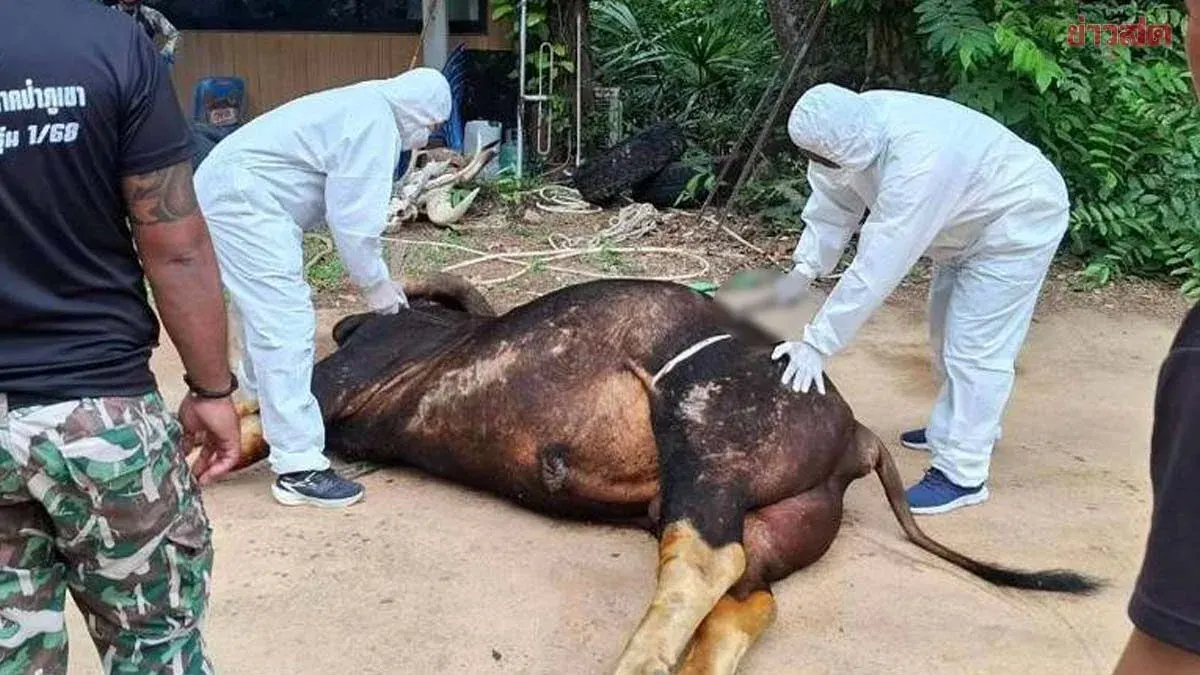
On July 29 at 09:00 AM, a veterinary team from the Wildlife Conservation Division, accompanied by the provincial administration led by Kanin Thongkom and Suriya Klom Piemsakul, Deputy District Officer of Kaeng Krachan, along with Major Sanchai Othaworwong, Public Relations Development Officer from Region 1, jointly conducted an autopsy of the bull carcass.
Initial autopsy results found no internal bleeding and no bullet wounds. The veterinarian concluded that death was likely caused by blood infection due to the large open wound on the right ankle from the spring trap, which became severely infected through prolonged contact with soil. Tissue samples were collected for laboratory examination to confirm the findings officially.
Authorities have compiled evidence, prepared investigation reports, and filed charges with Kaeng Krachan Police Station to pursue the perpetrator and conduct legal proceedings. To prevent threats to rare wildlife, the investigating team is preparing to submit a proposal to ban the possession and sale of ready-made spring traps in Phetchaburi Province.