Thailand has developed a new cloud-seeding agent called AR23 that works effectively during severe droughts when humidity is too low for traditional methods, potentially generating over 13 million cubic meters of water daily to support agric
The Agricultural Research Development Office (ARDA) is supporting research to help farmers cope with climate change by increasing rainfall opportunities during dry seasons and generating over 13 million cubic meters of water daily.
Dr. Taveesak Thanadechopol, ARDA director, emphasized that every rainless day represents not just seasonal drought but a threat to national food security. Thailand has over 149 million rai of agricultural land, with more than 70 percent located outside irrigation zones and depending on rainwater for 75 percent of water needs—totaling over 65,000 million cubic meters annually. Climate change has intensified droughts, erratic rainfall, and PM2.5 pollution, making the royal rain-making program increasingly vital to water resource management.
Previous cloud-seeding operations faced significant limitations because traditional seeding agents required relative humidity above 60 percent, making them ineffective during severe droughts when water is most needed. ARDA therefore funded the Thailand Institute of Scientific and Technological Research (TISTR) to develop AR23, an alternative seeding agent led by Dr. Arissa Jaiyu, which can function at humidity levels of 56–60 percent.
AR23 increases cloud condensation nuclei by approximately 12 percent and extends rain-making capabilities during droughts and irregular rainfall periods—previously the most restricted times for cloud seeding. This innovation is built on meteorology and cloud physics science, with evaluation systems using empirical data including upper-atmosphere measurements, cloud condensation nucleus counts, cloud water droplet measurements, weather radar analysis, and statistical analysis to ensure all operations rest on verifiable scientific evidence.
Research confirms AR23's effectiveness and has passed testing for real-world use by the Royal Thai Navy's Meteorological Department and the Department of Agricultural Aviation. Nationwide deployment began in fiscal year 2567, enabling rain-making operations under previously limiting atmospheric conditions while improving cloud formation and precipitation efficiency. AR23 supports water augmentation, drought relief, and mitigation of haze and PM2.5 pollution.
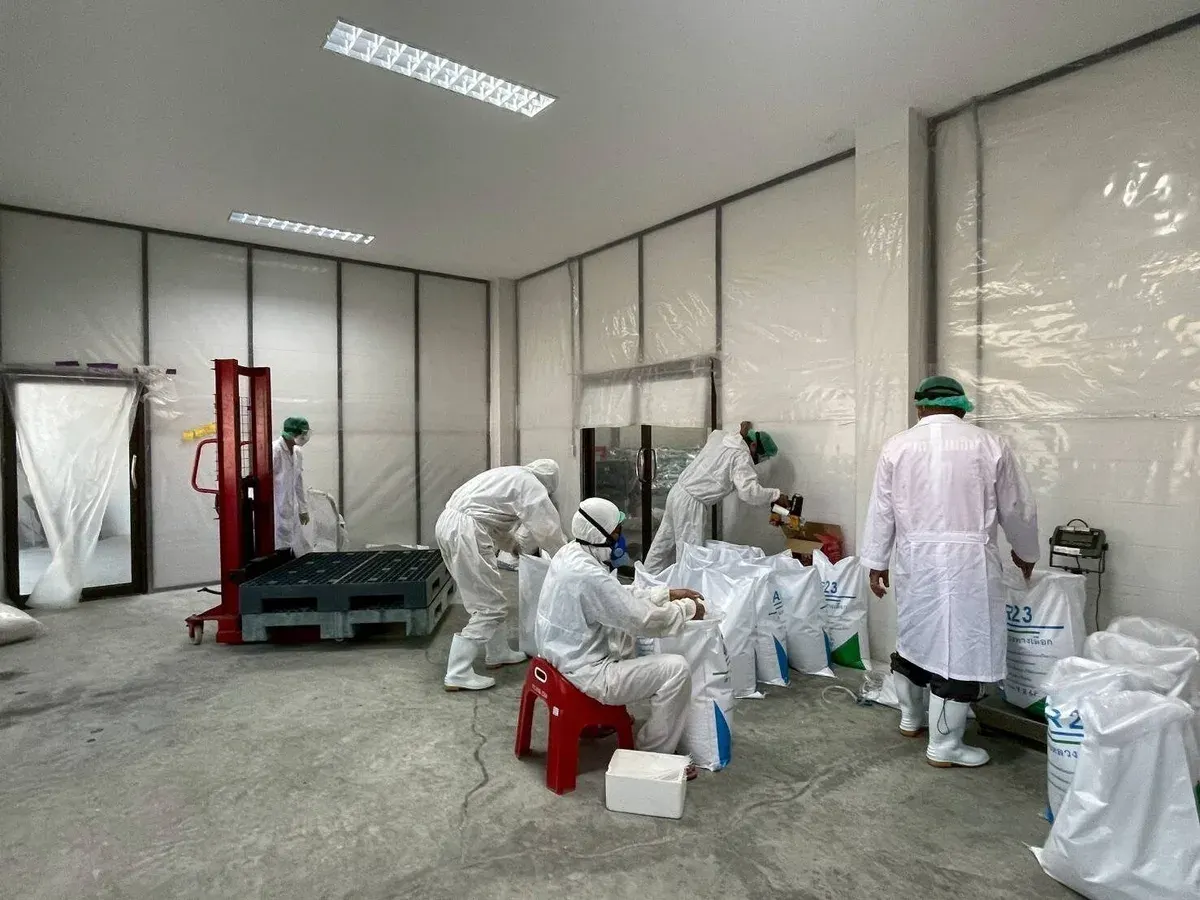
Within just two years, ARDA-supported research through collaboration between TISTR, the meteorological department, and the agricultural aviation department successfully developed AR23 and transitioned it from laboratory to operational use. Production has exceeded 35 tons, with knowledge transfer and training provided to over 30 personnel. Plans call for expanding annual production capacity to at least 100 tons to support nationwide rain-making operations.
The initiative can increase water supply in agricultural areas by an average maximum of over 13 million cubic meters daily, benefiting more than 1 million rai and generating approximately 2,107 million baht in economic value through reduced agricultural damage, enhanced dry-season rain-making capability, drought impact mitigation, and air pollution relief. It also reduces state budget burdens for long-term drought recovery and rehabilitation, representing an important project that advances the nation's water management efficiency.