Chula and MIT Unveil Water Crisis Solutions at National Forum
Chulalongkorn University and MIT convened a national water resilience forum to address Thailand's escalating water crises driven by climate change. Experts urged a shift from reactive disaster relief to proactive water management, advocating a "Water Economy" approach informed by international models. A new high-resolution climate modeling system developed with MIT was unveiled to simulate extreme rainfall risks for Bangkok at a 5-kilometer scale.
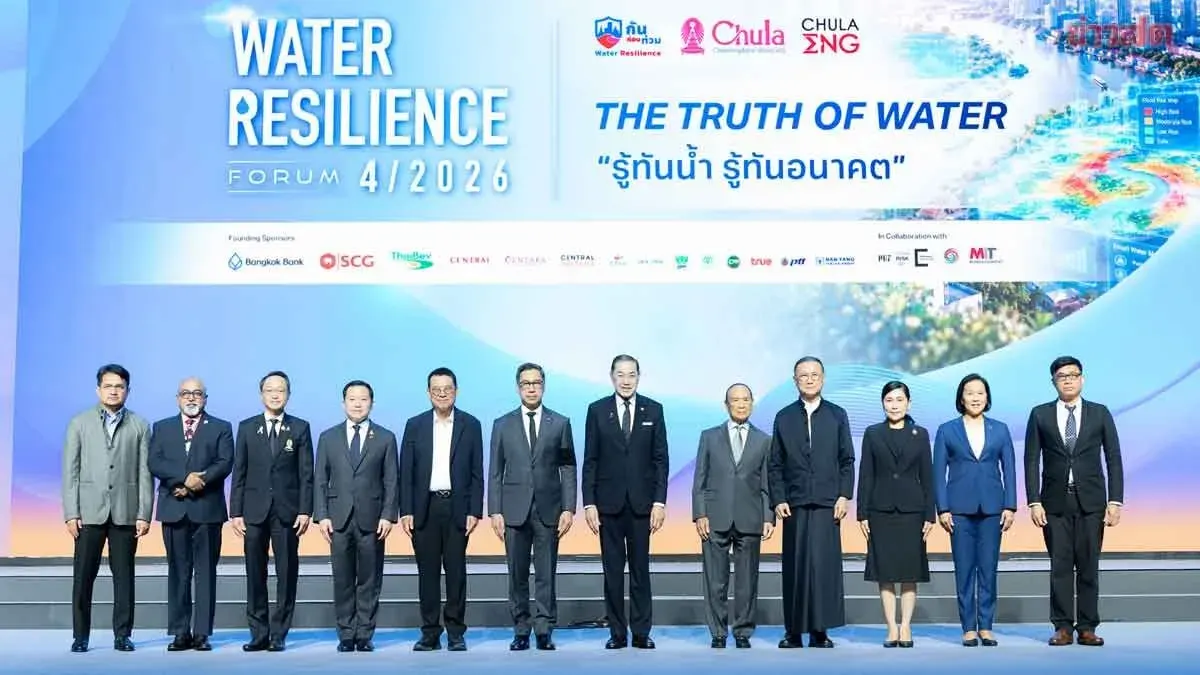
Chulalongkorn University, through its Water Resilience Center and Faculty of Engineering, organized the Water Resilience Forum 4/2026 under the themes "THE TRUTH OF WATER: Know Water, Know the Future" and "THE WORLD IS ADAPTING: When the World Must Live with Water, How Will We Live with It?" The event took place on November 12, 2026, at the SX Grand Plenary Hall, Queen Sirikit National Convention Center. Chula Council President Prof. Dr. Surakiart Sathirathai chaired the opening to exchange knowledge and approaches for managing water risks from climate change, especially extreme rainfall impacting urban areas, the economy, and the public.
Prof. Dr. Surakiart stated that Thailand has long been intertwined with water, but climate change, landscape shifts, and urban expansion have altered water risk patterns — including extreme rainfall, flash floods, sea-level rise, and drought. Recent floods show disaster relief is necessary, but what needs strengthening is pre-disaster preparedness: water management, early warning systems, evacuation plans, vulnerable group protection, and systematic drainage efficiency.
He added that Thailand should shift from viewing water management as risk or disaster toward water management that creates security and economic opportunity — moving from Water Risk to Water Economy. This means using data and knowledge to support decisions and investments aligned with risks, while learning from abroad: the Netherlands' room-for-rivers approach, Japan's underground drainage tunnels, and China's Sponge City concept. Water disaster management is not the duty of a single agency but requires cooperation among government, private sector, civil society, and academia to build long-term resilience and reduce losses.
The forum featured panel discussions including TRUTH 1 – THE TRUTH WE CAN SEE: "How Will Bangkok Handle Extreme Rain?" presented by Dr. Sai Ravela, Principal Research Scientist at MIT's Department of Earth, Atmospheric, and Planetary Sciences, and Asst. Prof. Dr. Pongsak Suthinon, Head of Water Resources Engineering at Chula Engineering and Water Resilience Center academic committee member. They presented future water crisis preparedness through high-resolution climate data and models.
A highlight was the unveiling of Bangkok's extreme rainfall future via the Climate Extreme Data of Science (CEDoS) system, a joint research project between the Water Resilience Center and MIT. The system simulates and predicts severe climate hazards at a local scale with approximately 5x5 km resolution, starting with Bangkok. It integrates climate data, scientific principles, satellite data, and AI to analyze future risks and support adaptation planning. CEDoS is a climate and future risk simulation tool, not a real-time weather forecasting or warning system.
TRUTH 2 – THE RISK WE MUST FACE addressed "When Water Risk Becomes..."