Civil Society Presents 16-Point Plan for Deep South Peace
Civil society organizations have presented a 16-point peace plan for Thailand's troubled southern border provinces, covering security, governance, education, and economic development after stalled government dialogue efforts.
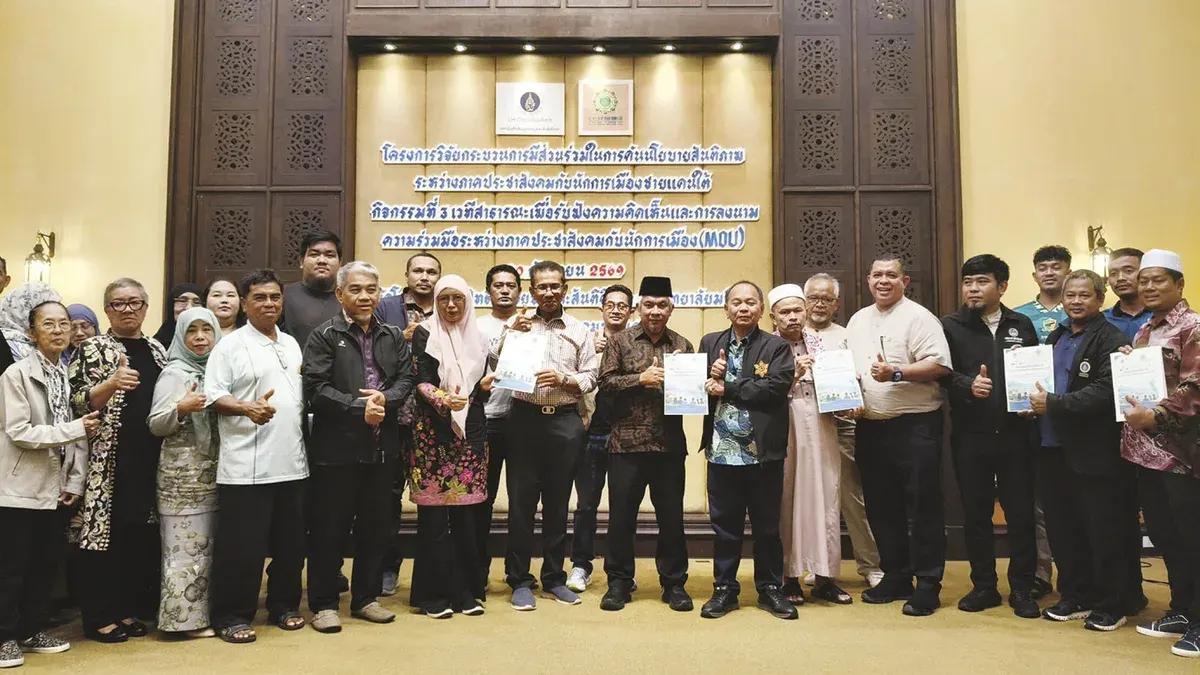
The Human Rights and Peace Education Institute at Mahidol University, working with the Southern Border Civil Society Council and network partners, has organized a forum to gather and present policy proposals for resolving problems in Thailand's southernmost border provinces. The proposal-drafting process began in January 2025 through consultations between civil society organizations and partners. This was followed by public forums marking the 13th anniversary of peace talks, where civil society collectively submitted demands to the government, both peace-talk committees, and relevant agencies. Civil society invited representatives from various political parties, particularly legislators from the border region, hoping the proposals would be forwarded to the prime minister, government, and opposition. The 16-point proposal covers public participation in continuous peace talks, space for stakeholders, reduced abuse of power affecting citizens' rights, and community-based security mechanisms. It also addresses grassroots economic development, support for local entrepreneurs aligned with regional identity, protection of language, religion and culture, forest and water restoration, and transparent environmental law enforcement. Additional points include strengthening communities, greater youth and women's participation, expanded educational opportunities, equality, remedies, justice, review of blacklist systems, and DNA testing procedures. Importantly, the proposals also call for administrative restructuring and appropriate power-devolution suited to local context, and development of governance models allowing greater public participation. The southern border region continues to experience periodic unrest and violence, with recent attacks on officials causing deaths and injuries, and arson incidents creating chaos. Although the government has established a southern border peace dialogue committee, it has stalled, leaving the current situation in a vacuum. The civil society's latest proposals do not limit southern border solutions to security alone, but encompass peace, economy, education, rights, identity, environment, power-devolution, remedies, and quality of life. It is hoped that stakeholders will help forward these proposals to the government, parliament, political parties, and the prime minister so they can be developed into policies truly suited to the region.