Commerce Ministry, Thai Chamber Join Forces on Economic Plan
The Commerce Ministry and the Board of Trade of Thailand have agreed on a four-pillar economic strategy covering competitiveness, stability, inclusive growth, and modernization. They are jointly addressing global trade challenges including FTA negotiations with the EU and UAE, while domestically focusing on food security, SME support, and price stability. The ministry urged the private sector to refrain from raising prices beyond actual cost increases to protect both producers and consumers.
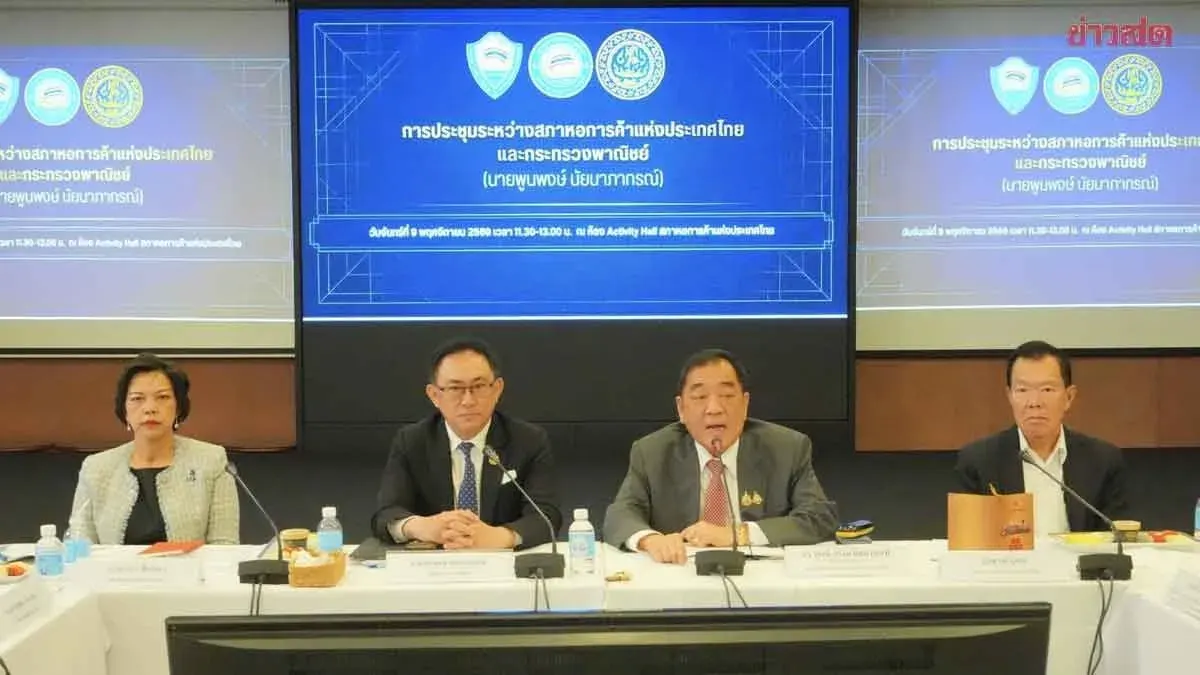
Commerce Ministry Permanent Secretary Punpong Nainapakorn revealed that senior ministry officials met with the Thai Chamber of Commerce and the Board of Trade of Thailand, led by Chairman Poj Aramwattananont, to outline cooperation strategies for strengthening Thailand's economy amid global challenges. The talks established a joint economic strategy across four pillars: Competitiveness, Security & Stability, Inclusive growth, and Modernization. Both sides have continuously exchanged intelligence to address geopolitical and economic volatility, including tax negotiations with the United States, accelerating FTA talks such as Thailand-EU and Thailand-UAE CEPA, and preparing Thai entrepreneurs for new global trade rules. Domestically, they are collaborating on food security, economic stability, and agricultural price management to distribute opportunities widely, especially for SMEs and community enterprises. The partnership also includes organizing the THAIFAX ANUGA ASIA trade fair, which generates over 100 billion baht annually and attracts more than 150,000 visitors, with the next edition scheduled for May 25-29, 2027 at IMPACT Exhibition Center. Punpong urged the private sector to hold prices steady amid economic volatility and rising production costs, adjusting only according to actual cost changes to balance impacts on producers and consumers. Poj noted discussions on removing trade obstacles such as Halal certification disputes, Vietnamese anti-dumping measures on Thai plywood, Myanmar import license hurdles, AI-based fruit inspection at the Huay Kon border checkpoint, and facilitating container transshipment at Laem Chabang Port.