Environment Minister Unveils Four Measures to Tackle Kok River Pollution
Thailand's Natural Resources and Environment Minister announced four urgent measures to address chemical pollution in the Kok River, including declaring a pollution control zone on December 2, cracking down on chemical smuggling at the Myanmar border, drilling 24 groundwater wells for clean water, and creating contamination maps. The plan follows the Prime Minister's directive and involves multi-agency coordination plus international cooperation with neighboring countries.
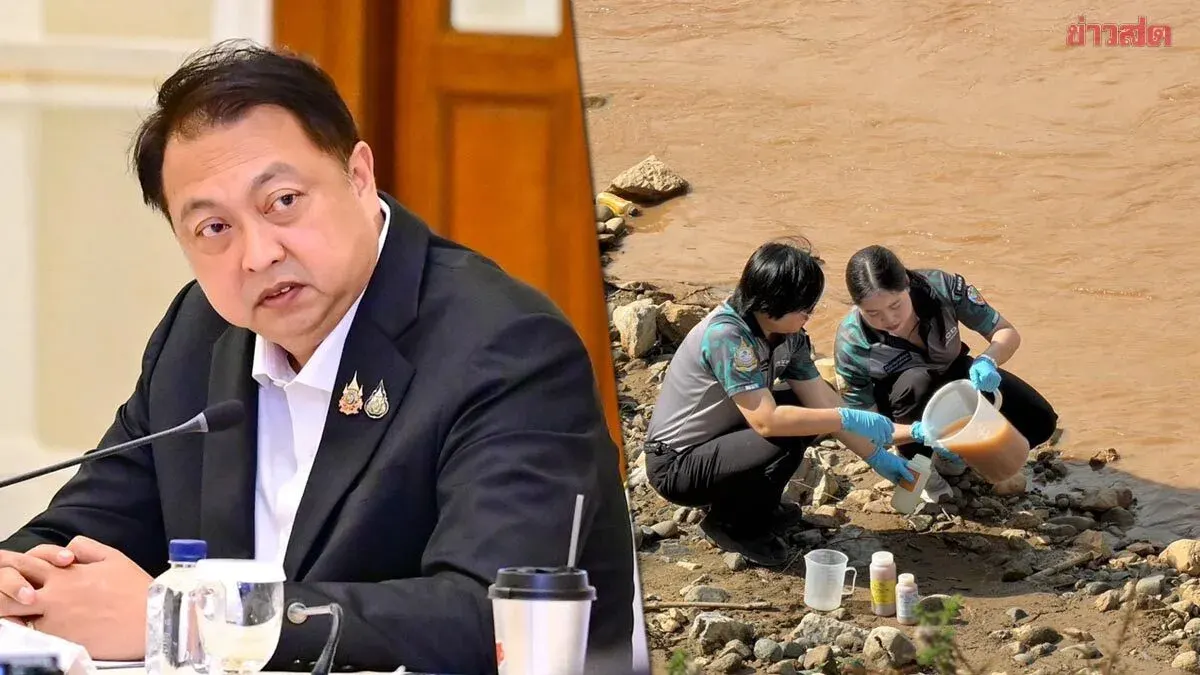
On November 21, 2025, Natural Resources and Environment Minister Surasak Karnjanarat revealed that the ministry is preparing an operational plan and measures to resolve contamination in the Kok River and upper northern water sources, per Prime Minister Anutin Charnvirakul's order. The comprehensive approach covers pollution source control, restoration of affected areas, clean water provision for the public, and international cooperation to address root causes and prevent long-term impacts. Minister Surasak outlined four key measures: 1. Accelerate the proposal to declare a pollution control zone before the National Environment Board on December 2, 2025, to elevate management of pollution in riverside areas, enabling systematic control, prevention, and restoration with integrated resources from all relevant agencies. 2. Strictly control the source by intercepting chemicals used in mineral extraction along the Myanmar border. Security and related agencies will integrate efforts to tighten control and prohibit the export of chemicals used in mineral processing along the Myanmar border to prevent cross-border pollution, while screening risk factors that could cause water contamination. 3. Expedite drilling of 24 groundwater wells along the Kok River to deliver clean water to the public. The ministry will coordinate with the Ministry of Interior and Ministry of Agriculture and Cooperatives to urgently drill 24 wells in riverside areas, alongside establishing central water distribution points and deploying mobile water production trucks to ensure sufficient and continuous clean drinking water for consumption, reducing risks from using monitored water sources. 4. Proactively monitor water quality and create maps separating contaminated from safe areas. The ministry will integrate work with the Ministry of Higher Education, Science, Research and Innovation, Ministry of Interior, and Ministry of Public Health to comprehensively assess water quality and produce clear maps showing contaminated and safe zones, enabling the public and local agencies to make informed decisions and implement appropriate measures. The Ministry of Foreign Affairs will coordinate international cooperation mechanisms to monitor and prevent cross-border pollution, while pushing collaboration with neighboring countries to resolve issues at the source. Minister Surasak added that all four measures are driven by the Prime Minister's directive, and the ministry will urgently coordinate all agencies to operate in unison, linking data and operations to achieve tangible results in pollution source control, natural resource and environmental restoration, and public safety, with the people at the center so they can have confidence in clean water and live safely.