Finance Minister Flags 5 Global Risks, Drives Clean Energy Shift
Finance Minister Pichai Chunhavajira outlined five global risks threatening Thailand's economy and detailed government plans to maintain fiscal discipline while transitioning to clean energy and boosting AI adoption for small businesses. The administration will promote rooftop solar with 20-year power purchase agreements, attract food industry investment through fast-track incentives, and upskill workers via university-industry partnerships.
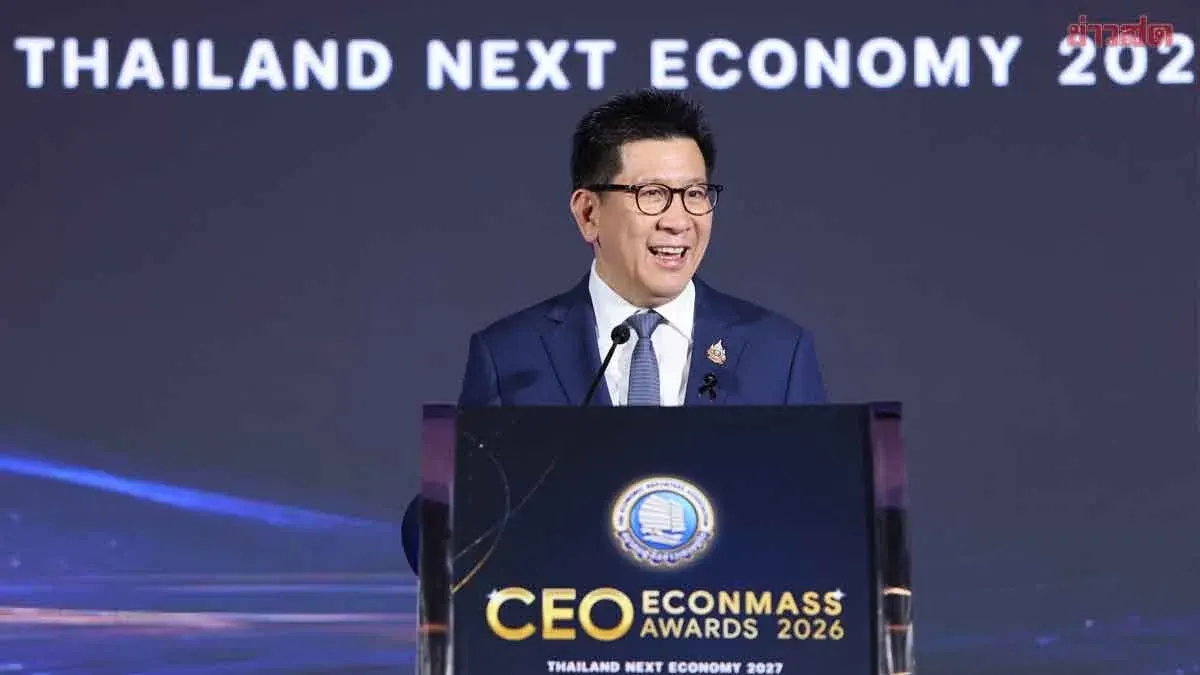
Deputy Prime Minister and Finance Minister Pichai Chunhavajira delivered a keynote address titled "Thailand Next Economy 2027: The Future of the Thai Economy" at an event organized by the Economic Reporters Association. He described the Thai economy as a small vessel confronting turbulent global waves, identifying five key risks: geopolitical polarization and trade wars, high interest rates, AI technology, climate change, and energy crises — all capable of impacting Thailand continuously.
Pichai noted that U.S. 10-year Treasury yields exceed 5% while Thailand's stand at around 2.4%, reflecting borrowing cost differences. Thailand has benefited from maintaining fiscal discipline, prompting credit rating agencies to revise their outlook from negative to stable, preserving confidence and lowering borrowing costs for both public and private sectors. The government must therefore sustain fiscal discipline, control deficits, and manage the budget efficiently while plugging economic leaks in household and public debt. Limited funds should target vulnerable groups and small entrepreneurs precisely, shifting from short-term relief to long-term income-generating capacity.
A key initiative is "Small AI for Better Jobs," applying small-scale AI to boost productivity. The "Nok Kradib" (Whisper Bird) project uses AI to help vendors analyze sales and plan inventory, while leveraging 4-5 months of historical income data to secure unsecured loans from state banks. This approach has drawn interest from the World Bank President and at APEC forums. Meanwhile, the "Thai Chuey Thai Plus" project aims to upskill entrepreneurs using AI and online commerce systems for greater self-reliance.
On energy and environment, the government is preparing for climate volatility and anticipated El Niño risks next year, with education and infrastructure investment support from the World Bank and Asian Development Bank. Since Thailand imports oil and gas worth nearly 10% of GDP, accelerating the transition to clean energy is essential. The Finance Ministry will propose cabinet approval for measures supporting rooftop and ground-mounted solar installations, enabling citizens to produce and sell clean electricity to the Electricity Generating Authority of Thailand under 20-year power purchase agreements, with financing support from Government Savings Bank, Government Housing Bank, and Bank for Agriculture and Agricultural Cooperatives to reduce upfront investment burdens.
To attract investment, the government will promote future industries — especially food and pet food — through measures like Thailand Fast Pass or BOI Fast Plus, alongside the "Skill Bridge" project linking factories with universities to develop workforce skills matching business needs. Pichai cited an investor committing 23 billion baht who opened a factory within six months of initial talks, citing confidence in Thailand's neutrality and potential to employ thousands, positioning Thailand as a global food production base.
The government aims to maintain fiscal stability, target assistance to vulnerable groups, transition to clean energy, and upgrade labor skills to propel the Thai economy onto a higher growth trajectory.