Four Business Giants Back AI, Capital, Energy as Thailand's Path Forward
Four Thai business leaders at Bangkok's 2026 summit called for AI investment, competitive energy costs, and business partnerships to drive Thailand's economic recovery and global competitiveness.

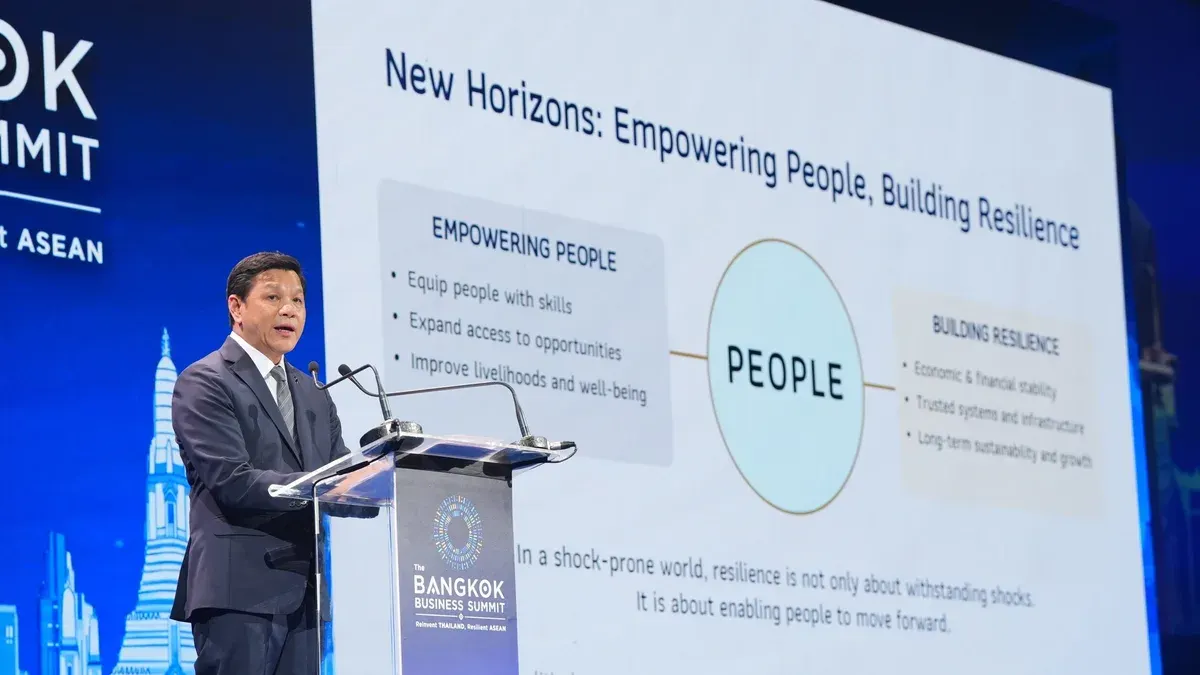
Four major business leaders presented their vision for Thailand's economic recovery at the Bangkok Business Summit 2026 under the theme "Winning in Turbulence."
Supachai Chearavanont, senior vice president of Charoen Pokphand Group, highlighted artificial intelligence and precision irrigation as drivers for agricultural productivity. He noted that Thailand's durian exports, valued at over $4 billion annually, could increase yields three to five times if AI and smart irrigation systems were deployed across 120 million hectares. He proposed a five-tier AI ecosystem involving government and private partnerships, along with a seed fund of 5-40 billion baht to support approximately 2 million students in developing next-generation technology entrepreneurs.
Kattiya Intravijai, chairman and chief executive of Kasikornbank, stated that banks must evolve beyond lending into transition partners helping businesses adapt and transform. KBANK will support seven strategic industries aligned with Thailand's Reinvent Thailand initiative, particularly focusing on small and medium enterprises that need to accelerate transformation, expand exports, and adopt sustainable finance.
Harald Link, chairman of B.Grimm Power, identified natural gas costs as a critical factor affecting Thailand's industrial competitiveness. He urged Thailand to establish strategic partnerships with neighboring countries like Myanmar and Cambodia to secure natural gas at competitive prices. He also called for business flexibility, continuous learning, and innovation to compete globally.
Aalok Lohia, group chief executive of Indorama Ventures, addressed the petrochemical industry's overcapacity challenge. He emphasized that overcoming this crisis requires business partnerships, mergers, and synergies to reduce costs and maintain profit margins. He stressed the importance of "grit"—perseverance and confidence—and encouraged leaders to expand into high-potential foreign markets while leveraging Thailand's position as an ASEAN hub with a "can-do" mentality.
Overall, the four executives reflected that Thailand's economic challenge extends beyond weathering volatility. The country must transform crisis into momentum for productivity gains, cost reduction, and new competitive capabilities, with AI as an efficiency tool, capital supporting business transition, competitive energy costs, and business collaboration for global competitiveness.