First Carnivorous Dinosaur Footprints Found in Udon Thani
The article reports the discovery of the first carnivorous dinosaur footprints in Udon Thani, Thailand, dating back 120 million years. A tourist spotted them in a national park, leading to official verification confirming theropod tracks on
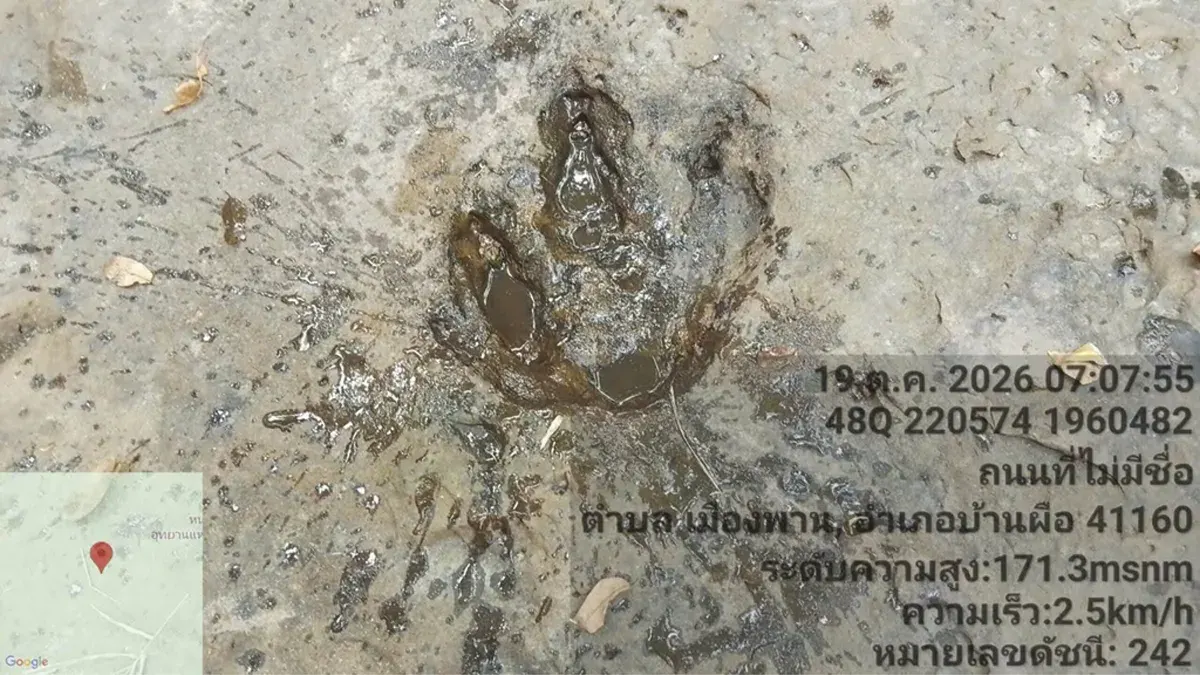
The Department of Mineral Resources has confirmed the discovery of the first carnivorous dinosaur footprints in Udon Thani province, dating back over 120 million years.
The find came after tourist Pichai Pratet Sena, while trekking a nature study trail in Phu Hin Chom That–Phu Phra Bat National Park (under preparation) in Muang Phan subdistrict, Ban Phue district, Udon Thani, noticed stone impressions resembling ancient animal tracks along a stream. He photographed them and shared the images on social media.
Park chief Winai Thongpan then led officials to conduct a further survey at National Park Protection Unit Por Thor 3 (Phu Phra Bat) in Ban Phue district. Around the sandstone plateau they found four distinct ancient animal footprints, each roughly 32 centimeters in width and length, with a consistent 80-centimeter spacing between prints — reflecting the walking gait of a large prehistoric creature.
Upon receiving the report, Natural Resources and Environment Minister Supat Chamgklín ordered the Department of National Parks, Wildlife and Plant Conservation to collaborate with the Department of Mineral Resources, dispatching a team of academics and experts to survey and safeguard the area.
"The Ban Phue area is considered nationally significant for its history, geology, and archaeology," Minister Supat said. "This discovery serves as valuable natural evidence, and the ministry aims to develop it into an academic learning site and conservation tourism destination to benefit local communities."
Department of National Parks Director-General Yuthyut Nakwiroj explained that the footprint site lies on a nature study trail. SMART Patrol rangers had previously noticed the spot but could not confirm it definitively until the photos circulated and drew attention, prompting a detailed surrounding survey that revealed four similar prints.
The geological environment at the discovery point is believed to be a sandstone layer of the Khorat Group, tens of millions of years old. The park has since cordoned off the area, recorded GPS coordinates, and compiled preliminary data for the Department of National Parks to prevent damage from natural factors and human interference.
On October 20, 2026, the Fossil Protection Division and Mineral Resources Regional Office 2, together with Phu Hin Chom That–Phu Phra Bat National Park (under preparation), Fine Arts Department officials, and related agencies, conducted an official on-site academic verification to classify the taxonomy, identify the species, and accurately assess body size and age range.
The examination confirmed a trackway of theropod dinosaur footprints — bipedal carnivorous dinosaurs — consisting of six prints on a sandstone layer of the Phu Phan Formation, Early Cretaceous period (approximately 120 million years ago). The prints show three distinctive pointed toes, measuring 29 centimeters long and 26 centimeters wide.
Body size analysis estimates the dinosaur stood about 1.42 meters tall at the hip and measured approximately 6.30 meters in total length, closely resembling "Siamotyrannus isanensis," a theropod dinosaur previously found in Thailand from the same era.
The Department of Mineral Resources has proposed that the Department of National Parks, Wildlife and Plant Conservation and the Fine Arts Department proceed with further protective and developmental measures.