Thailand Advances Legal, Sustainable Timber Industry at Global Forum
Thailand is strengthening its legal and sustainable timber industry following a global forum in Macau, where ministers adopted frameworks emphasizing transparency, traceability, and innovation across timber supply chains. The country expand
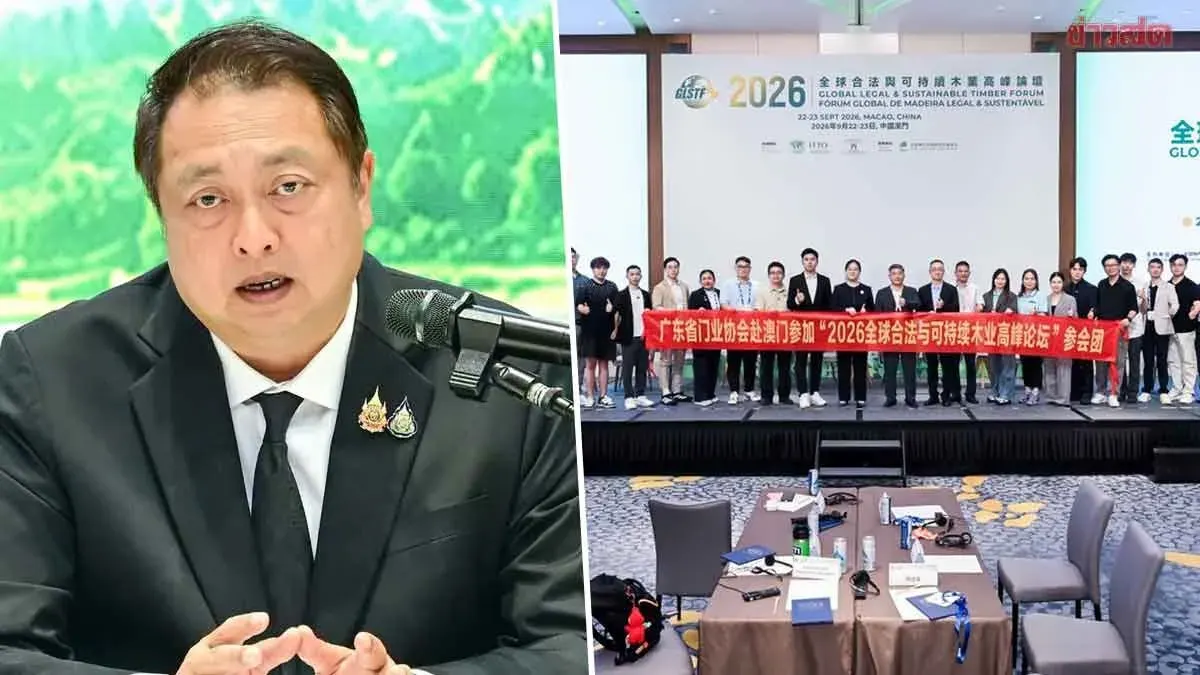
Natural Resources and Environment Minister Suchart Chomklin revealed on September 24 that the GLSTF 2026, held September 22–23 in the Macau Special Administrative Region, served as a crucial platform for exchanging knowledge, experience, and cooperation frameworks among government, private sector, and international organizations to tackle global timber industry challenges and develop a stronger, more resilient and sustainable sector under the theme "Innovation and Transformation – Pursuing Avenues for Resilient and Sustainable Global Timber Industries."
The minister said the conference outcomes reflected a critical shift in global timber industry priorities toward "legal timber, sustainability, transparency, and traceability" combined with technology and innovation to enhance supply chain efficiency from resource management and tree cultivation through processing, trade, and value-added wood product creation.
The forum released the Action Framework 2026 for Promoting Legal and Sustainable Timber Supply Chains, which covers cooperation networks, data sharing, supply chain development, trade facilitation, technology and innovation, traceability, market dynamics, finance and investment, and workforce capacity building.
The meeting also emphasized digital technology's role in building wood product credibility, introducing a Blockchain-based Timber Traceability System–Trading Platform (BTTS-TP) for timber traceability and trade linkage, developing a Global Timber Index (GTI) for wood product pricing to support market information and business decision-making, and establishing the Global Timber Association Network (GTAN) to promote information exchange and cooperation among timber industry associations worldwide.
For Thailand, the Ministry of Natural Resources and Environment will apply knowledge and approaches from GLSTF 2026 to drive the country's timber economy by promoting legal economic timber cultivation, expanding forest plantations, and supporting efficient integration of planted timber into the economic and industrial sectors while ensuring wood and wood products have legitimate origins, are traceable, and meet domestic and international market standards.
The Cabinet approved a ministerial regulation and revised the timber species list under forestry law, expanding plantable species from 58 to 211 types to simplify legal timber cultivation, harvesting, and trading for the public and industry. Thailand is also deploying innovation across the timber value chain, from improving plant genetics and sustainable forest management to processing into high-value products like structural timber and bioenergy, developing systems to certify legally sourced timber, supporting certification of timber management to international standards, and creating indicators for sustainable forest and community forest management.