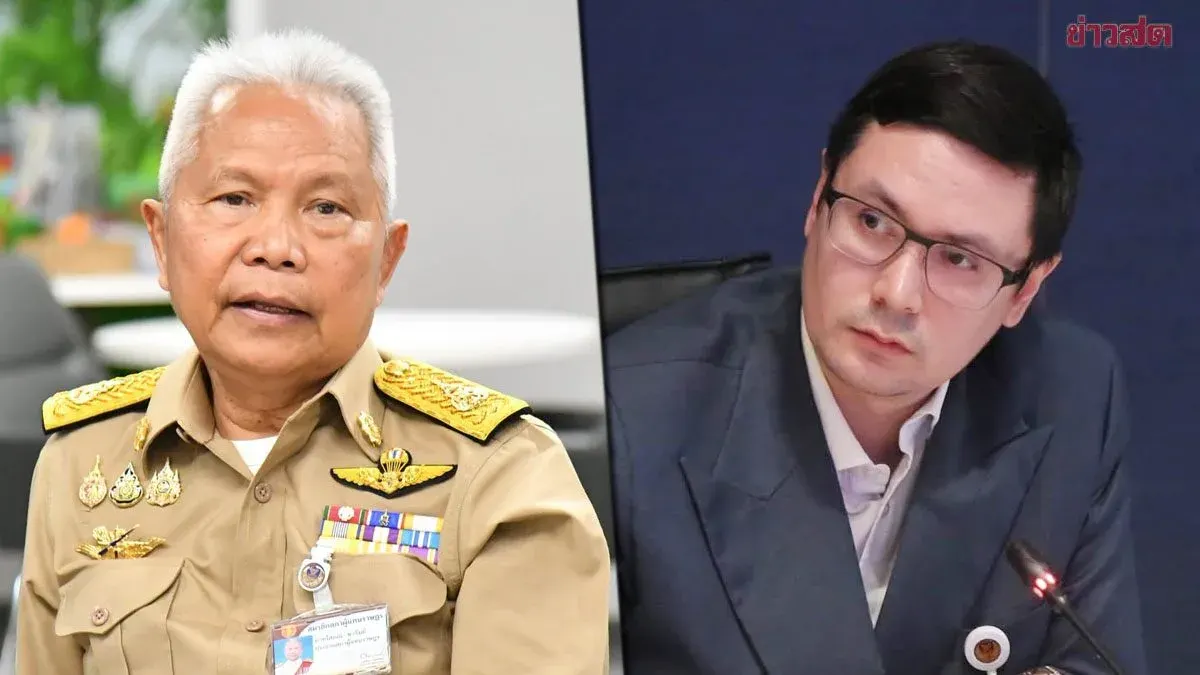
Government Whip Urges Public Solutions Over Political Games
Government whip Akara Det Wongpithakroj urged House committee chair Rangsiman Rome to prioritize solving public problems over political maneuvering, after Rangsiman moved to summon Prime Minister Anutin Charnvirakul. Akara Det argued that committee summons can be satisfied by representatives or documents, and that legal disputes should be settled by courts, not unilateral declarations.

Government whip Akara Det "Rom" Wongpithakroj, the Bhumjaithai Party MP for Ratchaburi, commented on the move by People's Party list-MP Rangsiman Rome, in his capacity as chair of the House Committee on Law, Justice and Human Rights, to press ahead with summoning Prime Minister and Interior Minister Anutin Charnvirakul to appear before the committee on November 14, 2026.
Akara Det said he wanted Rangsiman to consider the tangible results of the committee's work as paramount, especially solving problems for the public, and not to turn the committee's mechanisms into a political game or pursue legal victories over opponents at the expense of the real objectives.
Drawing on his own experience as a former committee chair, Akara Det said the crucial question when inviting someone to give explanations is whether the information and facts obtained can actually address the public's problems. It is not essential that the summoned individual appear in person every time; in practice, committee invitations to senior officials — permanent secretaries, directors-general, or provincial governors — have been satisfied by the official appearing personally, sending a directly responsible representative, or submitting written documents.
In this case, the prime minister has heavy duties and the designated official had urgent work, so a representative was assigned to explain or provide documents. The focus should be on substance and outcomes rather than on who physically shows up. "If we set the benchmark as successfully fixing problems for the people, then who gives the explanation — or whether it is given in writing — is not the important thing. What matters is whether the information received leads to solving problems for the public. Don't turn this into a political game."
Akara Det also addressed the dispute over the committee chair's legal procedures, noting that a chair's belief that their own actions are legally correct does not make it the final word. When legal opinions differ, especially on House meeting regulations, others may view the same actions as incorrect. Therefore, a committee chair cannot unilaterally decide who is right or wrong; if a genuine legal dispute arises, the ultimate arbiter is the courts, not one side's assertion.
He added that the prime minister has consistently valued legislation and the committee's work. Sending a representative does not mean neglecting or disregarding parliament, because the prime minister oversees 20 ministries plus many other duties. A directly responsible official may actually answer committee questions more deeply and precisely than the prime minister, who operates at the policy level, while the hands-on official holds the details of problems and solutions.
"I want to ask Khun Rom, with whom I have worked on many stages, to keep the focus on the success of solving problems for the people, rather than on beating each other on legal technicalities, because in the end..."