Luang Por Thieng: Kanchanaburi Monk Behind Legendary Tiger Amulets
A new profile details the life of Luang Por Thieng Chantasaro, a revered 20th-century monk from Wat Muang Chum in Kanchanaburi. Known for his mastery of tiger-skin takrut amulets and his lineage under meditation master Luang Pu Plian, he was celebrated for his blunt kindness, rural authenticity, and the legendary protective power of his sacred objects. The biography traces his journey from a justice-loving youth and conscripted soldier to a beloved abbot whose ordination hall was built by villagers amid World War II hardship.
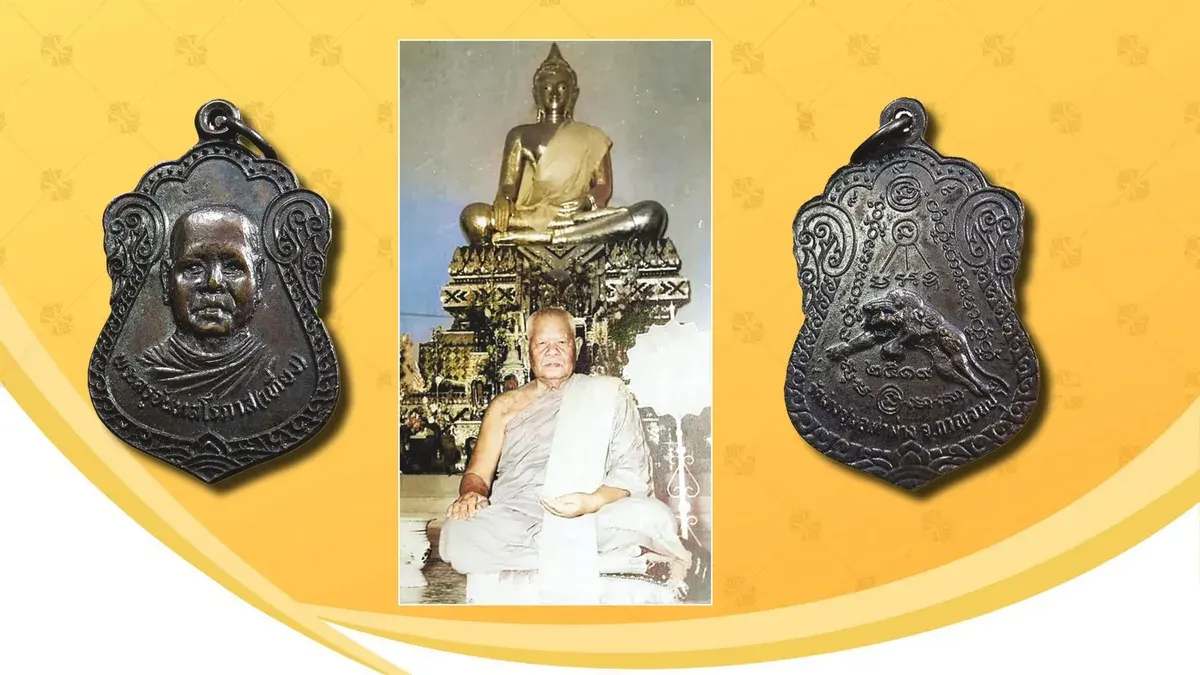
Phra Khru Chantasarophas, also known as Luang Por Thieng Chantasaro, former abbot of Wat Muang Chum in Tha Muang District, Kanchanaburi Province, was a renowned master of tiger-skin takrut amulets. He was a disciple and maternal great-grandnephew of Phra Visuthirangsi (Luang Pu Plian) of Wat Tai (Wat Chai Chumphon Chana Songkhram), a famous meditation master. He was also a close Dhamma companion of Luang Por Na of Wat Si Loharat Bamrung and had a strong bond with Luang Por Te of Wat Sam Ngam in Nakhon Pathom, said to have learned the art of tiger-skin takrut from the same lineage. Other Dhamma companions included Luang Pu Tao of Wat Pradu Chimphli and Luang Pu Thim of Wat Laharn Rai.
His birth name was Thieng Khaeng. He was born on a Thursday in the Year of the Rabbit, in B.E. 2431 (1888 CE), at Ban Muang Chum, Tambon Muang Chum, Tha Muang District, Kanchanaburi Province, the son of Nai Khiao and Nang Thong Khlao. He had seven siblings. As a child, he liked boxing and loved justice, speaking straightforwardly without fear, making him a natural leader among peers. In B.E. 2452 (1909 CE), at age 21, he was conscripted for two years of military service. After discharge, he returned home to farm.
At age 24, he ordained at the ordination hall of Wat Ban Tham, studied for a while, then moved to observe the rains retreat at Wat Muang Chum, near his home. Having had little formal schooling due to a shortage of teachers and classrooms, he found great joy in learning and progressed rapidly. After studying Buddhist scriptures and rituals, he turned to Vipassana meditation and occult sciences with Luang Pu Plian of Wat Tai. Because Luang Por Thieng was his maternal great-grandnephew, Luang Pu Plian showed him special kindness, transmitting all branches of knowledge, especially Buddhist doctrine, until he became highly proficient.
Villagers often said, 'Whoever wears his amulets, mosquitoes won't bite,' meaning the wearer's skin becomes tough, impervious to stings and bullets. Even Luang Pu Yaem, the famous master of Wat Sam Ngam in Don Tum District, Nakhon Pathom, praised his prowess. Luang Pu Yaem was a Dhamma companion of Luang Por Te Khongthong (Luang Pu Yaem's teacher), both renowned for crafting tiger-faced takrut.
He was a true rural monk, speaking bluntly without pretense, using pure Thai like Luang Por Koon — not pleasing to the ear but full of loving-kindness. Relatives seeking his help received kind assistance in all matters. Villagers recount his love for boxing, folk opera (Li-ke) and shadow puppet theatre (Nang Talung). He was a genuine rural monk who never missed chewing betel nut, which inspired his famous betel-nut amulets.
He began building the ordination hall in B.E. 2484 (1941 CE), constructing within his means without burdening villagers. At the time, Thailand was in the late stages of World War II. Kanchanaburi suffered heavily from Japanese bases and Allied bombing. The economy was dire, yet villagers donated to complete the hall, which received the royal boundary marker (Wisungkhamasima) on 3 February B.E. 2494 (1951 CE).
He passed away peacefully at 09:00 on 27 November B.E. 2523 (1980 CE) at Wat Muang Chum, aged 92, with 69 years in the monkhood. The tiger-faced takrut amulet is his most famous sacred object, created before...