NIDA Poll: Northerners Back Smart Traps for Arsenic, Doubt Diplomacy
A NIDA Poll survey of 1,310 residents in Chiang Mai and Chiang Rai found that 37.86% support using smart sediment traps to catch arsenic pollution from cross-border mining, though many doubt the measure's effectiveness or cost-efficiency. Over half of respondents continue to consume local produce and fish despite contamination reports, while nearly 70% are pessimistic about diplomatic negotiations with neighboring countries to address the mining pollution at its source.
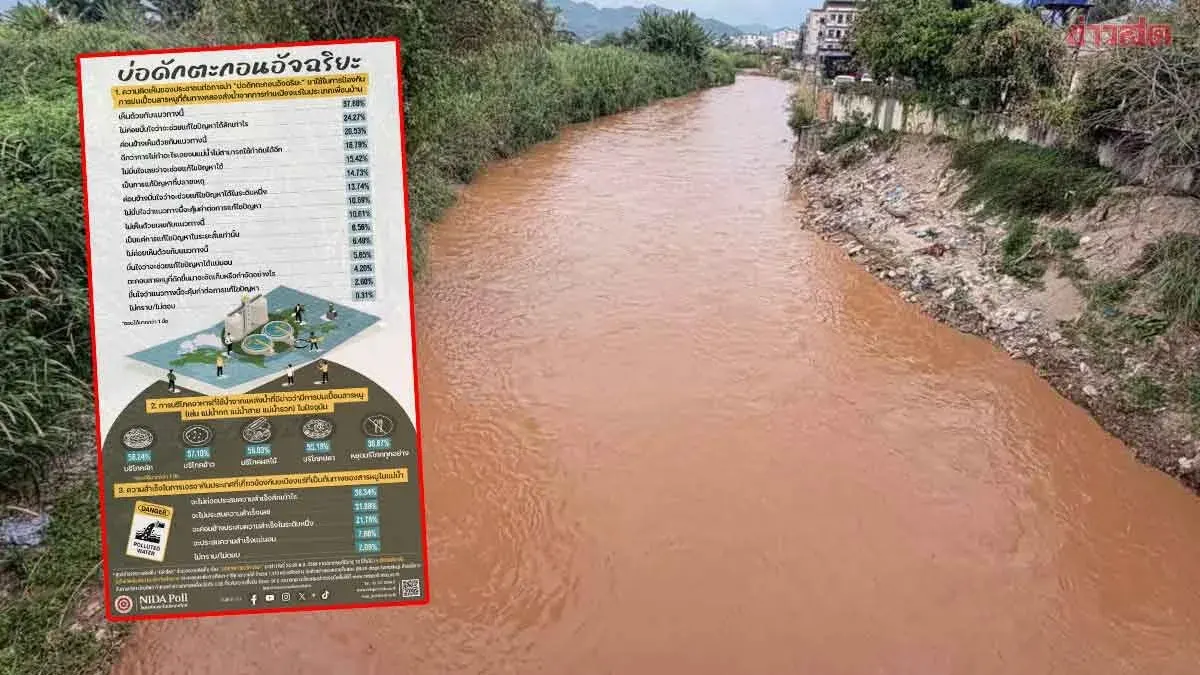
The NIDA Poll center at the National Institute of Development Administration has released survey results on "smart sediment traps" conducted from November 24-26 among 1,310 eligible voters aged 18 and older across Chiang Mai and Chiang Rai provinces, spanning all education levels, occupations, and income brackets. The survey examined public opinion on deploying these traps to prevent arsenic contamination originating from mining operations in neighboring countries that flows into local canals and rivers.
When asked about using smart sediment traps to address arsenic pollution at the source, 37.86% of respondents agreed with the approach, 24.27% were unsure how much it would help, 20.53% somewhat agreed, 16.79% said it was better than doing nothing until rivers become unusable, 15.42% had no confidence it would solve the problem, 14.73% viewed it as treating symptoms rather than root causes, 13.74% were fairly confident it would help somewhat, 10.69% doubted its cost-effectiveness, 10.61% completely disagreed, 6.56% saw it as only a short-term fix, 6.49% somewhat disagreed, 5.65% were confident it would definitely work, 4.20% questioned how trapped arsenic sediment would be stored or disposed of, 2.60% were confident in its cost-effectiveness, and 0.31% didn't know or didn't answer.
Regarding current consumption of food sourced from water bodies with reported arsenic contamination (such as the Kok, Sai, and Ruak Rivers), 58.24% said they consume vegetables, 57.10% consume rice, 56.03% consume fruit, 55.19% consume fish, and 36.87% have stopped consuming all such products.
Finally, when asked about the likelihood of successful negotiations with countries hosting the mines that are the source of arsenic in Thai rivers, 36.34% believed talks would not be very successful, 31.98% expected no success at all, 21.76% thought they would be somewhat successful, 7.86% were certain of success, and 2.06% didn't know or didn't answer.