Nine Rajamangala Universities Link Degrees to Professional Standards
Nine Rajamangala University of Technology campuses signed an MOU with the Thailand Professional Qualification Institute to align academic programs with professional standards. The partnership enables students to earn professional qualifications alongside their degrees through competency assessments. This initiative aims to better prepare graduates for industry demands and improve their employment prospects across Thailand.
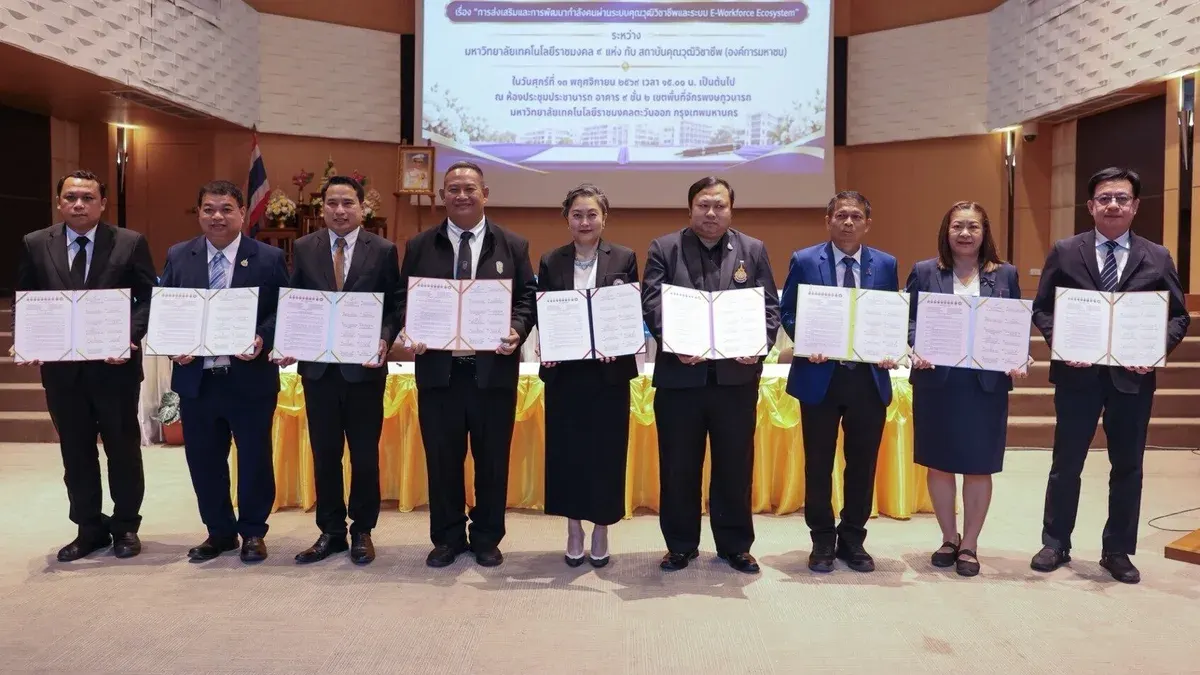
Nine Rajamangala University of Technology (RMUT) campuses announced their readiness to collaborate with the Thailand Professional Qualification Institute (TPQI) to develop practice-oriented graduates with skills matching industrial sector demands. This involves linking educational curricula with professional standards and encouraging students to undergo competency assessments to receive professional qualifications or competency certificates alongside their academic degrees. The cooperation falls under a Memorandum of Understanding (MOU) titled "Promotion and Development of Manpower through the Professional Qualification System and E-Workforce Ecosystem," signed between TPQI, represented by Director Julada Mee-jun, and the network of nine RMUT campuses led by Assoc. Prof. Dr. Khosit Sriphut, President of RMUT Isan and Chairman of the RMUT Presidents Council, along with executives and representatives from all nine universities: RMUT Bangkok, RMUT Tawan-ok, RMUT Thanyaburi, RMUT Phra Nakhon, RMUT Rattanakosin, RMUT Lanna, RMUT Srivichai, RMUT Suvarnabhumi, and RMUT Isan. The ceremony took place at RMUT Tawan-ok (Chakraphong Phuwanat).
Assoc. Prof. Dr. Khosit stated that all nine RMUTs aim to produce practice-oriented graduates with knowledge and skills ready for real work. Collaboration with TPQI will help universities link curricula with professional standards more clearly, covering skills development, competency accumulation, and creating opportunities for learners to receive competency certification according to professional standards. This prepares manpower to meet industrial sector demands and changes in the working world, helping elevate education quality and develop manpower to keep pace with global changes.
Julada Mee-jun said TPQI stands ready to act as a "Skill Bridge" connecting the learning world with the working world, bringing a competency database covering 1,033 occupations to support universities in developing curricula and learner skills aligned with actual job requirements. The cooperation will promote linking the Competency Credit Bank system with university credit accumulation systems, allowing learners to accumulate and transfer learning outcomes. It also encourages competency assessment according to professional standards. Those who pass receive professional qualifications or competency certificates as proof of work ability alongside academic degrees, helping employers make hiring decisions and increasing learners' career opportunities.
TPQI also stands ready to support the use of the E-Workforce Ecosystem (EWE) platform to connect competency data, skills development, and employment opportunities, including learning through the E-Training system for students and workers seeking new skills or upskilling. This ensures continuous learning and capability development after graduation, supporting the development of Thai manpower to have potential and be fully ready to compete in the future.