No-Confidence Debate Set for December; Government Predicted to Win Easily
Academics predict the government will easily survive December's no-confidence debate as a divided opposition struggles with credibility after presenting fake evidence.
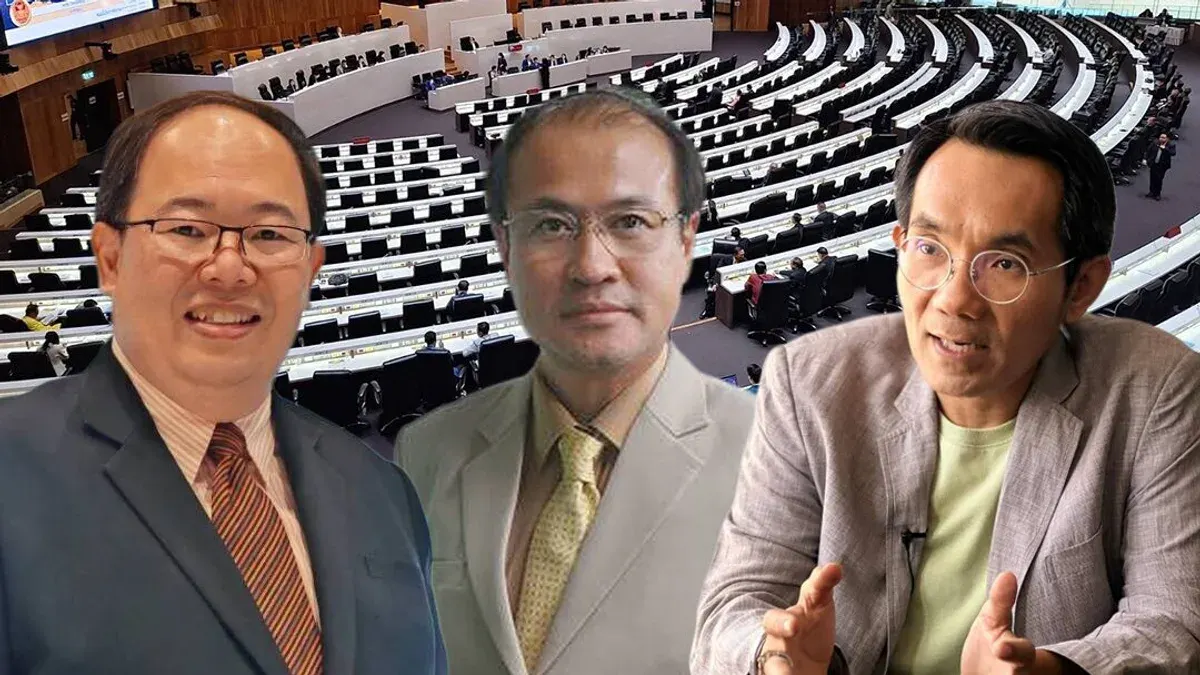
Academics assess the delayed no-confidence debate against the prime minister and 18 ministers, now pushed to early December after opposition parties demanded it in November. Ultimately, who gains or loses from this political maneuver, and what issues could destabilize the government?
Yutthaporn Isarachai, Lecturer, Faculty of Political Science, Sukhothai Thammathirat Open University.
Regarding the opposition's talking points, I don't expect anything new. The opposition regularly holds live broadcasts and forums, so we can already anticipate the economic, social, and political issues they'll raise. On high-profile political matters: the BMA governor scandal, local exam cheating corruption, the TH-AI Passport project, and possibly the Khe Khadong case. Flood relief, state welfare cards, and the southern border unrest may also come up, but the core focus will be political.
The key challenge for today's no-confidence debate is declining viewership over the past three to four years, as the public accesses more information through social media. As I often say, 'politics outside parliament advances; politics inside parliament lags behind.' People don't trust the parliamentary system to solve real problems, so the question becomes whether the majority's votes will shift. This is the major task for both government and opposition: to make this debate constructive, not a baseless mudslinging match or a performative defense of the government — which many are tired of. The opposition must also bring creative, substantiated evidence, not just floating accusations. Both sides must help restore confidence in the parliamentary system.
However, the opposition lacks a unified front, as seen with the Kla Tham Party's emergence. Meanwhile, the Democrat Party's main challenge today is rebuilding its voter base rather than aiming for government, since it cannot even field a prime minister candidate with only 21 MPs. The Democrats will likely target Bangkok Governor Chadchart Sittipunt to reclaim Bangkok votes from the Kla Tham Party. Similarly, at the national level, a recent poll surprisingly shows Democrat leader Abhisit Vejjajiva still more popular than People's Party leader Natthaphong Ruengpanyawut, despite the latter being the opposition leader. This reflects the Democrats — a smaller party — commanding more political space than the People's Party.
Today, as the People's Party trends downward, the Democrats' support will likely rise. I don't think the two parties will merge or coordinate; they'll compete for the spotlight, with the smaller party stealing scenes from the larger one.
Regarding the fake tea-money receipts targeting Deputy Prime Minister and Interior Minister Anutin Charnvirakul, the opposition shot itself in the foot, damaging its own credibility and undermining trust in the censure process. This despite the government facing multiple crises: flooding, the husband of MP Ideas Suree Sang (asset proxy for a Bhumjaithai MP from Chaiyaphum).
On the government's choice to hold the debate in December, whoever gains or loses the advantage: selecting the optimal timing and key figures doesn't guarantee the best outcome. Ultimately, the government will likely survive. I predict it will pass 'ultra-smoothly' — votes won't fall short but will exceed the minimum, with extra support from coalition parties like Kla Tham.
O.