Phatthalung Farmer Earns 100,000 Baht Monthly Growing Split-Gill Mushrooms
Phatthalung farmer Mayuree Temram earns 100,000 baht monthly growing split-gill mushrooms using a low-cost, short-cycle cultivation method.
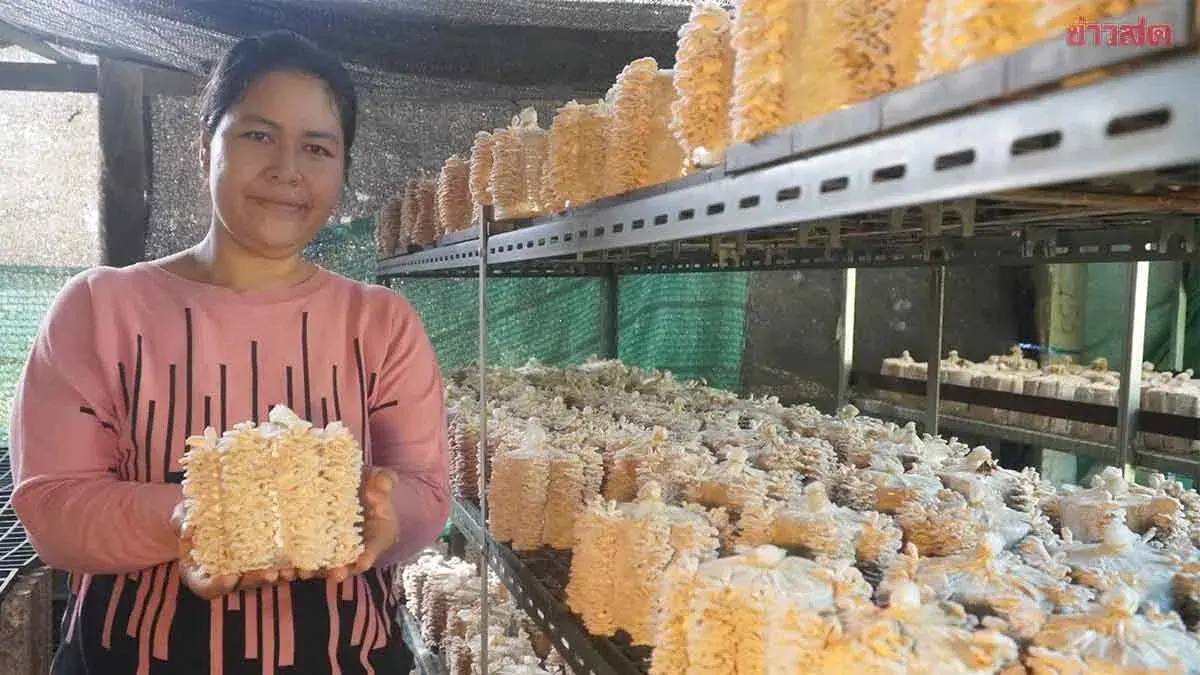
In Phatthalung, a local villager grows split-gill mushrooms for income, benefiting from low production costs and a short harvest cycle to earn 100,000 baht monthly. The farm owner shares the cultivation formula and production process, highlighting the mushrooms' delicious flavor, versatility across many dishes, and high market demand.
November 16, 2026 – Reports indicate that split-gill mushrooms, also known as 'hed teen took kae,' go by different names across Thailand: 'hed kaen' or 'hed tamod' in the North, 'hed yang' in the South because they grow on para rubber trees, and 'hed mamuang' in the Central region due to growth on mango trees. Split-gill mushrooms grow widely year-round on various substrates such as logs, branches, leaves, and grass, and can be foraged for consumption.
Currently, split-gill mushroom yields can be preserved longer if not cooked immediately — for example, vacuum-packed products achieve a shelf life of up to six months. This allows producers to plan output clearly and set precise market volumes, avoiding oversupply.
Mayuree Temram, 41, a resident of Khao Ya village in Sri Banphot district, Phatthalung, owns the Phatthalung Split-Gill Mushroom Farm and has been earning income from mushroom cultivation since 2008. She explains that cultivation methods resemble those for other mushrooms, but with an adjusted substrate formula.
Once the spawn bags are fully colonized — typically within a few days — pins appear and harvesting can begin. The harvest cycle is shorter than for other varieties, and low costs mean returns come quickly.
The spawn substrate formula: 100 kg sawdust, 50 kg rice bran, 2 kg gypsum, 200 g salt, and clean water adjusted to 70–75% moisture.
Production steps: 1. Mix ingredients in the specified ratios to the desired volume, then blend thoroughly with a spade or mixer. 2. Add water to the sawdust, mixing again until moisture reaches 70–75%. Test by squeezing a handful: if water drips between fingers, it's too wet; if the clump crumbles when released, it's too dry. Ideal moisture holds together without dripping. 3. Pack the mixture into heat-resistant plastic bags (6.5 x 10 inches), about 600 g per bag. 4. Compress the substrate, seal the bag by gathering the neck, insert a plastic bottle neck, fold the bag over it, secure with a rubber band, and plug with cotton before steaming.
After bagging, steam immediately the same day — overnight storage causes the rice bran to sour due to moisture and gas buildup. Steaming at 100°C for 3–4 hours in a pressure cooker or large pot pasteurizes the substrate, eliminating rival fungi, insects, and other contaminants. Cool afterward and transfer to the inoculation room.