Researchers: 2025 Earthquake Activity Within Normal Range Over 100 Years
Earthquake activity in 2025 remains within normal historical ranges, with researchers noting that improved global monitoring networks and instant communication create a false perception of increased seismic events. Thailand faces minimal di
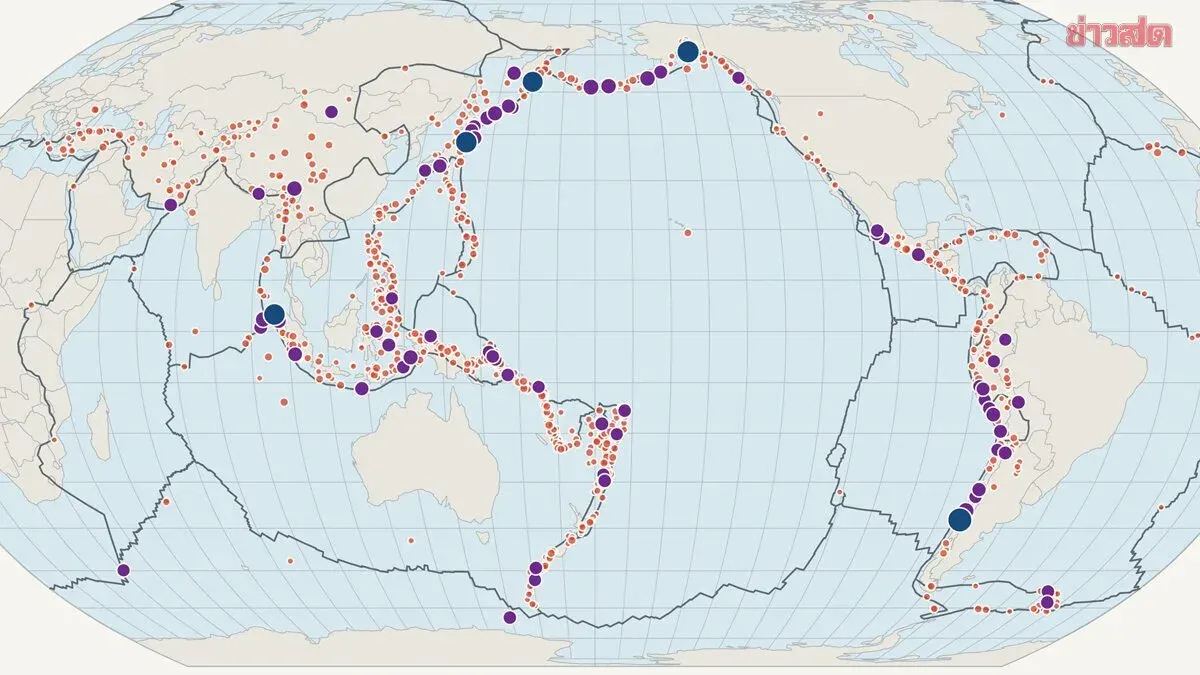
Researchers have concluded that 2025 earthquake statistics, when compared with data spanning the past 100 years, fall within natural fluctuations and occur regularly as tectonic plates collide and separate, causing faults to slip suddenly.
On August 17, 2025, Assoc. Prof. Phassakorn Pananon, instructor in the Department of Earth Sciences at Kasetsart University, addressed major earthquake events that have continuously appeared in social media and various news outlets in recent months. These incidents in the Philippines, Japan, Indonesia, Venezuela, Colombia, and Pacific islands—accompanied by images of widespread tremors, swaying buildings, structural damage, and urgent evacuations—have created a public perception that the Earth's crust is moving more frequently and intensely than normal.
"With news reaching us almost instantly, the key question is not simply how large each earthquake is, but whether these successive events signal that the world is entering an abnormal period, and how alarmed should Thailand be?" Pananon said.
According to USGS data from January 1 to August 17, 2025, the world recorded 11 large earthquakes ranging from magnitude 7.0 to 7.9 across 9 countries, with no earthquakes of magnitude 8.0 or above. When compared with long-term statistics dating back to 1926, the world averages 10–20 earthquakes of magnitude 7.0 or greater per year, with earthquakes larger than magnitude 8 occurring roughly once annually. This clearly shows that the number of major earthquakes remains within the natural fluctuation framework and represents a regularly recurring process.
Importantly, nearly all earthquakes occur at tectonic plate boundaries rather than scattered randomly across the globe. Earth's outer crust is not a single layer but divided into multiple tectonic plates that move slowly. When tectonic plates collide, separate, or slide past one another, stress accumulates along faults. When stress exceeds friction, the fault suddenly slips and releases energy as seismic waves.
Researchers attribute the perception of more frequent earthquakes primarily to advances in communication technology and the expansion of monitoring networks. With vastly more monitoring stations, the USGS can now detect approximately 20,000 earthquakes per year, or an average of 55 per day. Images and news from affected areas are transmitted to people worldwide very rapidly.
However, statistics being normal does not mean there is no danger. The impact on human lives and property depends not only on earthquake magnitude but also on depth, distance from cities, fault slip direction, soil conditions, and the vulnerability of structures. Shallow earthquakes near major cities can cause severe damage through landslides, liquefaction, fires, or tsunamis—potentially more damaging than large earthquakes occurring at greater depths and far away.
"Although Thailand does not sit directly on a major tectonic plate boundary, it is affected by the Sunda Trench subduction zone, fault movements in Myanmar, and various internal fault systems. Soft sedimentary basins like Bangkok and major cities across Thailand can amplify long-period seismic waves from distant earthquakes, causing tall buildings to sway noticeably. Therefore, we must be prepared to handle natural disasters using scientific knowledge to reduce unnecessary alarm," the researcher stated, adding that scientific understanding of earthquake causes and sources is essential.