The scooter rule almost nobody checks on Koh Lanta, and what it does to your insurance
Most Koh Lanta scooter rental shops don't check for a valid motorcycle licence, but riding without one can invalidate your travel insurance and leave you uninsured in an accident.
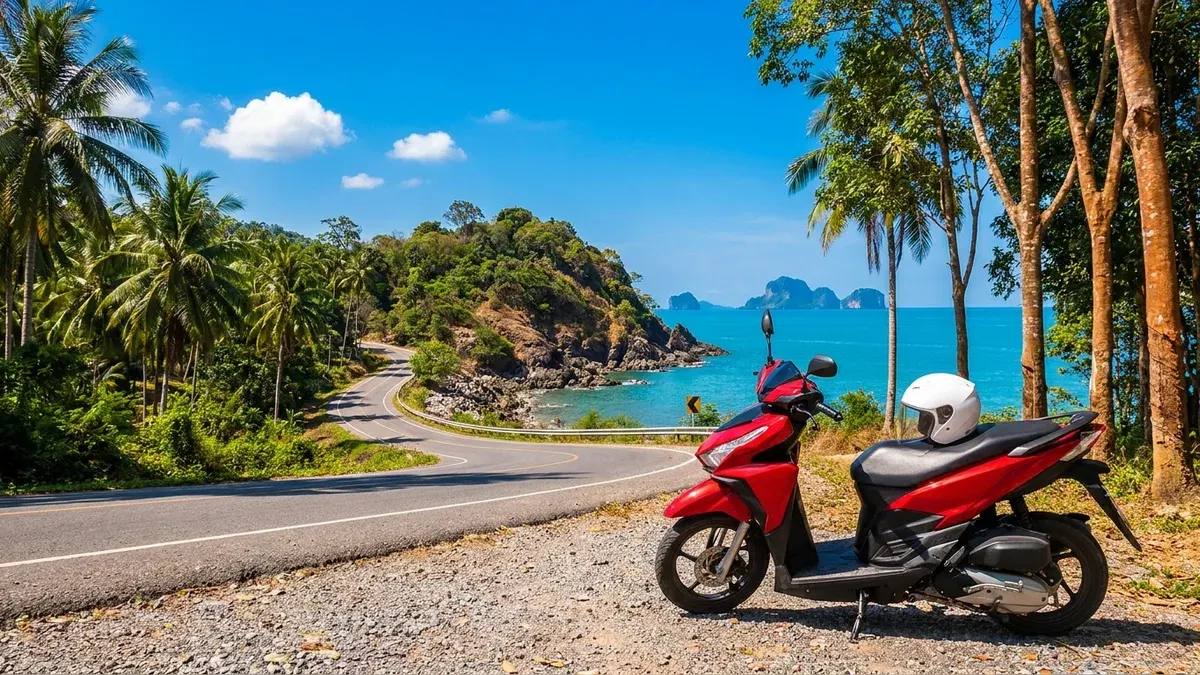
Photo: Illustration generated by Lanta News
A scooter is how most people see Koh Lanta. The shops along Saladan and the beach roads rent one for a couple of hundred baht a day, take a photocopy of your passport, show you the fuel cap, and wave you off. What almost none of them do is ask to see a motorcycle licence.
That silence costs people a lot of money, and it is worth understanding before you ride rather than after.
The rule is about what you are licensed for at home
Thai law requires a motorcycle licence to ride a motorcycle. For a short-stay visitor that normally means your own country's licence with a motorcycle entitlement on it, carried together with an International Driving Permit that also shows the motorcycle category.
The trap is the category. A great many visitors hold a car licence and a car-only International Driving Permit, and assume a 125cc automatic scooter is a smaller, gentler thing that sits outside all of that. It does not. If you are not licensed to ride a motorcycle at home, an International Driving Permit does not create that entitlement for you here.
The British government puts the consequence plainly in its own travel advice for Thailand: if you could not legally drive the vehicle in the UK, "your insurer may not cover you for driving it in Thailand", and driving or riding without a valid licence "could invalidate your travel insurance and you'll be unable to claim if you have an accident or injury".
That is the whole problem in one sentence. The rental shop's indifference is not permission, and it is not cover.
Two more things in that same advice worth knowing
The first is about the bikes themselves. The Foreign, Commonwealth and Development Office warns that rental motorcycles and scooters in Thai tourist areas are "often unregistered and cannot be used legally on a public road". That is not something you can tell by looking at a clean bike outside a clean shop.
The second is simpler and absolute: "By law, you must wear a helmet when riding a motorcycle." Helmets come with the bike here. Wearing one is not a matter of local custom.
The same advice notes that you cannot buy an International Driving Permit once you have left home, so it is not something you can fix on arrival at Saladan pier.
Why this matters more on this island than on a city street
Koh Lanta is long and thin, and one road, Route 4245, does most of the work. From Saladan it runs south down the west coast past Long Beach, Klong Khong and Klong Nin, and for most of that stretch it is flat, wide enough and easy.
South of Klong Nin it changes. The road climbs into the headlands toward Kantiang Bay and on to the national park at the island's southern tip, and the cross-island road over to Lanta Old Town climbs too. These are real hills with real bends, and the concrete and asphalt on them becomes slick within minutes of a rain shower. In the wet months, roughly May to October, that happens without much warning.
Two other local details matter. Fuel is easy in Saladan and much less easy the further south you go, so the tank you set out with is part of your planning. And the island has no traffic lights and very little street lighting outside the built-up beach strips, which makes the southern hills after dark a different proposition from the same road at noon.
None of this makes Koh Lanta dangerous to ride. It makes it a place where an ordinary mistake has less margin around it than it would at home, on a bike you may be riding for the first time, on the opposite side of the road.
What to actually check
- Your own licence. Does it carry a motorcycle entitlement, or only a car one?
- Your International Driving Permit. Look for the motorcycle category on it specifically. A permit issued by default against a car licence will not have it.
- Your travel insurance policy, in writing. Find the motorcycle clause and read what it requires of you. Some policies also set an engine-size limit, and some exclude riding altogether.
- Your own government's current advice. The wording above is what the UK tells British travellers. Other countries phrase their requirements differently, and none of it replaces reading your own policy.
If something does happen
Thailand's national emergency number is 1669. There are clinics on Koh Lanta and a district hospital on the island, and several private clinics advertise round-the-clock emergency lines and ambulance cover. Anything genuinely serious, though, is stabilised here and moved on to the larger hospitals in Krabi or Phuket, and that transfer is exactly the kind of cost travel insurance exists to carry.
Which is the point of all of the above. The licence question is not really a question about paperwork. It is the difference between an insurer paying for that transfer and you paying for it yourself.
What we could not verify
We have not quoted fine amounts for riding without a valid licence, because we could not confirm current figures from a Thai government source and the numbers repeated online vary. We also found conflicting published addresses for Koh Lanta's district hospital, including different sub-districts, so we have not printed one. If you know this island's emergency provision well and can correct or sharpen any of this, please write to us.