Sukhothai Students Invent AI Voice-Controlled Rehab Devices
Students and instructors at Sri Sachanalai Vocational College in Sukhothai have developed two AI-powered rehabilitation devices — a vertical knee ligament stretcher and an elbow tendon therapy machine — both controlled by voice commands. Named "Nong Mali" and "Nong Manao," the embedded AI assistants can adjust therapy settings, converse with patients, and even tell stories during sessions, helping hemiplegic and mobility-limited users who cannot operate manual controls. Each device costs only 7,500 baht and is made from lightweight, heat-resistant melamine plastic with aluminum and stainless steel frames.
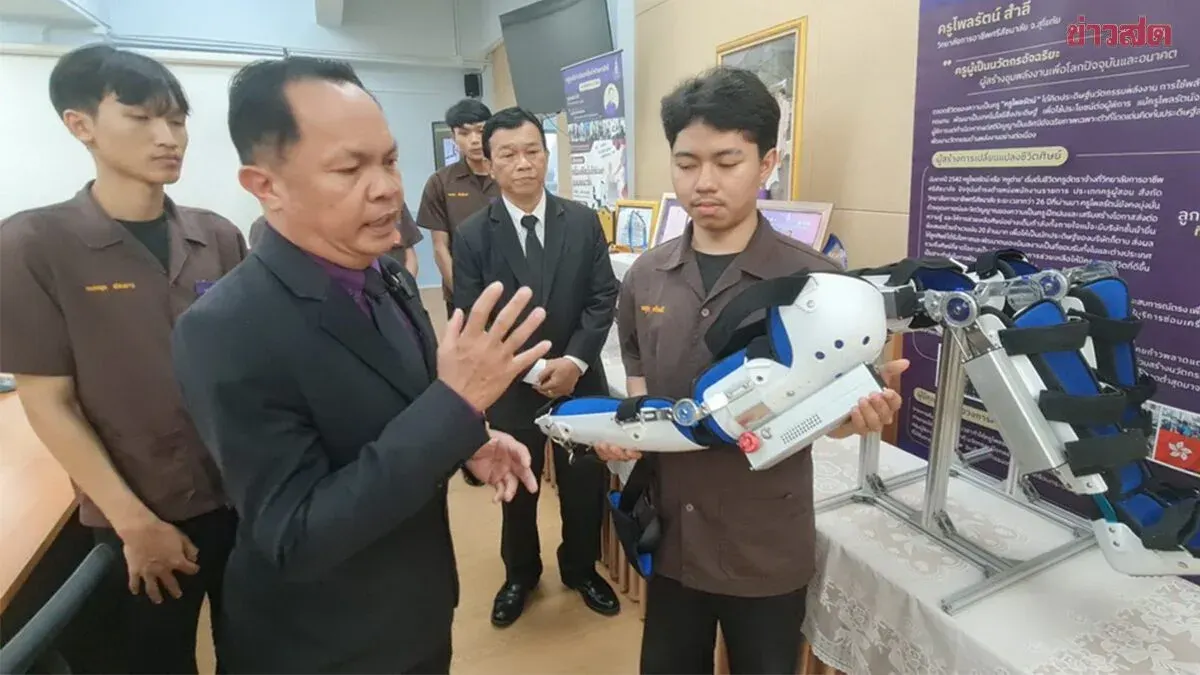
Sukhothai — A cutting-edge new invention: an AI-controlled elbow tendon therapy and knee ligament stretching device named "Nong Mali." It operates via voice commands, can converse interactively, tells stories during sessions, acts as a companion so patients don't feel lonely, and helps rehabilitate hemiplegic patients at an affordable price. It is sturdy yet lightweight.
November 25, 2026 — Reporters revealed that after creating a buzz in 2025 with the groundbreaking "vertical knee ligament stretcher" that facilitated physical therapy for hemiplegic patients, those with muscle weakness, and post-knee-surgery patients — earning widespread praise — recently, Mr. Phairat Samlee, head of research and innovation at Sri Sachanalai Vocational College in Sukhothai, together with second-year vocational certificate students in electronics, have further advanced the innovation. Their brand-new devices, completed just days ago, include a vertical knee ligament stretcher and an elbow tendon therapy machine controlled by artificial intelligence (AI) and voice commands.
Ajarn Phairat explained that the original knee ligament stretcher was operated by hand-pressing switches to adjust speed and extension angle. However, after a year of real-world use with patients alongside medical experts, they found some patients also needed therapy for other areas, such as elbow tendons. This led to the invention of the "elbow tendon therapy machine" alongside an upgraded "vertical knee ligament stretcher."
The devices use an embedded AI brain that processes analysis on-device and operates via voice commands for "increase speed, decrease speed, increase angle, decrease angle, stop, pause, start, resume." They can also converse, search for real-time information, or have the AI tell stories during therapy sessions.
The AI for the elbow tendon therapy device is named "Nong Mali," while the AI for the knee ligament stretcher is named "Nong Manao." Their primary role is to act as an assistant that receives commands from the patient, converses, and serves as a thinking companion so users don't feel isolated. This technology also solves problems for the original user group who have limited mobility or cannot operate devices by hand, since they can now use voice control instead.
Regarding cost, Ajarn Phairat said the devices are inexpensive at just 7,500 baht each. Materials are melamine plastic — flexible, heat-resistant, lightweight, and sturdy — with foam padding to prevent pressure sores. The design resembles robotic arm-leg sleeves, assembled with aluminum and stainless steel. Voice-controlled operation, wearable on both left and right sides, and adjustable extension.