Smart Home Learning Kit Expands Tech Access for Students with Learning Disabilities
Mae Fa Luang University developed an interactive smart home learning kit designed specifically for students with learning disabilities, enabling them to build and program IoT devices while developing tech skills and confidence.
Mae Fa Luang University in Chiang Rai, supported by the Public Communications Fund, is running a project to develop an IoT learning kit tailored for children with learning disabilities. The program gives LD students access to Internet of Things technology through tangible, interactive learning materials, led by Associate Professor Amphapoom Pumpote. The project responds to the critical need for 21st-century technology skills by creating media designed for children with reading, writing, or math difficulties, using hands-on learning as its core approach to make complex technology accessible and intuitive.
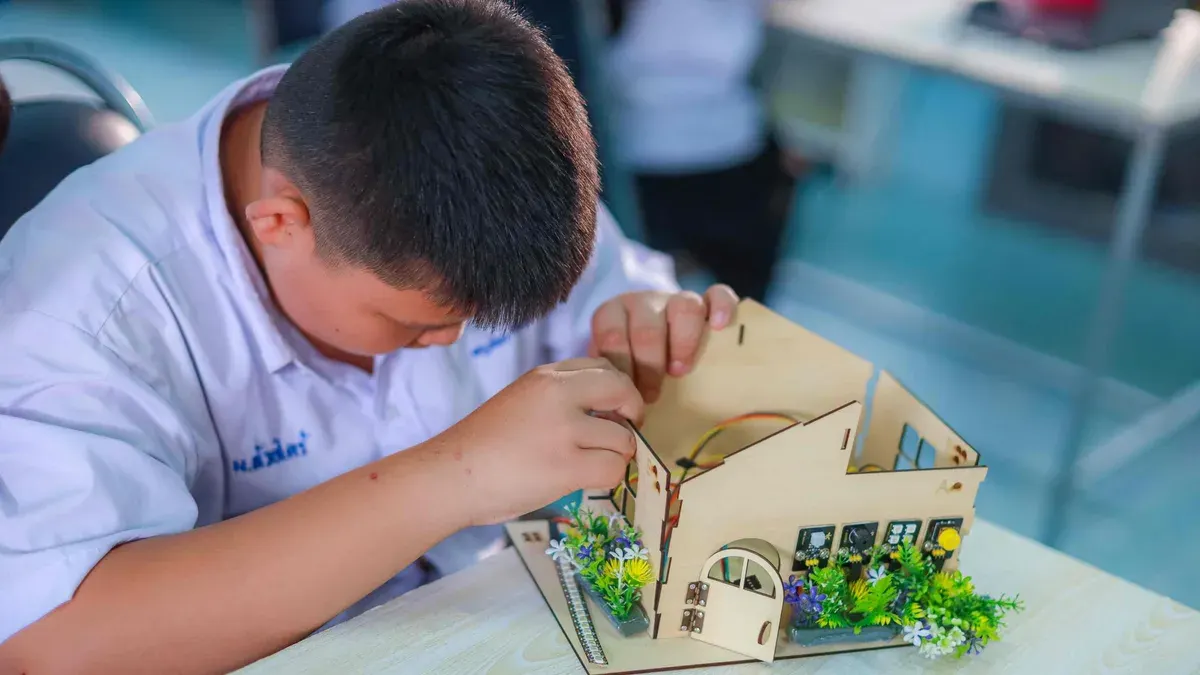
The centerpiece is a model smart home learning kit resembling a buildable toy equipped with real IoT devices found in daily life, including motion sensors, light sensors, temperature and humidity sensors, smoke detectors, LED lights, and fan motors. Students do not merely observe demonstrations but actively install equipment, connect circuits, link sensors, and write programs using MicroBlock IDE to control lights, fans, and sensor displays. This learning approach aligns with Seymour Papert's constructionism and John Dewey's learning-by-doing philosophy, helping children develop focus, logical thinking, planning, problem-solving, creativity, and confidence in technology.
The learning kit took approximately one year to develop, covering needs assessment, media and device design, curriculum creation, and review by specialists in special education, physical therapy, and technology. The project operates with ten schools and special education centers across Chiang Rai and Chiang Mai, training roughly 30 teachers in IoT fundamentals, device operation, programming, and assessment tools before working with approximately 120 LD students. Teacher development alongside the curriculum ensures learning continues beyond the project period and can be adapted to individual classroom needs. Evaluation measures both foundational knowledge and practical classroom application using IoT learning cards and pre- and post-tests.