TDRI Chief Urges Election Commission to Resolve Parliament Case
TDRI president Somkiat Tangkijwanich urged Thailand's Election Commission to refer a parliament dissolution case to the Supreme Court rather than resolve it internally, citing insufficient investigative capacity and the need to rebuild publ
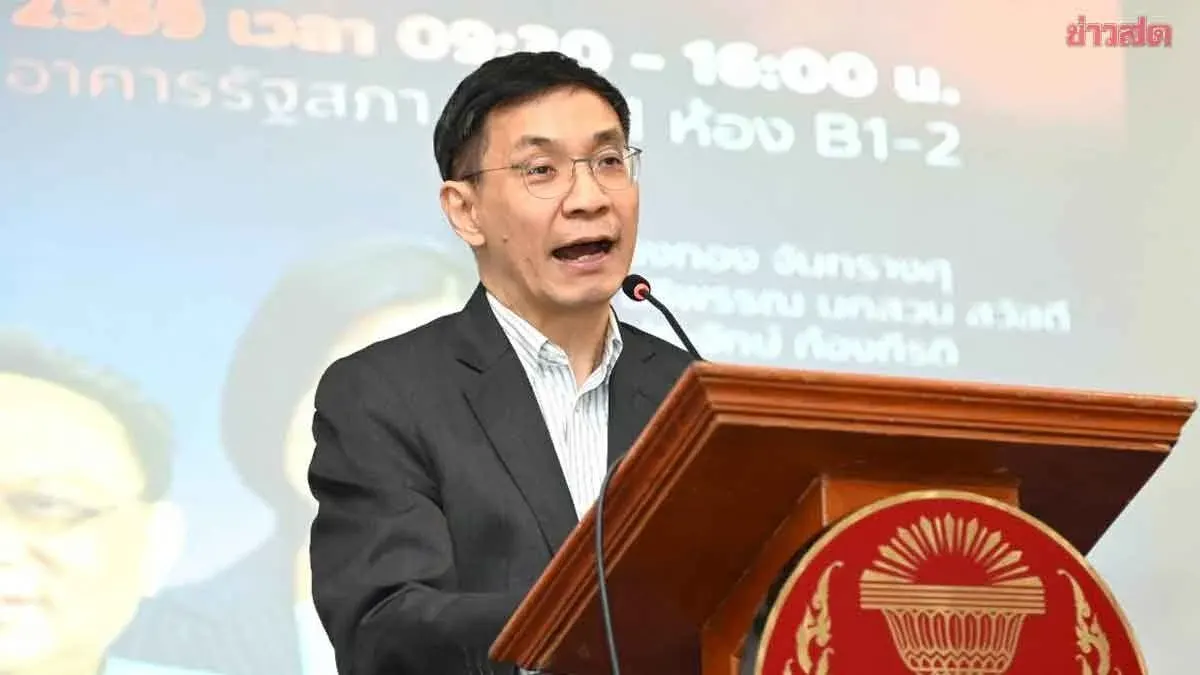
The president of the Thailand Development Research Institute expressed concern that the Election Commission crisis stems from insufficient capacity to investigate, urging it to accelerate submission of the parliament dissolution case to the Supreme Court for definitive resolution to rebuild public trust. He cautioned that resolving the matter internally would amount to failing in its duties.
At a parliamentary committee seminar on September 12, 2025, titled "Monitoring Independent Organizations' Role in Thailand's Political Crisis," Somkiat Tangkijwanich, president of the Thailand Development Research Institute, discussed the role of independent bodies in Thai politics. He noted that in many countries, the traditional three-way separation of powers—legislative, executive, and judicial—is insufficient to protect democracy under a constitution, particularly in societies where politics is dominated by political parties. The executive branch tends to consolidate power, exploit budgets to build political support, and create incentives for corruption.
Somkiat proposed a new framework featuring a fourth sovereign power: a democracy-protection institution acting as guardian separate from the legislature, executive, and judiciary to enforce the rules of democratic competition, maintain balance, prevent political abuse of power, and protect citizens' fundamental rights and freedoms, with status equal to the other three branches.
He identified a major challenge in designing independent organizations: balancing true independence with accountability. Genuine independence from political parties cannot be achieved through constitution or law alone but requires consideration of political reality, particularly the competitive structure of political parties. "While independent organizations can work well, it is not easy. The political environment matters more than the design itself. In unsuitable conditions, independent bodies are often interfered with or become tools against political opponents," Somkiat said.
He outlined four requirements for successful independent organization design: first, even excellent constitutional design cannot prevent a coup, but good design reduces the risk; second, distributing oversight power as a network is more sustainable than relying on a single independent body; third, personnel recruitment is as important as structural design—political interference can turn independent organizations into government legitimacy stamps and weapons against opposition; and fourth, independence must come with accountability and the ability to be checked as easily as it checks other agencies.
Somkiat said Thailand's independent organization design has at least two critical failures: the selection process and the Senate, which controls all independent body appointments. Should constitutional amendments occur, whether a Senate remains or not, the system should not depend on a single weak point. Independent organization selection methods should be diversified to function as a mutual oversight network.
He proposed multiple mechanisms for removing independent organization leaders and alternative legal avenues for impeachment of officials in political positions.