Thai Youth Innovators Tackle Climate Crisis in National Competition
Gulf Development and Chulalongkorn University concluded the third Green Mission competition, which challenged Thai youth to create climate-resilience innovations. From 927 entries, a platform that turns rice straw into income while cutting PM2.5 won the top prize, alongside an IoT forest-monitoring system and water-hyacinth insulation panels. Winning teams receive funding to pilot their solutions in real communities.
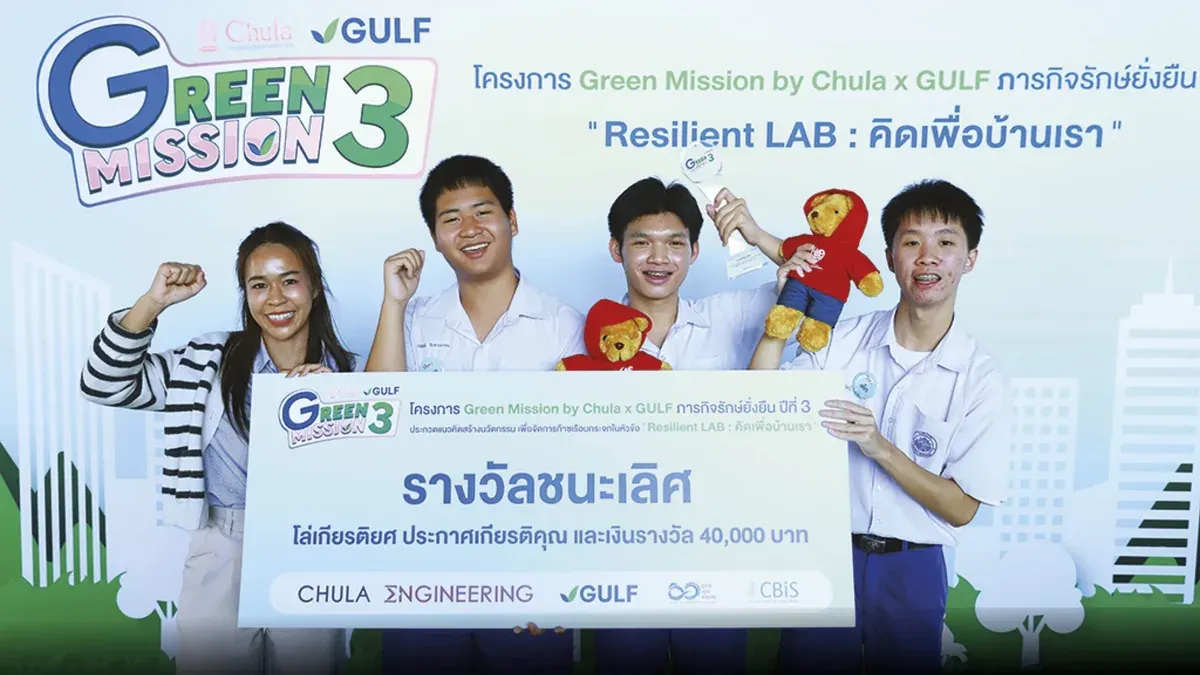
Amid mounting climate-change challenges, Gulf Development and Chulalongkorn University's Faculty of Engineering launched the third "Green Mission by Chula x GULF: Sustainable Mission" under the theme "Resilient LAB: Think for Our Home." The program blends climate-mitigation concepts with community-resilience building, guiding youth to prototype innovations tested in real-world settings. The contest drew 927 teams nationwide; 20 were chosen for incubation and eight reached the final pitching round.
Throughout the project, all 20 teams learned outside the classroom and experienced applied energy and technology at Gulf Group's Uthai Power Plant and Gulf Space Technology's ground station in Pathum Thani, followed by a three-day bootcamp at Chulalongkorn University's Regional Learning Network Center in Saraburi.
The grand prize went to Satit University of the Arts Demonstration School (Secondary) for "Fang Work," a platform linking farmers who want to sell rice straw with buyers, turning agricultural waste into value and income while reducing straw burning — a major source of PM2.5. Satellite data estimates straw volume and calculates carbon-emission reductions from avoided burning. The team received a trophy and a 40,000-baht scholarship.
First runner-up was Mahidol Wittayanusorn School for an IoT-based forest-intrusion detection network using small sensor nodes that spot abnormal activity and relay data to speed up ranger response.
Second runner-up went to Chanthaphan Witthaya School in Nonthaburi for "Root to Roof," heat-insulation panels made from water hyacinth for small-scale chicken farms. The idea sprang from a Bang Kruai community plagued by the invasive plant, turning a local nuisance into a cooling solution.
Outstanding-mentor awards were presented to teacher Nathonng Phetsida of Hat Yai Wittayalai and teacher Wichiraporn Akkharathit of Satit University of the Arts Demonstration School.
The top three teams each receive up to 20,000 baht in implementation grants to pilot their prototypes in communities under guidance from Chulalongkorn professors and Gulf experts.
A representative of the winning Satit University of the Arts team said: "Fang Work began with a real problem we saw in our community — rice-straw burning after harvest. We are delighted and proud to win, proving that local problems can become solutions benefiting everyone. Next we will pilot the platform with farmers in Nakhon Pathom before expanding, and explore carbon-credit linkage to create long-term value for farmers and the environment."