Gulf and Chula Launch Third Year Green Mission for Youth Innovation
Gulf and Chulalongkorn University’s Faculty of Engineering have launched the third year of their Green Mission program, inviting high‑school students across Thailand to turn local climate challenges into innovative solutions. The initiative selected 927 teams, narrowed to 20 for a learning camp, and will support eight finalists to develop real‑world sandbox projects. Organizers aim to move ideas beyond the competition by providing funding and expert guidance for pilot testing in communities.
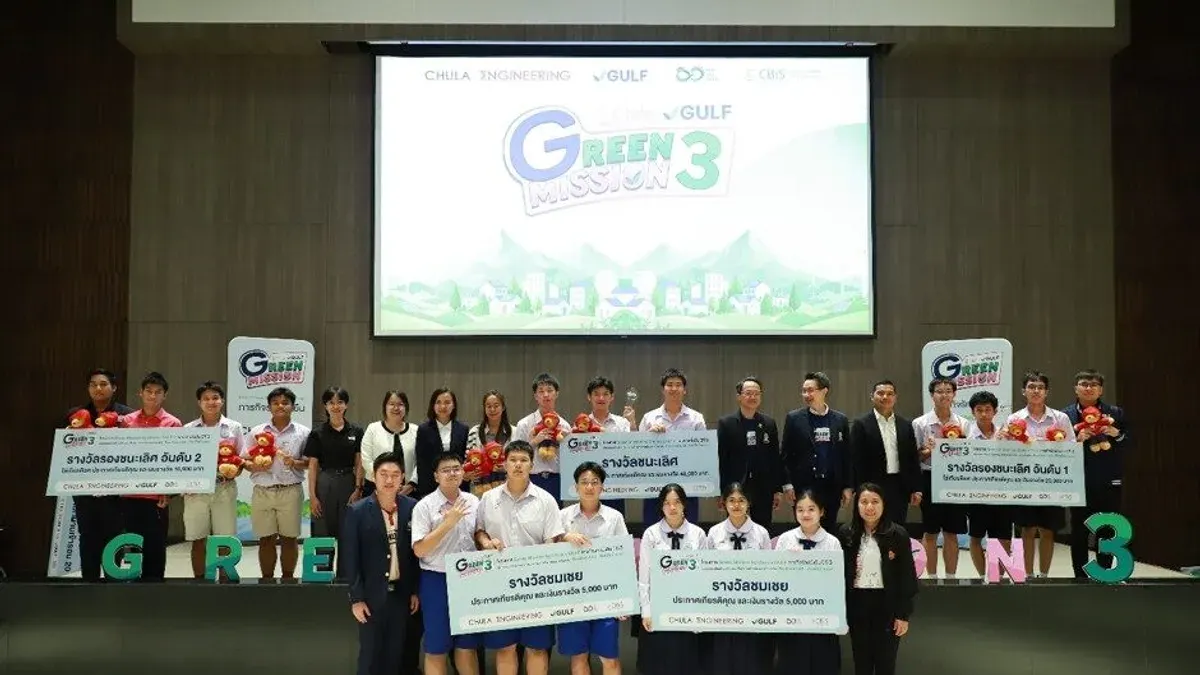
Gulf is nurturing a new generation of innovators, turning environmental challenges into economic opportunities. This is the mission that Gulf Development Public Company Limited (GULF) and Chulalongkorn University’s Faculty of Engineering are driving forward through the third year of the “Green Mission by Chula x GULF” project, under the concept “Resilient LAB: Thinking for Our Home”. The initiative opens a platform for high‑school students nationwide to bring community‑based climate problems and develop innovations to address them. What stands out this year is not merely the number of applicants or competition results, but the private sector’s effort to link youth development with real‑world problem solving through a learning process that values technology, community understanding, and the feasibility of scaling up the projects. In today’s economy, competitiveness depends not only on access to technology but also on people’s ability to apply knowledge, create innovation, and turn challenges into economic opportunities. From CSR to building an innovation ecosystem, Green Mission Year 3 had 927 teams apply nationwide, narrowed to 20 teams (60 students and 20 teachers) who joined a four‑day, three‑night learning camp at Chulalongkorn University’s Regional Learning Network Center in Saraburi province, held as a carbon‑neutral event before selecting eight teams for the finals. The learning process covered design thinking, problem‑cause analysis, user understanding, and feasibility assessment. Students also visited real sites such as the Thaicom station and Gulf Uthai power plant to learn about relevant technology and infrastructure. Crucially, Gulf and Chula did not end learning with a presentation; they enabled selected teams to develop their ideas into sandbox pilot projects in real locations, with funding and expert consultation to move prototypes from classroom to user testing. This approach gives Green Mission a dimension beyond a typical innovation contest, creating a learning process where youths face real constraints—community needs, operating costs, technology readiness, and sustainability. Gulf’s corporate social‑responsibility activity manager, Sittuman Rattanawadi, said: 'What impresses me this year is how many student ideas start from something close to home—problems they see in their own houses or communities—and they ask what they can change. That’s an important starting point.' 'For Gulf we want to give students a space to try, to act, and learn from real experience. Importantly, we don’t want those ideas to end after the competition, so we support winning teams to take their presented prototype back to the field for real testing and further development.'