Thailand Signs MOUs with NXP, Twente to Boost Chip Industry
Thailand has signed memoranda of understanding with Dutch semiconductor firm NXP and the University of Twente to advance the Siam Silica chip project. The agreements aim to transfer technology, develop local talent, and expand chip production to position Thailand as a regional logistics and innovation hub. Officials say the move supports Thailand’s goal of becoming the ASEAN center for semiconductor innovation.
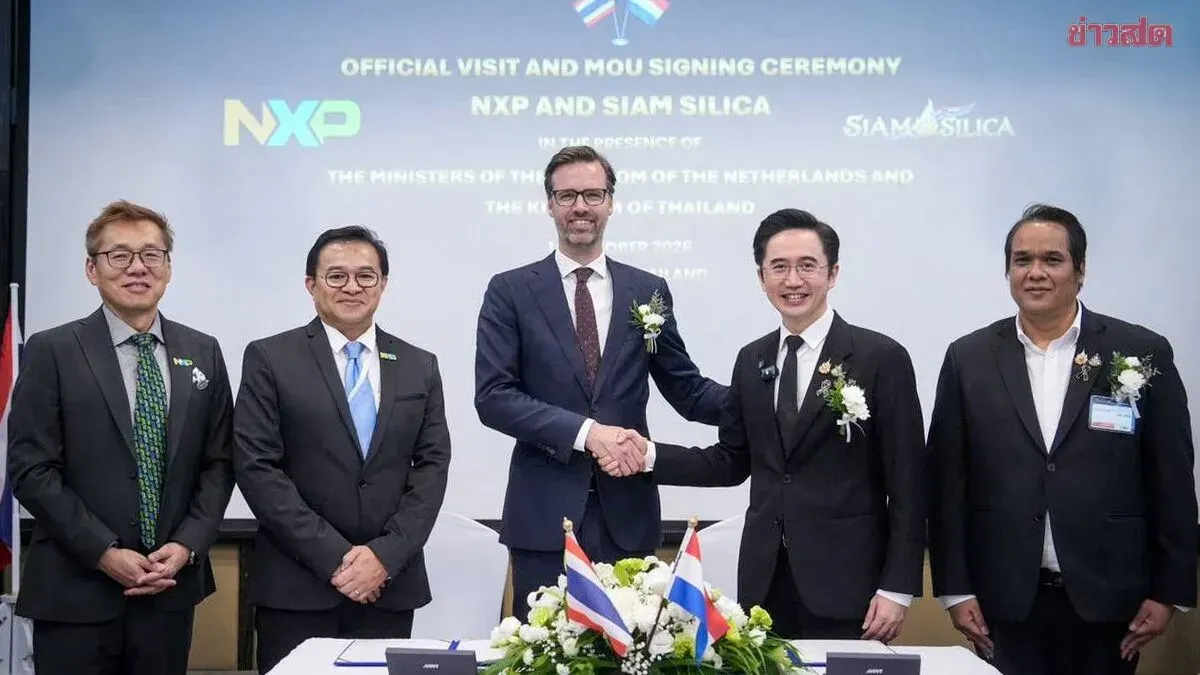
On 14 October 2069 (Buddhist calendar, corresponding to 2026 in Gregorian), Deputy Prime Minister and Minister of Higher Education, Science, Research and Innovation Yoschanan Wongsuwan, alongside Dutch Minister for Foreign Trade and Development Cooperation Schuurt Schuurtz-Ma, presided over the signing of a memorandum of understanding between NXP Manufacturing (Thailand) Ltd. and Siam Silica, and a memorandum of agreement between Mahanakorn University of Technology and the University of Twente. Yoschanan said Thailand's strong manufacturing base in electric vehicles and electronics could be leveraged to produce chips domestically, cutting logistics costs and positioning the country as a regional logistics hub. He added that visits to the University of Twente and its MESA+ Nano Lab revealed opportunities for human‑resource development aligned with his proposed ASEAN Chips Act, which aims to create shared semiconductor supply‑chain protocols with Thailand as the innovation hub. The Dutch minister welcomed the collaboration, noting that the Netherlands faces a shortage of skilled semiconductor personnel and sees Thailand’s Siam Silica project as compatible with its Brainport initiative.