Thailand Confirms First Carnivorous Dinosaur Footprint in Udon Thani
The user wants a short summary (1-2 sentences, 120-220 characters, max 240) in English only. The article is about Thailand's Minister of Natural Resources and Environment confirming the discovery of the first carnivorous dinosaur footprint
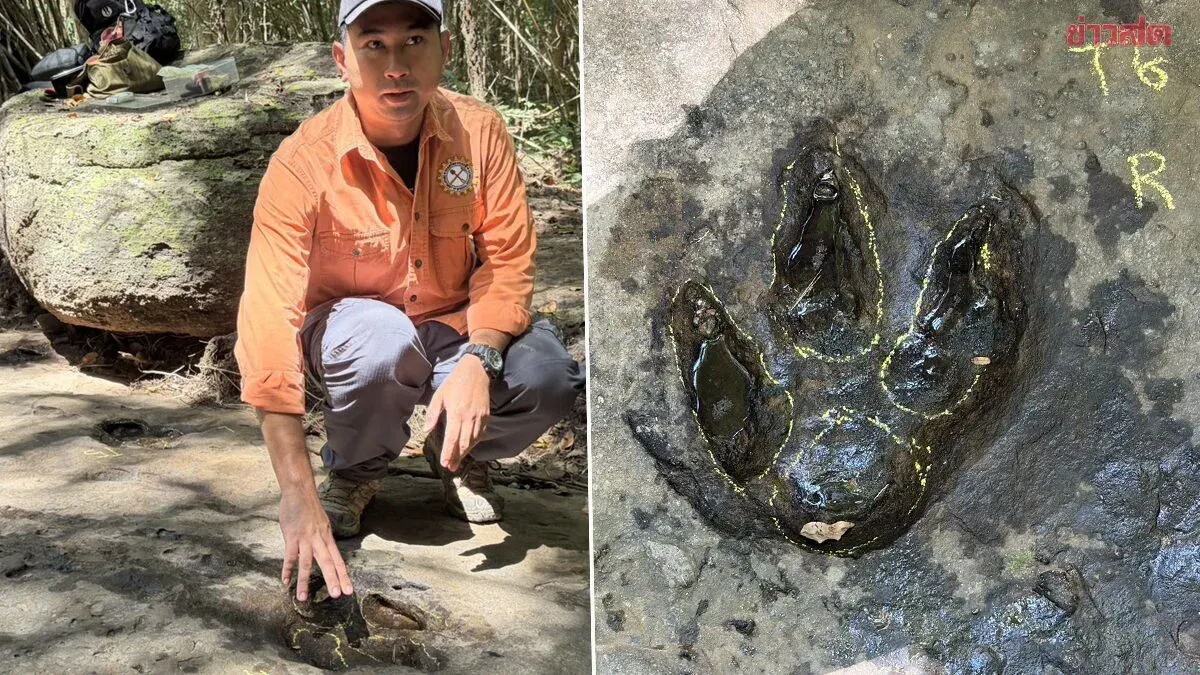
Natural Resources and Environment Minister Suchart Chomklin announced that the Department of Mineral Resources has confirmed the discovery of Thailand's first carnivorous dinosaur footprint in Udon Thani province. On October 20, 2026, the minister directed the department to investigate and verify the authenticity of the find reported on the Facebook group "What Is This?" and discovered by Pichai Pratet Sena at Protection Unit 3 (Phu Phra Bat) in Muang Phan subdistrict, Ban Phue district.
Deputy Permanent Secretary Nipon Jamnongsirirak, acting as Director-General of the Department of Mineral Resources, assigned the Fossil Protection Division to conduct an urgent on-site inspection. Senior geologist Pannipa Saetian and geologist Pol. Capt. Krisana Sutchua from Mineral Resources Office Region 2 led the team, joined by Phu Hin Chom That–Phu Phra Bat National Park chief Winnai Thongpan, park officials, Phu Phra Bat Historical Park chief Kulwadee Somsakthai from the Fine Arts Department, and other relevant staff.
The inspection confirmed a trackway of theropod dinosaur footprints — bipedal carnivores — consisting of six prints on Phu Phan Formation sandstone from the Early Cretaceous period (approximately 120 million years ago). The three-toed, clawed prints measure 29 cm long by 26 cm wide. Analysis estimates the dinosaur stood about 1.42 meters at the hip and measured roughly 6.30 meters in length, comparable to "Siamotyrannus isanensis," a theropod previously found in Thailand from the same era.
The Department of Mineral Resources, Department of National Parks, Wildlife and Plant Conservation, and Fine Arts Department are now proceeding under Section 25 of the Fossil Protection Act B.E. 2551 to prevent damage from tourist interference and water erosion, while also planning to develop the site as an important geological and paleontological research, education, and tourism destination for the country.