Thailand's Shadow Economy Ranks 14th Globally, Costing State Revenue
Thailand's informal economy ranks 14th globally and costs the state significant tax revenue, while the Bank of Thailand warns that capital misallocation to large businesses over SMEs hampers economic growth and productivity.
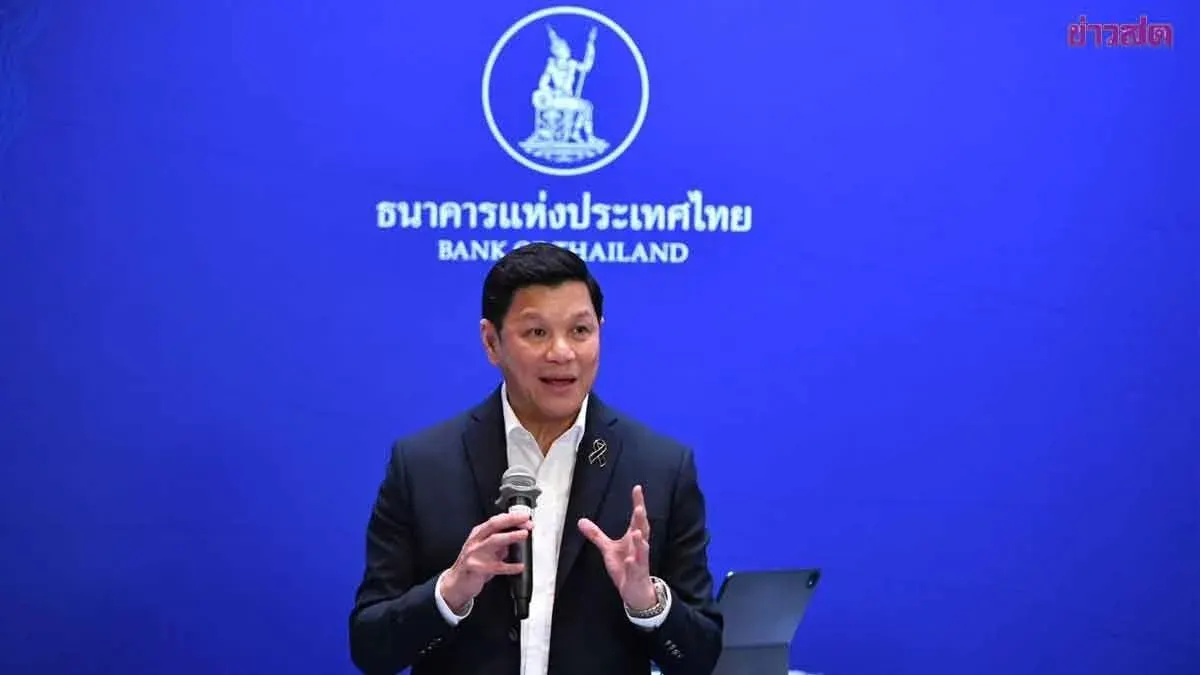
The Bank of Thailand has revealed that Thailand's informal economy ranks 14th worldwide, causing the state to lose tax revenue and budget funds. On July 31, 2025, Sethaput Ratanapor, Governor of the Bank of Thailand, delivered a special address at The INTANIA Forum on surviving under the new world order at Chulalongkorn University's Faculty of Engineering, with Prime Minister Srettha Thavisin in attendance. Ratanapor explained that the traditional economic world driven by globalization, free trade, and maximum efficiency has changed, and the global economy has entered a multipolar era where no single power determines direction. He highlighted how tariffs and trade measures are now used as tools of power competition, while global shocks from COVID-19, the Ukraine war, trade conflicts, and Middle Eastern tensions occur frequently.
Ratanapor stated that Thai economy must not only be flexible but also absorb shocks, adapt, and move forward. The key is structural economic reform, particularly addressing resource misallocation, which hampers productivity and the nation's GDP potential. He noted that Thailand does not lack capital—the Bank of Thailand currently absorbs liquidity through various channels worth approximately 5-6 trillion baht daily—but much of this money does not flow to efficient business units, resulting in below-potential economic growth.
Data reveals clear anomalies: over 75% of capital is allocated to large businesses, while SME credit has remained negative for 15 consecutive quarters. Even the top 30% of high-performing SMEs access only 21% of credit compared to large businesses accessing 63%. Ratanapor highlighted that financing cost disparities worsen SME competition, with efficient small businesses paying average interest of 7.8% while large enterprises pay around 3.9%. The solution involves creating a large-scale database to improve credit disbursement accuracy, reduce credit risk costs, and lower operational expenses. This database would integrate credit information, utility consumption data, and alternative data to more comprehensively assess borrower potential.
Ratanapor said this aligns with government policy, with Deputy Prime Minister and Finance Minister Ekniti Nitivattananon leading the initiative and using the government's Connect mechanism as the driving force. Success would help small-scale individuals and disciplined SMEs without sufficient collateral to access credit at reasonable costs. He emphasized that reallocating resources to more efficient business units would improve the Thai economy, increase productivity, and expand GDP potential.
Another major problem, he noted, is underground capital and the informal economy, which drain resources from the real economy. Thailand has the world's 14th-largest informal economy, representing 9-13% of economic activity as gray economy, preventing the state from collecting taxes and keeping money out of the budget system. The Bank of Thailand is closing multiple loopholes, including requiring explanations for cash withdrawals exceeding 5 million baht monthly. This followed the discovery that old 1,000-baht banknotes worth 140,000 million baht had disappeared from the system. Authorities are also monitoring gold transactions through apps that affect the baht's value. Ratanapor stated that gold regulatory measures are being implemented.