Finance Minister Unveils Plan to Drive Growth Beyond 3%
Finance Minister Pichai Chunhavajira launched the MOF Transformation plan targeting over 3% annual GDP growth, investment rising to 30% of GDP, and a top-20 global competitiveness ranking. The strategy combines an economic framework (STI) with internal ministry reforms (DEE) and includes immediate measures to help SMEs, promote clean energy, and digitise government services.
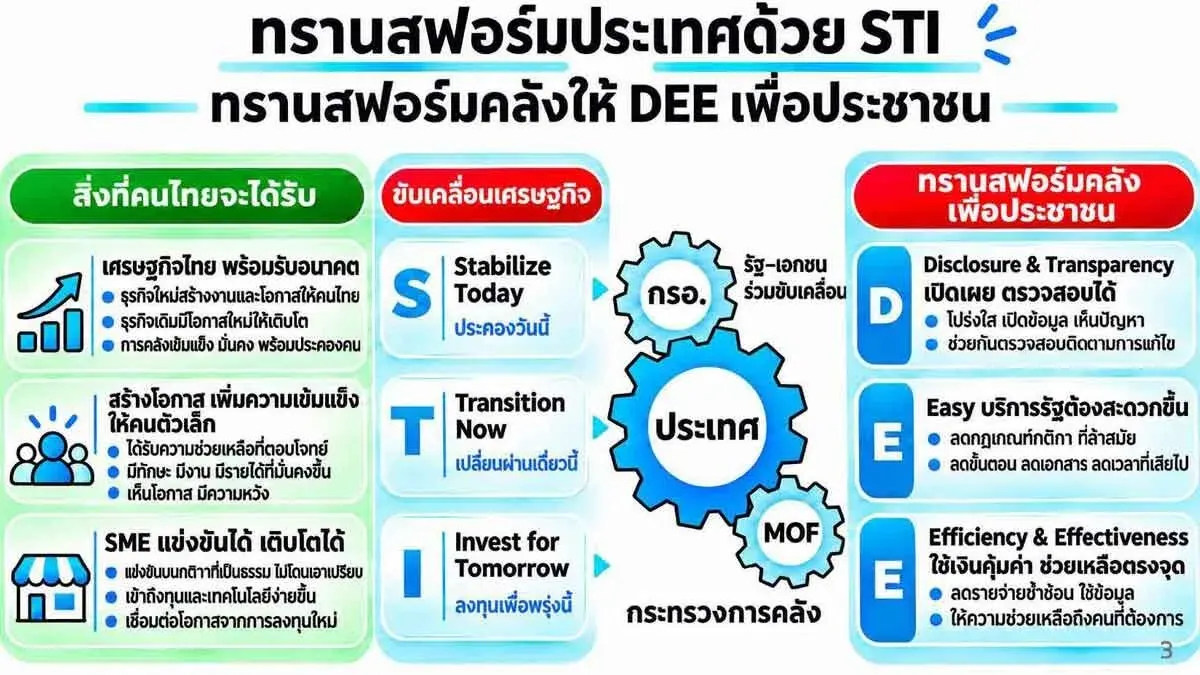
Deputy Prime Minister and Finance Minister Pichai Chunhavajira has unveiled the "MOF Transformation" plan to reposition the Ministry of Finance as a driver of economic growth and public services. The strategy rests on two pillars: STI to steer the nation and DEE to upgrade the ministry’s performance. STI stands for Stabilize Today — cushioning the economy and helping vulnerable groups while maintaining fiscal discipline; Transition Now — accelerating incentives for households and businesses to adapt to new economic and energy models; and Invest for Tomorrow — building future capabilities through investment led by the private sector with government support. DEE comprises Disclosure & Transparency — opening data and linking databases; Easy — cutting red tape and digitising state services; and Efficiency & Effectiveness — using data to make policy and budgeting more targeted. In the next three to six months the ministry will pursue quick wins such as the Ari Score credit-rating system to improve SME access to finance, tax-benefit adjustments for SMEs, support for government supply-chain financing via PromptBiz, and clean-energy measures including public-sector solar and electric-motorcycle incentives. It will also restructure taxes to back future industries, expand alternative funding through public-private partnerships and new financial instruments, and advance operational reforms including open procurement data, a central data exchange, electronic customs, an MOF Data Lake, and AI-driven administration of state assets and operations. The ministry views the transformation as a key mechanism to restructure the Thai economy for inclusive growth, create opportunities for citizens and SMEs, and lay a long-term foundation of data, technology, and investment while preserving fiscal stability.