Transport Ministry Plans Congestion Fees to Boost Bangkok Public Transit Use
The user wants a short summary (1-2 sentences, 120-220 chars, max 240) of the article about Bangkok congestion fees and public transit plans. The article is in English, so output must be in English. Must not repeat title verbatim, must add
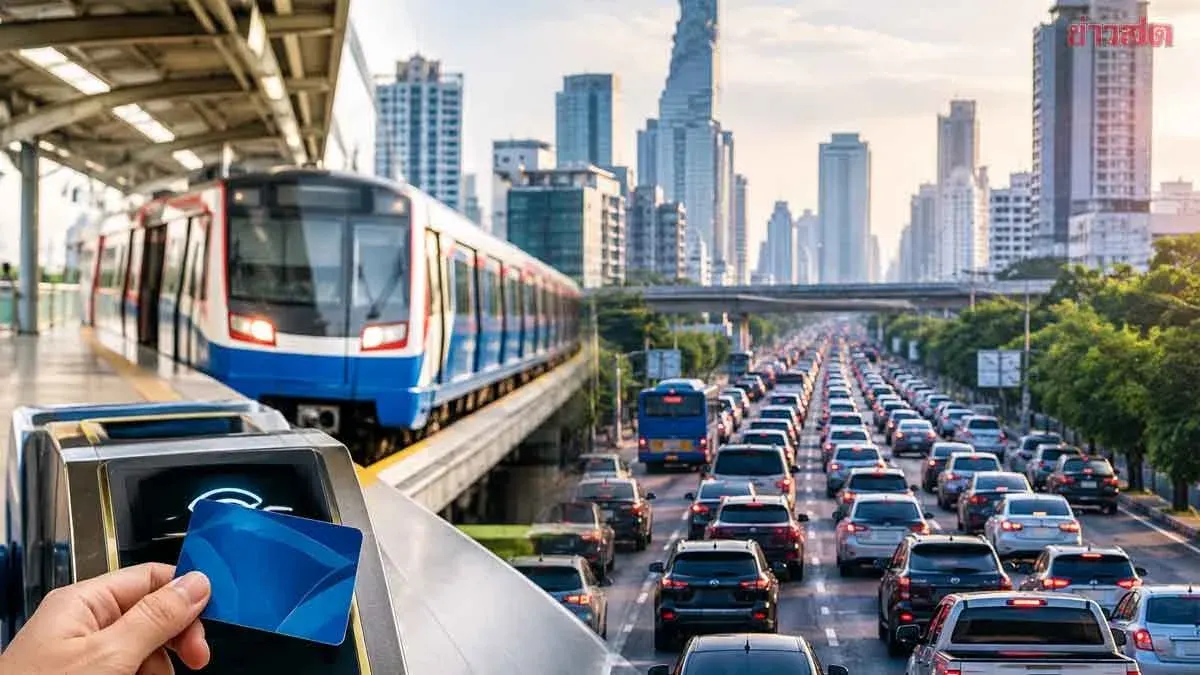
Bangkok residents face new congestion charges as the Ministry of Transport studies ways to increase public transport usage. Jirarot Sukkharat, director of the Office of Transport and Traffic Policy and Planning (OTP), chaired the second seminar on developing the capital's transport system to raise the share of journeys made by public transport in Bangkok and its surrounding areas.
The study aims to develop a public transport system that meets people's needs. Although Bangkok continues to expand its electric train network and bus services, many travelers still choose private cars because reaching stations remains difficult or transferring between systems is inconvenient. Therefore, priority must be given to developing a comprehensive public transport network that offers convenient access from home to the system and seamless inter-system connections.
OTP has studied the travel behavior of actual users to determine development guidelines aligned with public demand and to encourage greater public transport use. The study gathered input from government, private sector, and citizens to finalize a plan that can be implemented practically.
Currently, public transport accounts for about 18% of trips in Bangkok and its vicinity. The integrated public transport development plan sets a three-phase framework from 2027 to 2037, focusing on improving access and connection points, and developing feeder systems to continuously expand network coverage. The 2027 target is to increase the share to 40%, a significant challenge. Measures already underway include a common ticketing system, projected to raise electric train ridership by about 20%, while daily electric train trips in Greater Bangkok are expected to grow from 1.55 million to 4.5 million.
For the integrated plan covering infrastructure and services, the study proposes developing the rail network according to the M-MAP2 plan and water transport, alongside a common ticketing system, park-and-ride facilities, connecting walkways, footpaths, and bicycle lanes to ensure convenient, seamless end-to-end journeys.
It also proposes adjusting the fixed-route bus network, which currently has about 269 routes with 239 operating and roughly 30 lacking operators. The plan suggests shortening about 50% of overly long main routes for better efficiency, reducing overlapping routes to increase service frequency, and adding more than 100 feeder routes to expand coverage. Songthaews (Route 4 vehicles) would connect communities to electric train stations and key transfer points.
The project surveyed access to every currently operating electric train station within a 500-meter radius, covering 29 connection points, to develop improvement proposals for areas and facilities. It proposes developing seven key interchange points: 1. Hua Mak Station: Construct an elevated walkway (Skywalk) linking the Yellow Line ARL, 51 meters, budget 42.10 million baht. The Mass Rapid Transit Authority of Thailand (MRTA) is preparing to proceed. 2. Lak Si Station: Build a ground-level covered walkway connecting the Pink Line electric train and the Red Line commuter train, 57 meters, total budget 9.49 million baht. MRTA is preparing to proceed. 3. Phetchari Station / Makkasan Station: Construct a building...