Travel Guide Highlights Wat Pho History and Reclining Buddha
A travel guide details Wat Pho's history as Siam's first university and highlights its iconic gilded Reclining Buddha with 108 mother-of-pearl auspicious symbols.
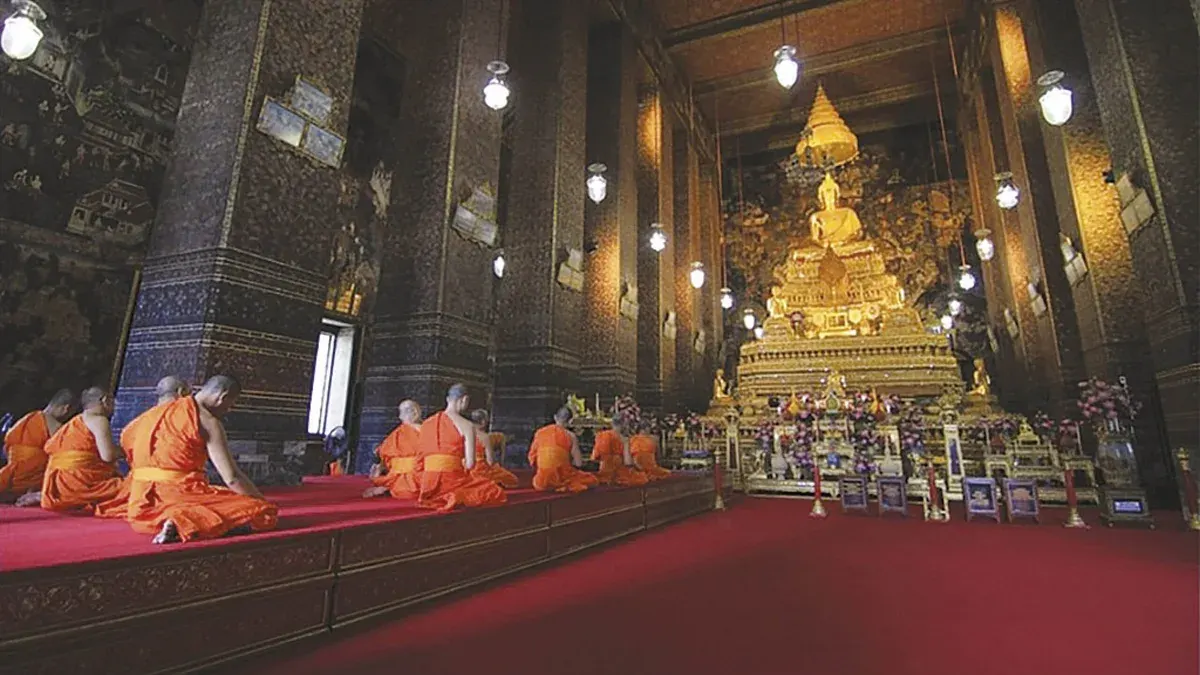
Wat Phra Chetuphon Vimolmangklararam, also known as Wat Pho, is a first-class royal monastery of the Ratchavoramahavihan type situated at 248 Thanon Thai Wang, Phra Borom Maha Ratchawang Subdistrict, Phra Nakhon District, Bangkok.
It ranks among Thailand's most significant temples and served as the royal temple during the first reign of the Chakri Dynasty. Moreover, it functioned as Siam's first university, housing stone inscriptions encompassing diverse branches of knowledge including traditional Thai medicine, massage textbooks, hermits' exercises, and other sciences, allowing Thai citizens to pursue learning freely without class barriers — a public learning center for the masses.
Today, Wat Pho continues to attract numerous Buddhist devotees and international tourists. Anyone who has visited will find the temple offers many points of interest.
Transportation to Wat Pho is accessible via numerous bus routes including lines 1, 3, 6, 9, 12, 25, 32, 44, and air-conditioned buses Por.1, Por.12, Por.44, Por.48, Por.507, Por.508, among others. The MRT Blue Line to Sanam Chai Station is also convenient. However, driving personal vehicles is discouraged due to narrow sois with heavy opposing traffic; large tour buses cannot enter, and parking is extremely limited.
After alighting, walk straight into the soi for about 40 meters to see a modest sign indicating proximity to the temple. The front area is somewhat chaotic with congested traffic, though the small Tha Tien community nearby has shops lining the streets.
Upon entering the temple grounds, the first impression is one of cool, clean beauty. Visitors will see Buddhists and tourists lighting incense and candles, paying respects to the Luang Por Sod statue at the Phra Mongkhlthepmuni Hall, which draws particularly large crowds.
Passing through the temple gate reveals Chinese stone figurines standing on both sides. We first visit the Phra Phuttha Saiyat Viharn. Admission is free for Thais, while foreigners pay an entry fee. Inside, one is awestruck by the beauty and grandeur of Phra Phuttha Saiyat — a massive reclining Buddha image built of brick and plaster, completely gilded. The soles of both feet are level and inlaid with mother-of-pearl depicting 108 auspicious symbols, the central design being a wheel per the Mahapurisa Lakkhana tradition. The 108 motifs blend beliefs originating from India and China.
The Phra Phuttha Saiyat Viharn was constructed during the reign of King Rama III when he ordered the temple's expansion northward (encroaching on the former Wat Phodharam site which had been abolished). Prince Ladawan served as chief overseer. The Buddha image was built first, then the viharn, sized equally to the ubosot. The upper walls feature paintings of the Mahavamsa, while walls between windows depict the 13 female disciples, 10 male lay disciples, and 10 female lay disciples who attained enlightenment.
Inside the viharn enshrines Phra Phuttha Saiyat, a brick-and-plaster Buddha image completely gilded, ranking as the third largest in Thailand. Its distinctive features include the level soles adorned with 108 auspicious symbols inlaid with mother-of-pearl, the central motif a wheel per the Mahapurisa Lakkhana, the designs blending Indian and Chinese beliefs.
Wat Phra Chetuphon Vimolmangklararam opens daily to the public from 08:00 to 17:00.