Thailand Links Investment Promotion to IPO Program for New Economy
Thailand launched the "BOI to IPO" program linking investment promotion with capital markets to help New Economy businesses raise funds and expand operations. The initiative joins the Board of Investment, Stock Exchange, and Securities Comm
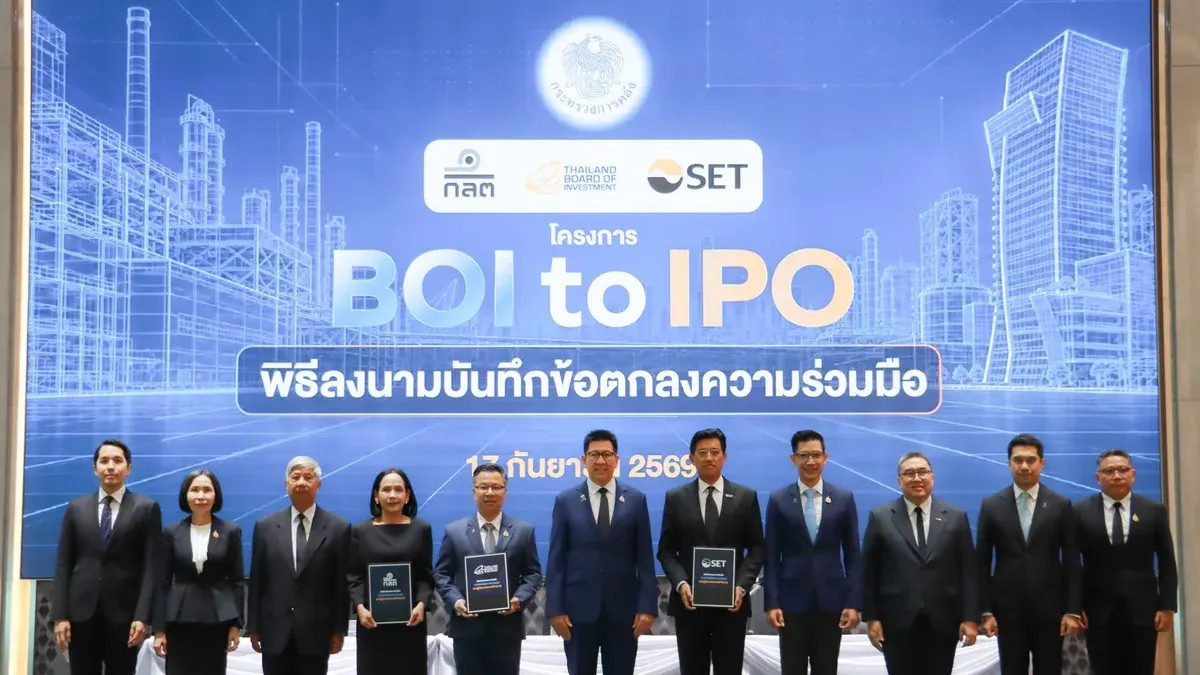
Deputy Prime Minister and Finance Minister Ekniti Nitithanpraphas, chairing the Investment Promotion Committee, witnessed a joint agreement signed by the Board of Investment, the Stock Exchange of Thailand, and the Securities and Exchange Commission to support capital raising among target entrepreneurs.
The "BOI to IPO" program bridges investment promotion with Thailand's capital market, specifically targeting ten New Economy industries to enable businesses to raise funds, expand operations, and use Thailand as a gateway to global markets. Ekniti stated that Thailand is undergoing economic restructuring amid technological change, global supply chain shifts, and competition to attract future industries. The government is pursuing an investment-led growth strategy that not only attracts capital but creates value through technology and innovation transfer, high-skill job creation, Thai workforce development, and integration of Thai entrepreneurs into modern supply chains.
BOI to IPO will serve as a mechanism to transition BOI-promoted businesses into the capital market, enabling New Economy enterprises to grow and continuously raise expansion capital from Thailand while channeling capital toward high-potential businesses and better reflecting the new economic structure in the Thai stock market.
Narat Thoedsatheersakdi, BOI Secretary-General, explained that the cooperation links tools from all three agencies: the BOI provides additional incentives for motivation, while the Stock Exchange and Securities Commission support readiness preparation and listing processes on the main board or Mai market, improving governance, transparency, and enabling Thai participation in high-growth potential enterprises.
The measure builds on examples of foreign companies that invested and grew until listing on the Thai capital market, such as Delta Electronics (Thailand) and Cal-Comp Electronics (Thailand).
Qualifying companies will receive enhanced tax benefits. New Economy group firms certified by the Stock Exchange receive a three-year corporate income tax exemption or optional 50 percent reduction for five years. General firms receive an additional two-year exemption or 50 percent reduction for three years, depending on business type.
Asadej Kongsiri, Stock Exchange Chairman and Chief Executive, said the exchange has adjusted listing criteria to make registration faster and easier for BOI-promoted entrepreneurs while supporting associated listing costs under Stock Exchange rules and the Capital Market Development Fund.
"The Stock Exchange and Securities Commission are testing streamlined IPO processes to reduce timeframes," he noted.
Secretary-General Pronraong Busaratrakun of the Securities and Exchange Commission said the agency will work with the BOI and Stock Exchange to help promoted entrepreneurs access the capital market efficiently, with improved and accelerated IPO procedures while emphasizing full disclosure, strengthened internal controls, and investor protection to build confidence in the Thai capital market.
The ten New Economy industries include advanced agriculture and food, biofuels and biochemicals, and medical and health services.