OLIC Launches Women's Health Education Campaign for 2026
OLIC, part of Japan's Fuji Pharma Group, launched a women's health education campaign in Ayutthaya focusing on contraception, STI prevention, and HPV management. The initiative emphasizes empowering women with accurate medical information t
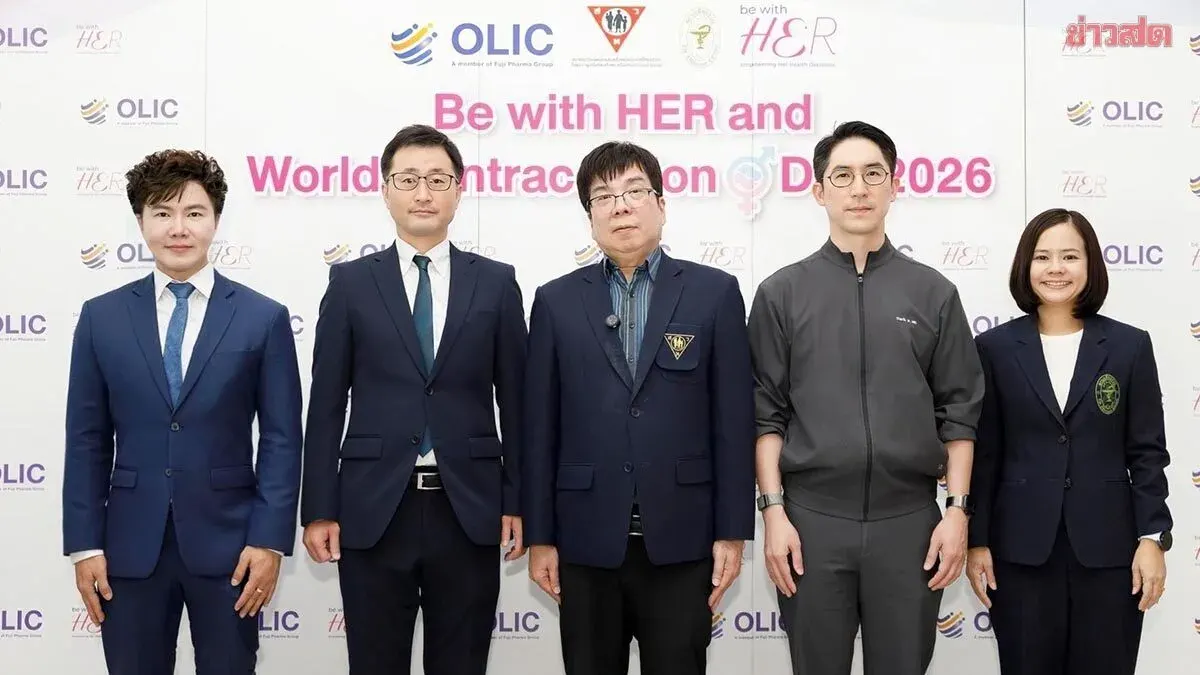
OLIC (Thailand) Limited, part of Japan's Fuji Pharma Group, is advancing women's health literacy through the event "OLIC – Be with Her: Empowering Choices, World Contraception Day 2026" held at its headquarters in the Bang Pa-in Industrial Estate, Ayutthaya Province. The event opened a forum for knowledge exchange covering contraception, appropriate hormone use, prevention of sexually transmitted infections, and HPV infection management.
Pharmacist Nuttakarn Prasob Sai Prom Kul served as host and joined healthcare partners in communicating health topics to share information that is understandable and practical.
Under the concept of "Empowering Choices," OLIC believes that choice becomes meaningful when women have correct information, understand benefits and risks, and can consult medical professionals to select approaches suited to themselves.
Takefumi Sagara, Managing Director of OLIC (Thailand) Limited, stated that OLIC views women's health promotion holistically—from prevention to information access to appropriate medication use and continued health management. "Our role is to be with her – not to make the decision for her, but to support her with knowledge, options and access to appropriate healthcare."
For OLIC, advancing women's health prioritizes building partnerships with healthcare networks to deliver accurate and trustworthy information to the public.
Birth control: More than pregnancy prevention
One key emphasis among experts is shifting the perspective on choosing contraceptives from considering only pregnancy prevention effectiveness to weighing other health benefits alongside safety and suitability for individual women.
Assoc. Prof. Dr. Manop Thamkhuntho, Chairman of the Family Planning Association of Thailand, noted that birth control may offer health benefits beyond contraception—such as regularizing menstrual cycles or reducing menstrual pain. Some types are registered for additional indications such as dysmenorrhea. However, selection should consider health history, risk factors, hormone type, and each person's health goals.
Dr. Olalik Musikwong, of the Ministry of Public Health Medical Communications Task Force, emphasized that for those requiring long-term hormone use, attention should be given to efficacy, safety, and individual suitability. All contraceptives carry different precautions and risks; women should consult doctors or pharmacists, especially if they have risk factors or chronic conditions.
Combined-hormone contraceptives now offer diverse molecules of both estrogen and progestin. One development in contraceptive hormones is Estetrol (E4), an estrogen naturally produced by the body during fetal development with tissue effects differing from some estrogens used in traditional contraceptives. This reflects diverse contraceptive options in development. Selection should consider precautions and individual suitability.
Community pharmacists: Key gatekeepers of women's health literacy
Pharmacist Chonakitt Imbumrung, Treasurer of the Pharmacists Council, stated that community pharmacists...