Deliveree Transforms Logistics for Thai Small Businesses
Deliveree, an on-demand logistics platform, is helping Thailand's small businesses reduce delivery costs by offering flexible vehicle rentals instead of requiring ownership of trucks or dedicated drivers.
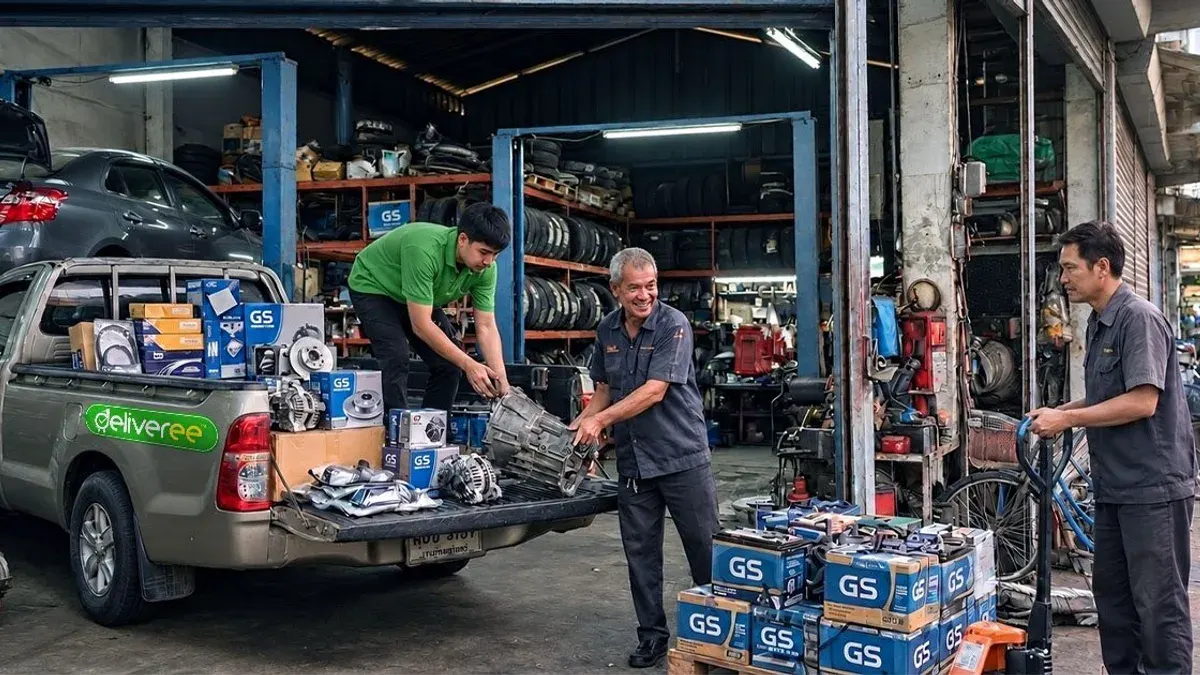
The Deliveree platform is revolutionizing how small business operators in Thailand ship goods and simultaneously transforming the survival equation for these enterprises. On an ordinary early morning in the Bangna area, Somsak Charoen Yont stands at the rolling shutter of his shop, which bears his name: "S. Charoen Yont Auto Parts and Repair." The shop has occupied this street for nearly two decades—long enough that vintage car mechanics in the area call him by a nickname. Inside, the shop is stacked floor-to-ceiling with engines, batteries, and tire pallets—everything that sustains his life and has also cost him many sleepless nights.
For nearly two decades, Somsak's delivery options were limited to just two: sending two employees out in an old pickup truck, which meant losing half a day of labor, or waiting for a freelance driver who might answer the phone. "Some days nobody comes. Customers in Chon Buri are waiting for their parts. I stand here calling, calling again," he recounts.
The challenge of moving goods from one place to another without owning a vehicle is the mission that Deliveree, a company founded in 2015, has set out to solve. The platform is not widely known among the general public because it is better known to warehouse employees. The service allows on-demand booking of vehicles ranging from motorcycles and sedans to six-wheeled and ten-wheeled trucks, with payment based only on actual usage. Operating in Thailand, Indonesia, and the Philippines with funding exceeding 100 million US dollars, Deliveree is one of several players competing in this market. What Deliveree and its competitors really sell, stripped of marketing language, is the ability to reduce fixed costs for business operators.
Deliveree itself wants to be clear that it differs from delivery apps that most Thais are familiar with, such as food delivery or small parcel services. "Deliveree was born specifically for business. It has been driven by technology from day one. Everything we do is aimed at serving businesses of all sizes," said Nongnaruethai Jaipol, the company's marketing manager. "Being a business-focused platform is in our DNA. That makes us different from other mass-market consumer apps like Grab and Lalamove." Yet this is merely brand positioning that the marketing department was hired to do. Whether it has real meaning for business operators remains to be seen—not in a conference room, but at the rolling shutters in the Bangna area.
The significance of this story depends on who you are. For Thailand's more than 3.2 million SMEs—nearly nine out of ten of all businesses in the country and the primary employer of most Thai workers—a truck sitting idle five days a week represents money bleeding away week after week, just as goods that never reach customers do.
Patharita Chaisit understands this problem well. She owns Fah Sai Coffee, a coffee shop in Pathum Thani that roasts and processes coffee beans before shipping them to customers nationwide. Years ago, she owned her own refrigerated pickup truck for deliveries. "It just sat there in the soi almost the whole week, but we still had to pay for it and its maintenance," she recalls. These days, she books vehicles as needed each day through her mobile phone. A few taps and she has a motorcycle or sedan to clear her morning online orders. She books a larger truck when she has catering jobs on weekends, and calls a delivery truck when she needs to send large orders occasionally. The app on her phone allows her to track everything.