Dog Nearly Triggers Grenade Found in Backyard
A family dog nearly caused a deadly explosion in Sisaket province after picking up a live Chinese hand grenade and bringing it home to play with on July 10. The device remained armed and intact until the homeowner discovered it and authorit
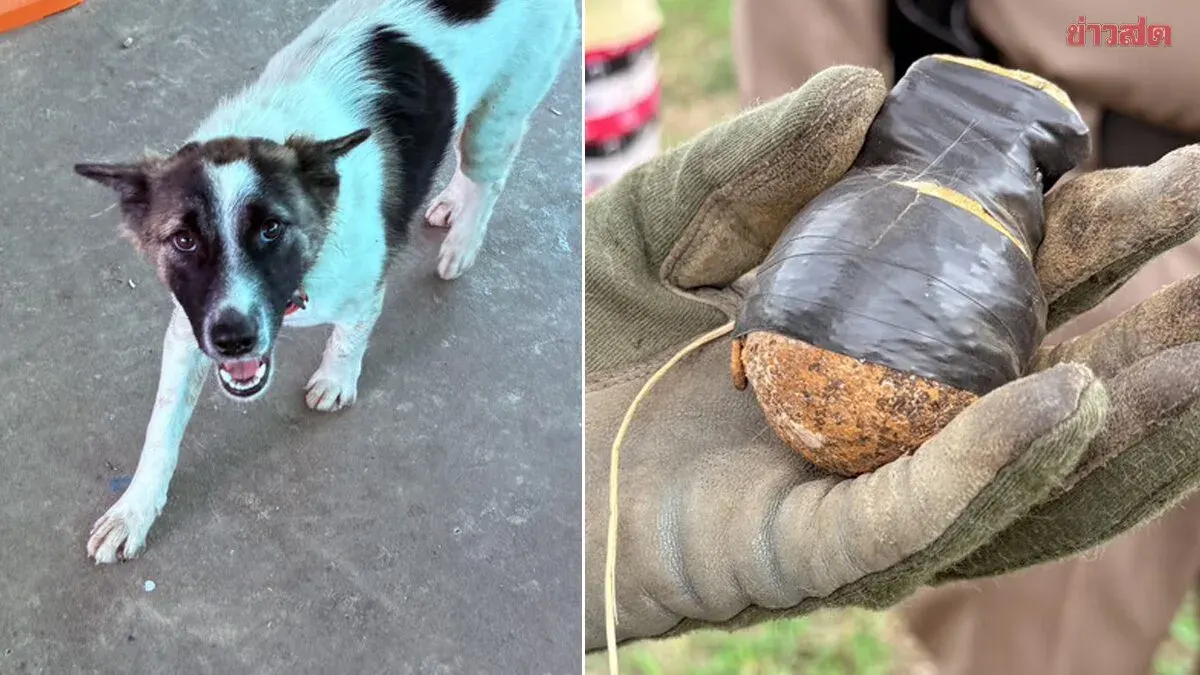
A family in Noen Khun district, Sisaket province narrowly escaped disaster when their dog picked up a live hand grenade and brought it home to chew on, thinking it was a bone. Noen Khun District Officer Chaiwat Thamwat reported that the incident occurred on July 10 at 2 p.m., when village officials in Phak Kha Yai Noi subdistrict notified police of a suspicious explosive-like object found on residential property. Officers immediately cordoned off the area and conducted a detailed inspection.
The homeowner, who requested anonymity, said he was resting on his porch after a doctor's visit when he spotted a dark, round object covered in rust. Thinking it was old scrap metal or plastic, he picked it up to examine it. When he flipped it over, he immediately spotted a grenade pin attached to the device and realized it was a hand grenade. Terrified, he quickly placed it down and moved it to an open area away from his house.
His elderly mother, who had been home alone all morning, revealed that the family dog had carried the object from somewhere unknown and had been playing with it near the house. Everyone assumed it was just an old bone or plastic scrap, so no one intervened. The homeowner said: "If the dog had bitten the pin or dropped it hard enough to trigger it, I don't know what would have happened. Thinking about it still gives me chills because the whole family and the dog were near this grenade all morning."
Police conducted initial checks and called in an explosive ordnance disposal team using maximum safety precautions. The investigation confirmed the object was a Chinese-manufactured TYPE 82-2 hand grenade—a fragmentation weapon. Despite its corroded exterior, all critical mechanisms remained intact and fully functional.
Officers explained that grenades of this type are commonly found in border areas and may have been abandoned for years, accumulating rust. However, this does not render them safe. Old explosives often present higher risks because their internal mechanisms cannot be reliably assessed. Any pulling of the safety pin or sufficient impact could trigger detonation, scattering shrapnel over a wide area and causing severe injury or death to nearby people and damage to property.
After obtaining authorization, officials carefully moved the grenade to a remote rice field away from the community and proceeded with standard demolition procedures. The resulting explosion left a crater approximately 30 centimeters deep and 60 centimeters wide in the soil.