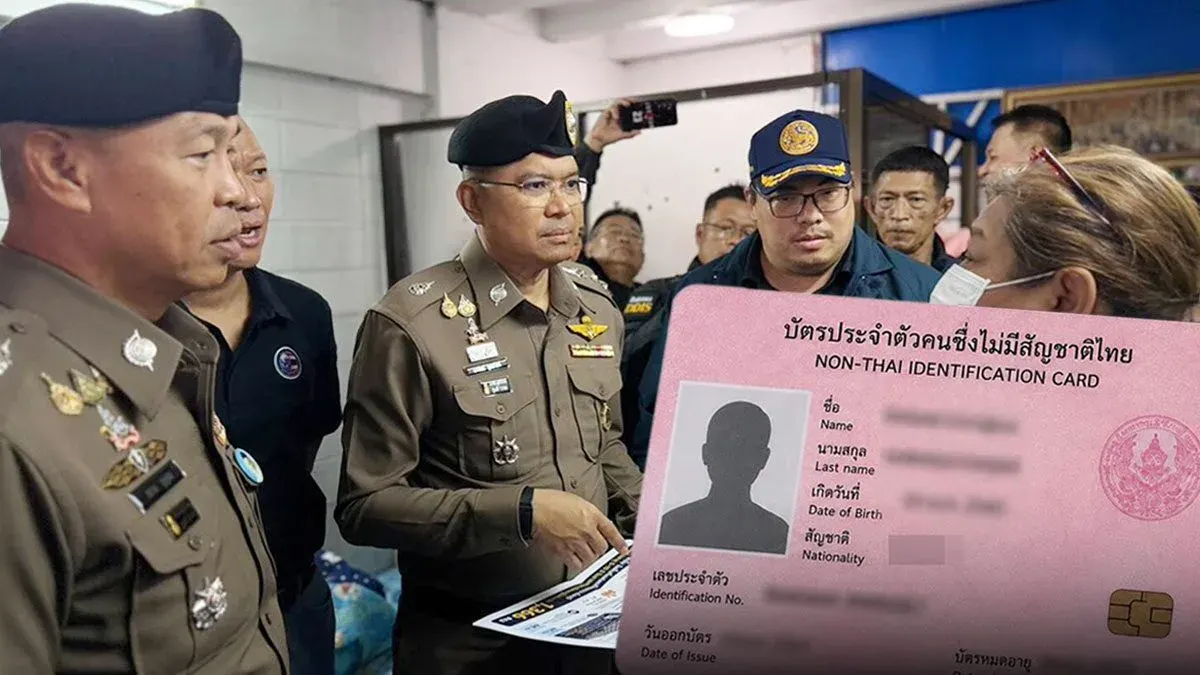
An illegal ID card scheme involving corrupt officials, intermediaries, and landlords has exposed serious gaps in Thailand's population registry system, with authorities discovering over 1,300 foreign names illegally registered in Bangkok ap
The illegal pink ID card case is not simply about issuing documents to foreigners unlawfully—it represents a breach of the state's population registration system, with intermediaries, landlords, and corrupt government officials operating as an organized network similar to previous high-profile cases.
The "Sweep Din Daeng" operation began at a Din Daeng apartment building. Officers randomly inspected just 3 rooms, each 34 square meters, and discovered 35–64 residents registered per room. When checks extended to over 5,700 rooms, 44 additional rooms contained 1,366 foreign names, mostly registered in 2567.
Within the operation, roles were clearly divided. Intermediaries recruited clients and collected fees. Landlords received approximately 5,000 baht in exchange for allowing foreign names to be added to their household registry. Government officials played the most critical role by approving transfers and issuing cards.
The resulting harm is substantial. Pink ID cards gave holders access to education and health services, enabled financial transactions and bank account openings, and were used for identity fraud in illegal schemes such as opening shell accounts and facilitating cross-border money laundering.
Seven people have been arrested and detained so far, including government officials, intermediaries, landlords, and accomplices. Involved officials have been suspended from duty pending investigation, and financial tracking has been referred to the National Anti-Corruption Commission.
A more serious concern emerged from claims by intermediaries that this scheme operates "in every district." If true, this is not a problem isolated to Din Daeng, where over 3,200 suspicious cases were found, but a systemic failure. Bangkok authorities must conduct a comprehensive audit of all 50 districts dating back to 2560–2569, focusing on households with unusually large numbers of registered residents.
State agencies investigating the illegal card scheme must pursue those responsible to the source—not just arrest intermediaries and stop there. They must trace all money flows, chain of command, and all involved officials completely.
When population registry records are bought and sold to illegally register foreigners, the ultimate victims are Thai citizens nationwide.
At the same time, community members must serve as eyes and ears, since official resources are limited and some officials are implicated. Residents may notice irregularities first—homes with dozens or hundreds of registered names, unknown faces moving in and out. Such observations are crucial leads.
When people report suspicious activity, they not only help prevent security threats and crime and protect public funds—they also safeguard their own rights and social benefits.