Government Unveils Plan to Tackle Kok-Sai River Pollution
The Thai government has launched a three-pronged strategy to address toxic contamination in the Kok and Sai rivers, involving international negotiations with China and Myanmar, scientific monitoring using satellite data, and emergency water supplies for affected communities. Deputy Prime Minister Yashchanan Wongsuwat is leading efforts to control exports of mining chemicals and establish a traceability system for rare earth minerals. Trilateral talks between Thailand, Myanmar, and China are scheduled for late November to coordinate joint pollution sampling and remediation.

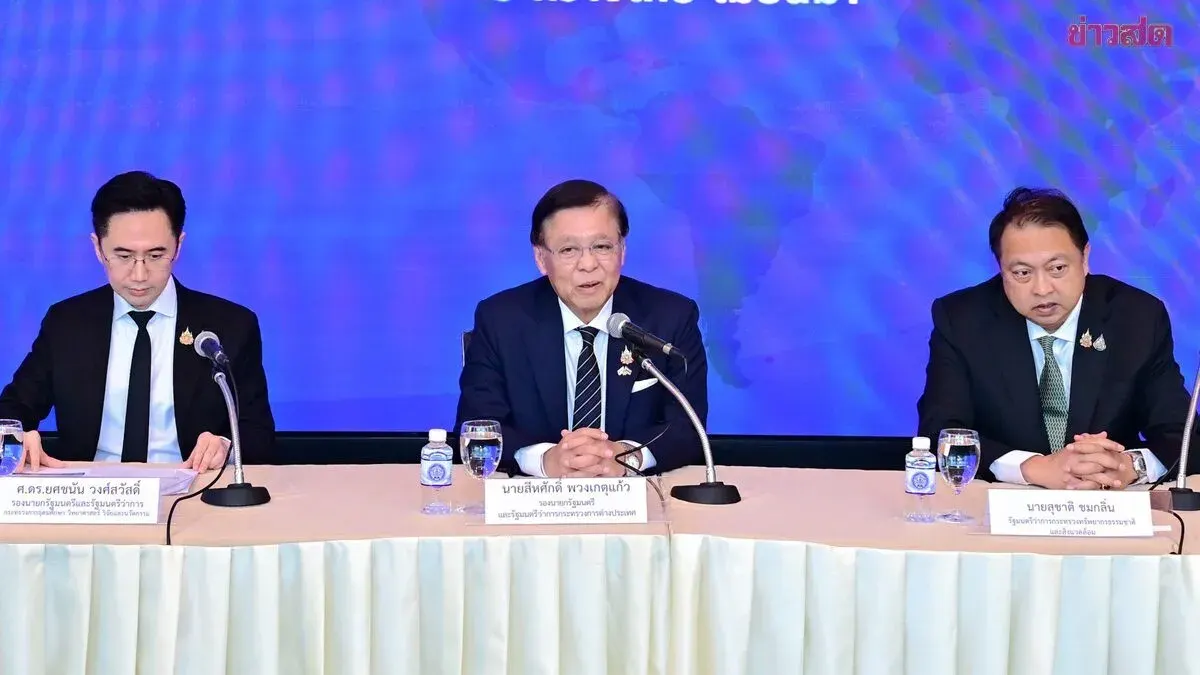
The Pheu Thai Party supports the government's comprehensive effort to resolve contamination in the Kok and Sai rivers, including controlling exports of precursor chemicals used in mining and employing international mechanisms to establish standards that reduce environmental impact. On November 24, 2026, Pheu Thai spokesperson Suthep Sriwichai, Deputy Secretary-General to the Prime Minister for Political Affairs, briefed on progress in tackling pollution in the Kok and Sai rivers. He said Deputy Prime Minister and Minister of Higher Education, Science, Research and Innovation Yashchanan Wongsuwat, in his capacity as chair of the Northern Disaster Prevention and Mitigation Committee, is driving solutions through three main approaches: addressing the problem at its source, using scientific evidence for international negotiations, and assisting communities affected by water contamination.
Regarding source control, Suthep said the government has elevated the issue to the international level. The Prime Minister and Yashchanan raised the matter with the Chinese President at the APEC summit, where China confirmed it does not support illegal activities. Separately, Yashchanan discussed the issue with senior Myanmar representatives at the ASEAN Summit in Manila, offering to send Thai experts and technology to help remove toxins in Myanmar-controlled areas if access is granted. From November 24-26, Thailand, Myanmar, and China will hold trilateral talks to agree on deploying joint field teams to collect samples and use academic data to determine joint remediation measures.
Simultaneously, the government will use the National Security Council mechanism to control exports of precursor chemicals used in mining, starting at border checkpoints. The Ministry of Industry and relevant agencies will closely monitor imports and exports of minerals. A joint field visit by Deputy Prime Minister Suriya Juangroongruangkit, Foreign Minister Yashchanan, and the Chinese Ambassador is scheduled for November 29.
Suthep added that Thailand will push on the international stage for a traceability system for rare earth minerals, ensuring industries using these minerals share responsibility for pollution cleanup and creating shared accountability across the supply chain.
The second approach uses scientific evidence for international negotiations. The government is utilizing satellite data from GISTDA to verify pollution sources, proving the location and expansion of mines potentially responsible for toxin releases, and using this as empirical evidence in negotiations. Meanwhile, Mae Fah Luang University's laboratory is being upgraded to efficiently test sediment and prepare contamination data.
At the same time, the government plans to distribute M-Sense water quality monitors to the Department of Disaster Prevention and Mitigation, the Ministry of Public Health, and the Ministry of Agriculture and Cooperatives to increase the speed and accuracy of water contamination testing, enabling more frequent monitoring at more locations.
The third approach focuses on downstream communities, particularly drinking water safety. The government has secured an additional reserve water source at the Nong Nam Phut reservoir, with a capacity of approximately 500,000 cubic meters, beyond sources prepared by the Department of Water Resources and the Royal Irrigation Department. Nanotech-developed water filtration systems from the Synchrotron Light Research Institute are being deployed into water supply systems, with the Ban Rim Kok system able to reduce lead in raw water by approximately...