Griffin Drone Delivers Food, Medicine During Flood Crisis
Military repurposes Griffin drone to deliver food and medicine to flood victims in Aranyaprathet District, Sakaeo Province, where ground access is limited. The Northeastern Army Command demonstrated how security technology can be adapted fo
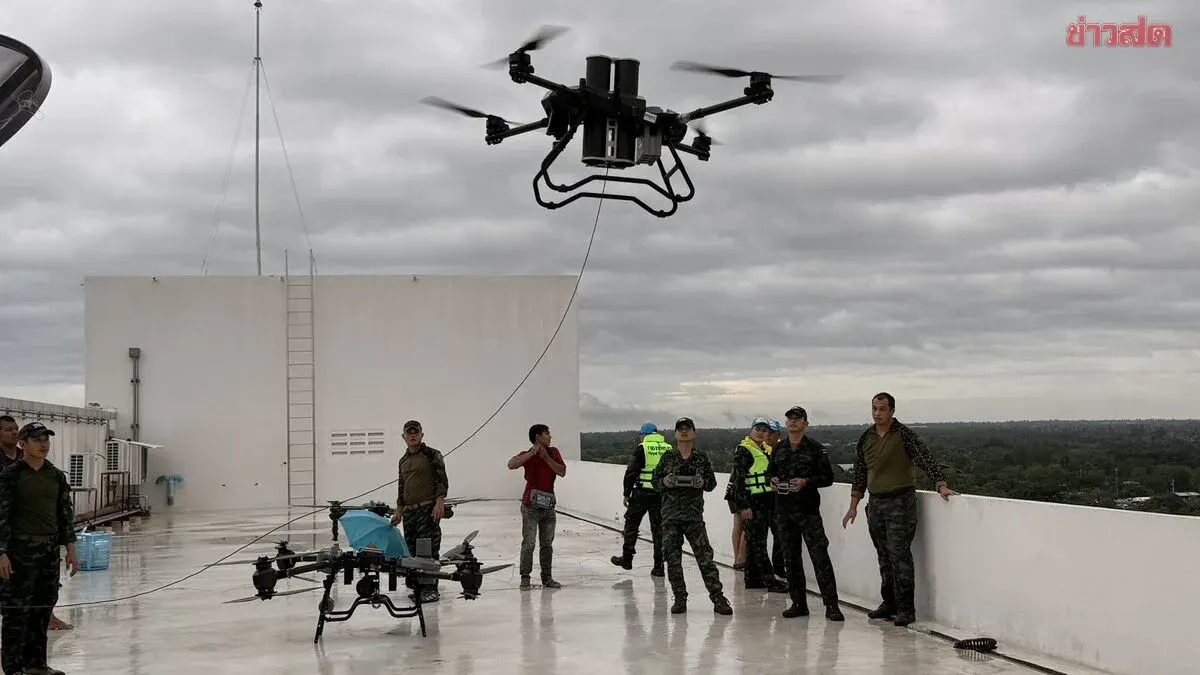
From border operations to humanitarian aid, the Griffin unmanned aerial vehicle, previously used to support security missions and military operations with cargo transport capability, has been repurposed to assist people affected by flooding in Aranyaprathet District, Sakaeo Province. The Northeastern Army Command's UAV operations team deployed the Griffin drone to deliver essentials including food and medicine to affected residents in areas where ground access is difficult, enabling rapid relief delivery through drone technology.
This mission illustrates that drone capabilities are not limited to security and combat missions but can be effectively adapted for disaster relief and humanitarian purposes. Once supporting border area operations, the Griffin drone has now become an important asset for emergency response, reflecting how the military is applying technology and capabilities for public benefit.
Meanwhile, the establishment of drone teams or UAV operations units across regional commands of the Royal Thai Army aims to enhance security and defense capabilities suited to modern warfare scenarios. Distributing drone teams across the four regional army commands enhances surveillance, reconnaissance, intelligence gathering, and unit mission support, particularly in the complex and rapidly changing border environment, with increased military and reconnaissance applications.
The Royal Thai Army's drone teams are organized by area and responsible units, including the Black Hornet Team under Regional Command 1, the Falcon Team under Regional Command 2, the Phoenix Team under Regional Command 3, and the LRRP 15 Team under Regional Command 4. The Special Warfare Command also operates the Peregrine Team, which handles UAV operations and related military applications.
Drone team development and anti-drone systems represent adaptation to emerging threats as drone technology is increasingly used for surveillance, intelligence, mission support, and combat in conflict areas. This same capability can also be applied for public benefit, as exemplified by the Griffin drone transitioning from border operations to delivering food and medicine to flood victims in Aranyaprathet, demonstrating military technology supporting both security and disaster relief missions.