Medical Sciences Department Unveils 20-Minute Urine Arsenic Test
Thailand's Department of Medical Sciences has developed a rapid urine test kit that screens for arsenic exposure in 20 minutes. An initial 2,000 kits will be delivered this December, with 10,000 total planned for distribution to local health units and subdistrict hospitals in at-risk areas. The test uses the Gutzeit chemical reaction method and is currently undergoing field trials with the Department of Disease Control before wider deployment.
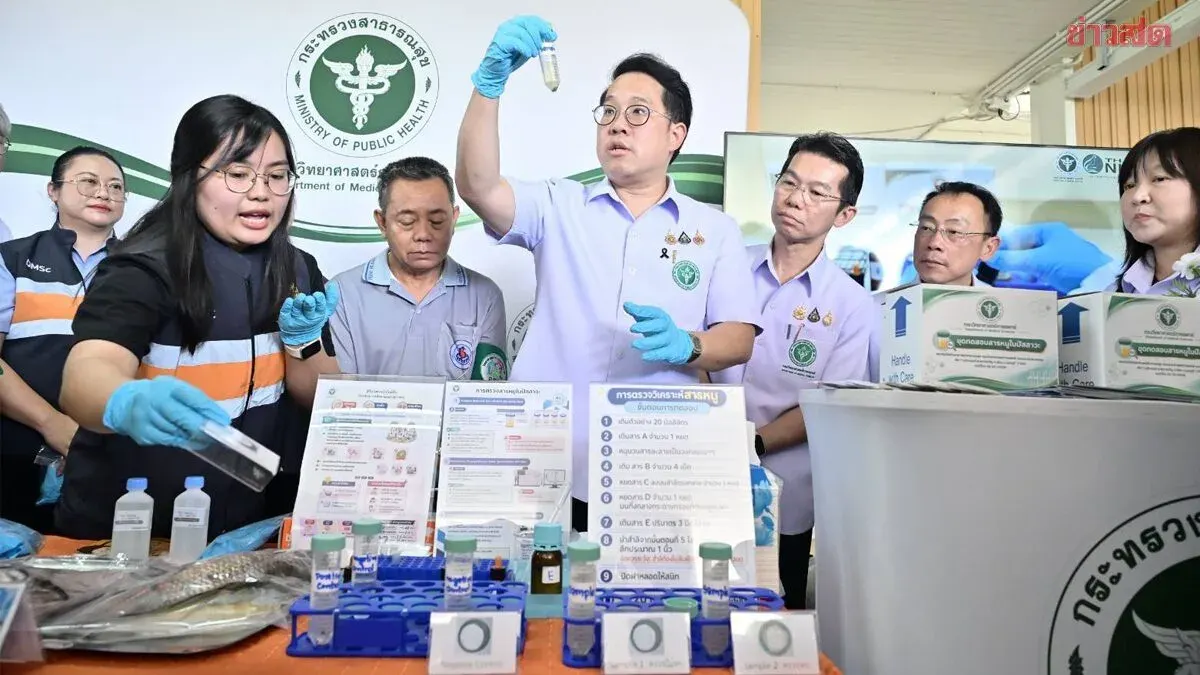
On November 25, 2026, the Department of Medical Sciences, Ministry of Public Health, accelerated development of a urine test kit for arsenic screening to identify people at risk of arsenic exposure. The test provides results within 20 minutes. The department plans to produce and deliver an initial 2,000 kits, followed by a total of 10,000 kits to local health agencies starting this December to support risk assessment and screening in vulnerable areas. There are also plans to further develop the test kits and transfer the innovation to the private sector for scaled-up production, enabling local agencies to conduct screening independently.
Dr. Adisorn Wattanasak, Director-General of the Department of Medical Sciences, disclosed that the Ministry of Public Health, led by Minister Phatthana Phromphat and Permanent Secretary Dr. Somruk Chuengsaman, tasked the department with developing a urine screening method for arsenic exposure to help local health units screen at-risk populations more quickly.
The department has successfully developed the test kit, which is currently undergoing field trials in collaboration with the Department of Disease Control, with an evaluation of field performance underway. In the first phase, 2,000 kits will be rushed into production and delivered before the full 10,000 kits are distributed to health units and subdistrict health promoting hospitals for screening in at-risk areas, helping to ease public concern. Deliveries are scheduled to begin this December.
The test kit serves as a preliminary screening tool to assess arsenic exposure in the population. If results warrant follow-up, confirmation will be conducted using specific, appropriate laboratory methods to ensure accurate assessment and proper care.
The Director-General explained that the kit uses a simple chemical reaction based on color change, known as the Gutzeit Test, a principle used to detect arsenic. Arsenic is converted into arsine gas (AsH3), which then reacts with a detection reagent such as silver compounds, producing a visible color change. The advantage is its uncomplicated principle and adaptability for field screening.
However, the Gutzeit method has limitations: it may be affected by interfering substances in urine, and the process involves toxic arsine gas. Therefore, appropriate safety controls are required, operators must be trained and follow procedures strictly, and future development aims to make the kit easier and safer for village health volunteers and medical technologists to use.
Dr. Adisorn added that the department plans to develop a next-generation urine arsenic test using electrochemical techniques requiring smaller urine samples, though interference factors in urine must still be addressed. Upon success, the innovation will be transferred to the private sector for production so that health units can conduct screening themselves.