The national park's own list of Koh Lanta's wildlife counts 38 mammals and 185 birds, and marks two big mammals as gone
Mu Ko Lanta National Park's page counts 38 mammal and 185 bird species and says the sambar deer and the tiger have disappeared, with the barking deer and fishing cat going the same way. It gives no dates.
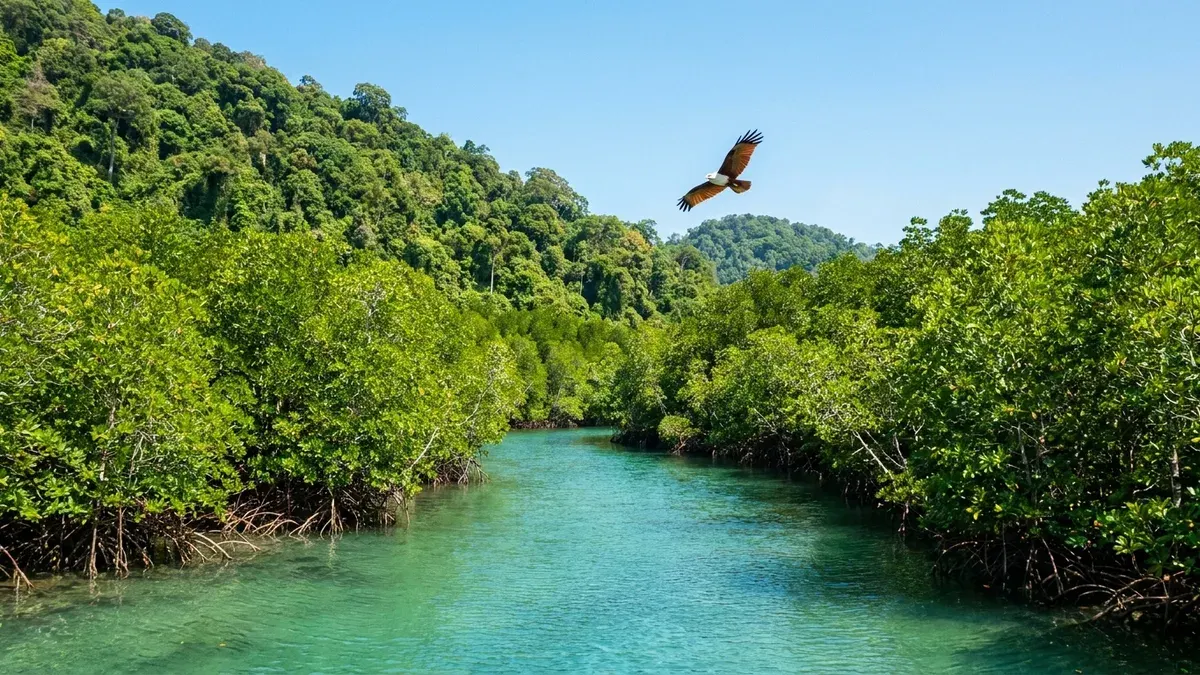
Photo: Illustration generated for Lanta News
Most writing about Koh Lanta's wildlife is about what you might see. The national park's own page does something less common: it lists what is no longer there. Two large mammals are marked as gone from the area, two more as on their way out, and the numbers around them are bigger than most visitors would guess.
What the park counts
The Department of National Parks page for Mu Ko Lanta National Park, which spans 25 islands in four groups, gives these totals. They are our translation from the Thai, and the page is undated.
- Mammals: 20 families, 30 genera and 38 species.
- Birds: 58 families, 130 genera and 185 species.
- Forest: 19.42 square kilometres of moist evergreen forest with a canopy averaging 15 to 25 metres, plus mangroves averaging about 5 metres on some of the small islands and beach forest on Ko Ngai.
The 185 birds matches a figure that circulates in other compilations of the same park, which our earlier piece on the island's animals was careful not to settle. It now has an official source.
What the park says is gone
Under its list of mammals the page names two it describes as having disappeared: the sambar deer (kwang pa) and the tiger (suea khrong). It gives no date and no source for when, so we cannot say how long ago that was.
It describes two more as disappearing: the barking deer (keng) and the fishing cat (suea pla). It lists Marshall's horseshoe bat as rare. And it names the dugong as a reserved species, which in Thai law is a category of strict protection. A dugong on this coast is a separate question from whether one is seen often, and the page does not say how many there are.
What the park says is still easy to find
Among birds, the page calls the brahminy kite and the green pigeon common, and lists the orange-breasted trogon and the little spiderhunter as hard to see. For reptiles it names the water monitor, a gecko and a python. In the water it names mushroom coral and staghorn coral among its corals, and a pufferfish among the fish.
One thing we left out
A line on amphibians says there are only two species while naming several, so we did not use it. We read the page through our own translation and may have misread a detail. If a figure matters to you, the park lists 0 7565 6576 for visit enquiries.
What we could not establish
When the tiger and the sambar deer disappeared, how the counts were made, how old the survey is, and whether the barking deer and fishing cat are still there today. The page is a snapshot with no date, and a species list in a park brochure is not the same as a recent survey. The illustration above is generated: a brahminy kite over a mangrove channel, not a photograph from the park.