Police Bust Chinese Nominee Networks Using Thai Frontmen
Chonburi immigration police dismantled two Chinese nominee networks that used Thai frontmen to illegally operate businesses and acquire property, including allocated housing. The investigation uncovered links to 54 companies and led to 26 arrest warrants for Thai and Chinese nationals, with assets valued over 35 million baht. Authorities are expanding the probe to trace financial trails and identify all participants in the scheme.
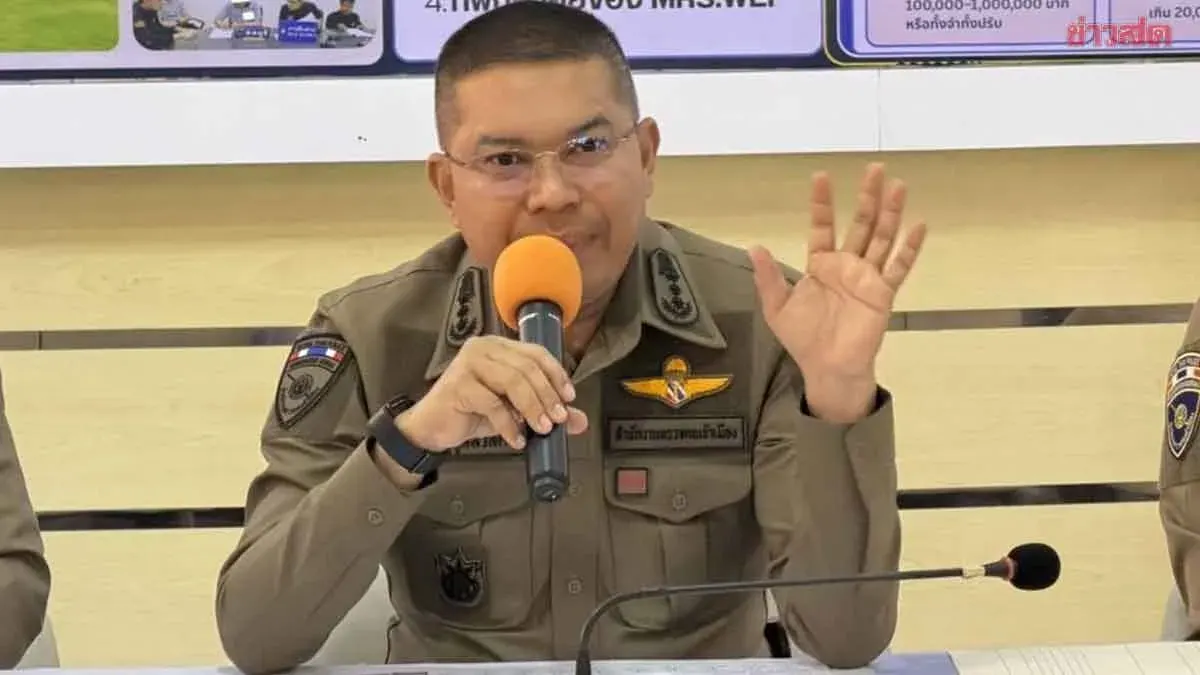
Chonburi Immigration Police Chief Pol Maj Gen Noppasit Poonsawat, accompanied by Pol Maj Gen Wasan Techa-akakasem, Deputy Chief of Immigration Bureau 2, Chonburi Governor Naris Niramaiwong, and senior immigration and local police officials, held a press conference at the Chonburi Immigration Checkpoint on November 22, 2026, announcing the results of an investigation cracking down on Chinese national networks using Thai nominees to conceal business operations and property ownership in violation of Thai law.
The operation stemmed from two major cases. The first originated on July 23, 2026, when Chonburi Immigration Police led by Pol Lt Col Kirawat Arayasuriwong and Pol Lt Col Kittiphat Hongchuwet, working with Tourist Police Division 4, responded to a distress call from a Chinese woman allegedly confined by a group of Chinese men at a house in Moo 4, Takhian Tia Subdistrict, Bang Lamung District. Officers located the house, rescued the victim safely, and arrested four Chinese suspects, three of whom had entered and stayed in the kingdom without permission. They were charged under Section 81 of the Immigration Act B.E. 2522 and jointly charged with unlawful detention under Section 310 in conjunction with Section 83 of the Penal Code.
Following the arrests, police discovered the rental house was registered under a corporate entity, prompting expanded checks into company registrations, shareholder structures, director boards, and business operations. Investigators uncovered suspicious patterns of Thai nationals holding shares on behalf of foreigners — "nominees" — with shareholding structures split 51:49 between Thais and foreigners.
The investigation identified a Mr. Sarawit as a key shareholder in multiple companies who registered firms, held shares, and recruited Thai nationals as nominee shareholders to establish companies for acquiring land and six allocated houses in a village linked to five Chinese and four Thai individuals. Crucially, Mr. Sarawit was found to hold shares in up to 54 companies. Authorities expanded their probe into these companies' operations, land and house ownership, and gathered witness testimony and documents to prosecute all involved parties.
The investigation secured court approval for 26 arrest warrants — 20 for Thai nationals and 6 for Chinese nationals — along with search warrants.