Gulf Development Company expanded its "Our Bottle" PET recycling program to seven Eastern Zone power plants, collecting 1,183 kilograms of used bottles between January and July 2025 for upcycling into monk robes, blankets, and clothing at J
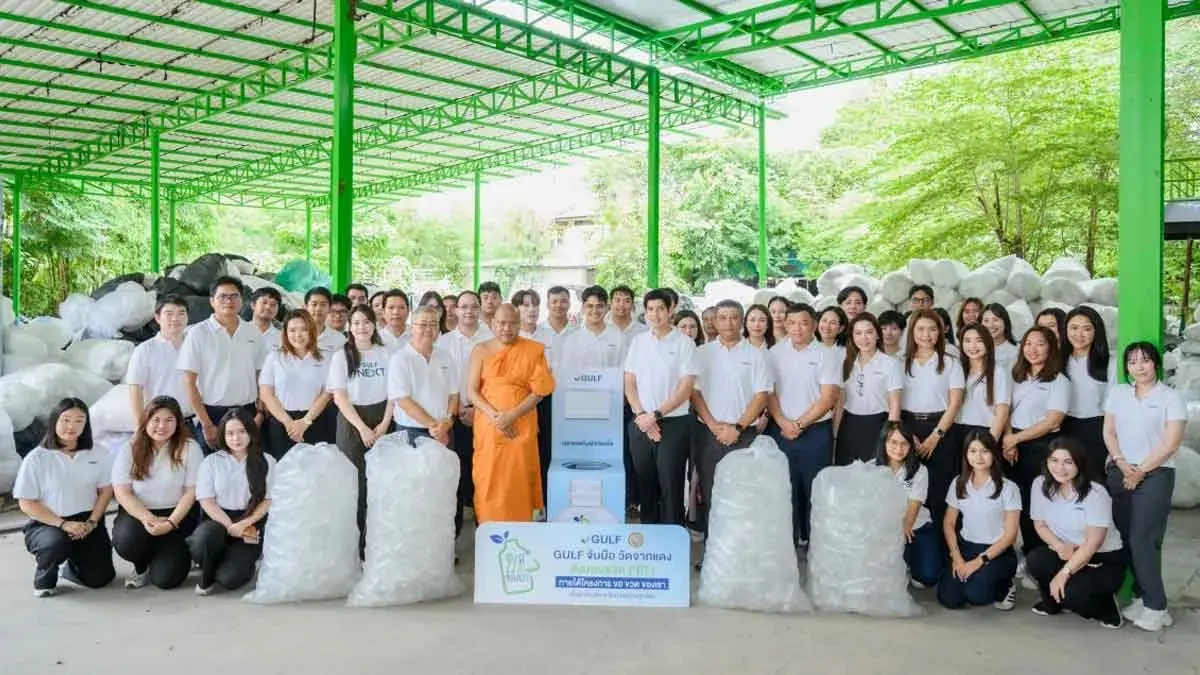
Gulf Development Company is expanding its environmental and waste-sorting culture through the second year of its "Our Bottle" programme, which has grown from its Bangkok headquarters to seven offices across the company's Eastern Zone power plant facilities. Employees are being encouraged to sort PET plastic water bottles from the source, and between January and July 2025, the initiative collected 1,183 kilograms of used PET bottles, which were donated to Jakdang Temple for upcycling into new products such as monk robes, blankets, clothing, and household items made from plastic bottle fibre.
The project has helped reduce greenhouse gas emissions by 2.48 tonnes of carbon dioxide equivalent. Sitamorn Rattanawadee, Strategic Planning Director at Gulf Development Company, presented the collected bottles to Phra Maha Pranorm Thammaleangkaro, Abbot of Jakdang Temple, on 7 August 2025 at the temple in Phra Pradaeng district, Samut Prakan province.
The "Our Bottle" initiative encourages employees to care for the environment through simple, everyday habits such as sorting PET water bottles, ensuring waste is properly managed and diverted from the environment while being transformed into useful new products. When materials are correctly sorted, waste becomes a resource with renewed value, reducing environmental burden and allowing resources to be reused efficiently.
This year the company expanded the programme from headquarters to Eastern Zone power plant facilities, collecting 1,183 kilograms of used PET bottles for upcycling. Since the project began in 2024, a total of 1,637 kilograms of PET bottles have been sorted, helping reduce greenhouse gas emissions by 3.42 tonnes of carbon dioxide equivalent.
This demonstrates that cultivating a culture of proper waste sorting and management within an organization, when carried out consistently and scaled widely, can create tangible positive environmental results.
Phra Maha Pranorm Thammaleangkaro, Abbot of Jakdang Temple, said the temple and Gulf collaborate on upcycling PET bottles into multiple products, including clothing and blankets made from the bottles themselves and keychains made from bottle caps for special occasions, creating benefits for society and the environment together. "If we view waste as rubbish, we must find somewhere to discard it, which is costly and damaging to the environment. But if we view it as raw material for production, benefits arise for ourselves, the world, and righteousness."
The abbot suggested that beyond managing external waste through sorting and reuse, everyone can practise managing internal waste—anger, resentment, and attachment—through mindfulness, loving-kindness, generosity, and effort, to create positive change for both self and society.
One employee participating in the programme said she was proud to be involved, and although sorting bottles in daily life seems small, knowing the final destination of sorted PET bottles and their benefits makes a difference. If this behaviour spreads continuously, she believes positive results will follow.