Poll Shows Government Flood Response Rated Poor, Relief Program Helps
Suan Dusit Poll shows the Thai government and prime minister received low scores for their flood‑response efforts, while the 'Thai Help Thai Plus Phase 2' program was seen as only partially easing living costs. The survey of 1,254 respondents found delayed warnings and perceptions of inadequate aid as the main shortcomings, with field troops rated highest among officials. Dr. Pornphan Buathong warned that growing public dissatisfaction could accumulate unless the administration quickly proves it is genuinely helping flood victims.
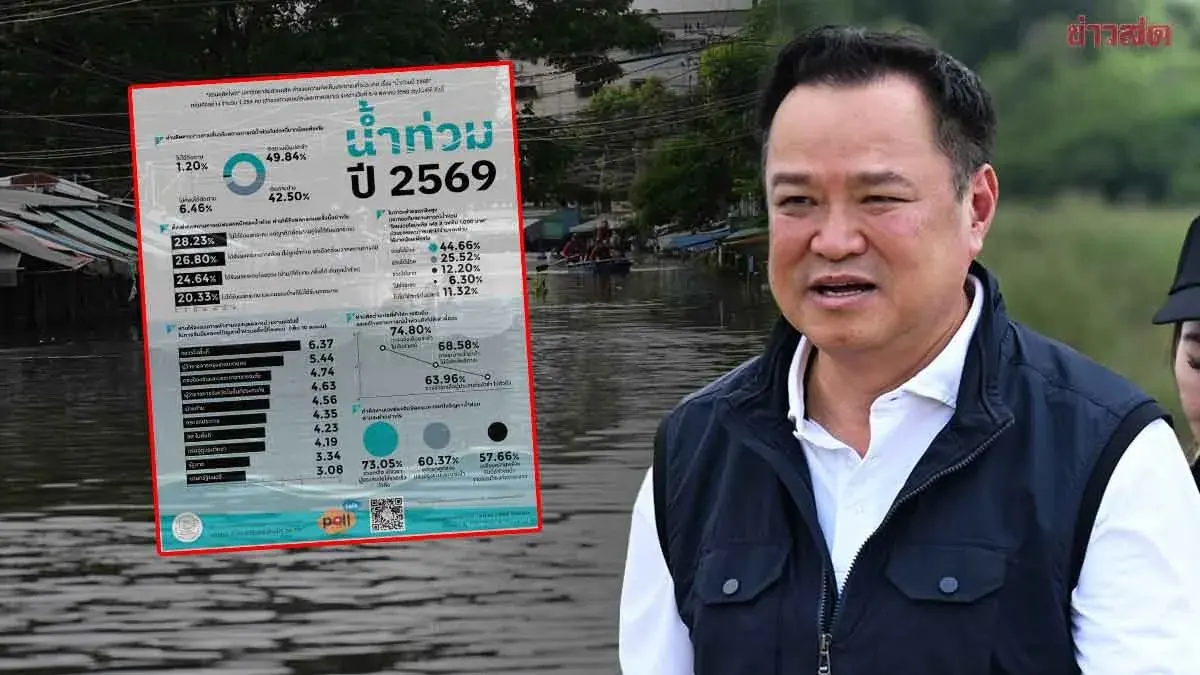
Suan Dusit Poll released its survey results showing the prime minister and government performed poorly in flood response, while the 'Thai Help Thai Plus Phase 2' initiative was viewed as offering some relief from living expenses. The survey, carried out online and in person between October 6 and 9, 2026, with 1,254 participants across Thailand, found that nearly half (49.8%) regularly monitor flood news, and over a quarter (28.2%) reported that relatives, friends, or acquaintances had been affected even though they themselves were not directly impacted. Given the high cost of living combined with flooding, 44.7% said the relief program helped ease financial burdens somewhat. In rating flood management, respondents gave field troops 6.37 out of 10, the Bangkok governor 5.44, the Department of Disaster Prevention and Mitigation 4.74, provincial governors in affected areas 4.63, the opposition 4.56, the Irrigation Department 4.35, local members of parliament 4.23, the Meteorological Department 4.19, the government as a whole 3.34, and the prime minister 3.08. The main shortcomings cited were delayed warnings (74.8%) and the belief that personal responsibility would lead to faster, more comprehensive aid (73.1%). Dr. Pornphan Buathong, director of Suan Dusit Poll, said the floods caused extensive household damage and that the low scores for the government and prime minister reflected a gap between official performance and public expectations, warning that prolonged dissatisfaction would accumulate unless the administration swiftly demonstrates genuine relief efforts.