Rare Thai Buddhist Amulets: Sing-Sao Coins Explored
The user wants a short summary of the article about rare Thai Buddhist amulets, specifically Sing-Sao coins. The summary must be in English, 1-2 sentences, 120-220 characters max (never more than 240), factual, plain English, no filler, lea
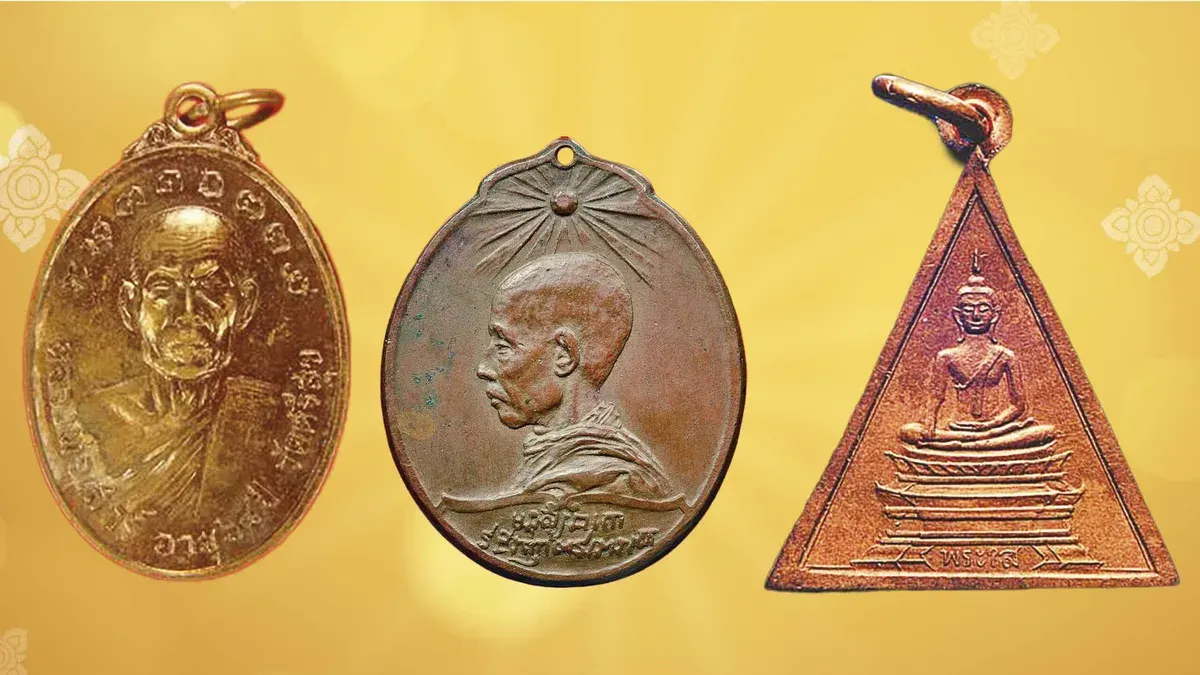
“Defilements are the masters who torment fools.” — a Dhamma teaching by Luang Por Cha Supatto of Wat Nong Pa Phong, Ubon Ratchathani. Somdet Phra Maha Saman Chao Krom Phraya Vajirananavarorasa served as the 10th Supreme Patriarch of the Rattanakosin era, residing at Wat Bowonniwet Vihara. His commemorative coin was minted in 1920 (BE 2463) for the royal cremation ceremony marking his 60th birthday. The oval coin measures 2.8 cm wide and 3.5 cm long with a suspension loop. The obverse features a half-length portrait of the Supreme Patriarch facing left, a radiant diamond above symbolizing “Vajira,” and Ariyaka script below — invented by King Rama IV — reading “Manussanako Vajirananavarorasa.” The reverse shows a blooming lotus above water with a Pali inscription in the center reading “Abhivadanasilissa nicca vuddha pajanino jataro dhamma vuddhanti ayu vanno sukham balam” (meaning: one who respectfully salutes and humbles oneself before elders, cultivating the four virtues of longevity, reputation, happiness, and strength). The bottom bears the numerals “2463” indicating the year of minting. This coin is considered rare.
Luang Pu Sing Khampiro, former abbot of Wat Si Suk in Kantharawichai District, Maha Sarakham Province, a renowned meditation master of the city of Takkasila, commissioned the first batch of Sing-Sao amulets in 1978 (BE 2521) for donors who contributed to building the ubosot of Wat Ban Si Suk. The oval amulet’s obverse depicts Luang Por Sao Sirijantho from the waist up, facing forward near the top edge, with Khmer-script heart mantras of the four elements. Along the left edge curving to the bottom right, Thai script reads “Luang Por Sao, age 68, Wat Si Suk.” The reverse shows a half-length portrait of Luang Pu Sing with Lao-script Khmer characters above forming a heart mantra for attracting fortune, curving from left to right along the lower edge. Thai script along the left edge curving downward reads “Phra Upajjhaya Sing, age 53, 2521.” Luang Por Sao was Luang Pu Sing’s older brother and also a meditation master. Amulet collectors in Sarakham refer to this batch as “Sing-Sao coins.” No more than 1,000 were cast in a single bronze alloy, and disciples compete fiercely to acquire them as personal treasures.
Luang Por Phai Sai, the principal Buddha image of Nong Khai city, is enshrined at Wat Pho Chai, a royal temple. Many amulet batches bearing his likeness have been produced, but the most popular is the “First Batch Luang Por Phai Sai Coin” created in 1942 (BE 2485) by Phra Wetiwutthikorn, former abbot of Wat Pho Chai. The triangular coin with a suspension loop is cast in bronze. The obverse shows Luang Por Phai Sai on a pedestal with the word “Phai Sai” on the base; the inner rim is sharp, matching the sharp fold at the left elbow, a rounded dot, and a fracture line at the left knee — key hallmarks of this batch. The reverse displays a large, clear yantra design with a rounded dot inside the head of the letter “O,” a crucial observation point.
Luang Por Teng Khankasuvanno, a famous meditation master of Wat Sam Ngam (a forest monastery) in Don Tum District, Nakhon Pathom Province, is renowned for his Khuman Thong (golden child) amulets. His most accepted amulet is the “First Batch Luang Por Teng Coin” made in 1943 (BE 2486) by his disciples together with Wat Sam Ngam, Nakhon Pathom. The obverse portrays Luang Por Teng wearing his robe draped over one shoulder.