CP Group Launches Forest Tokenization for Natural Capital Economy
CP Group is launching Reforest Tokenization, a digital system converting forest conservation into economic assets through carbon credits and natural capital valuation, with an initial pilot covering 10,000 rai across northern Thailand to pr
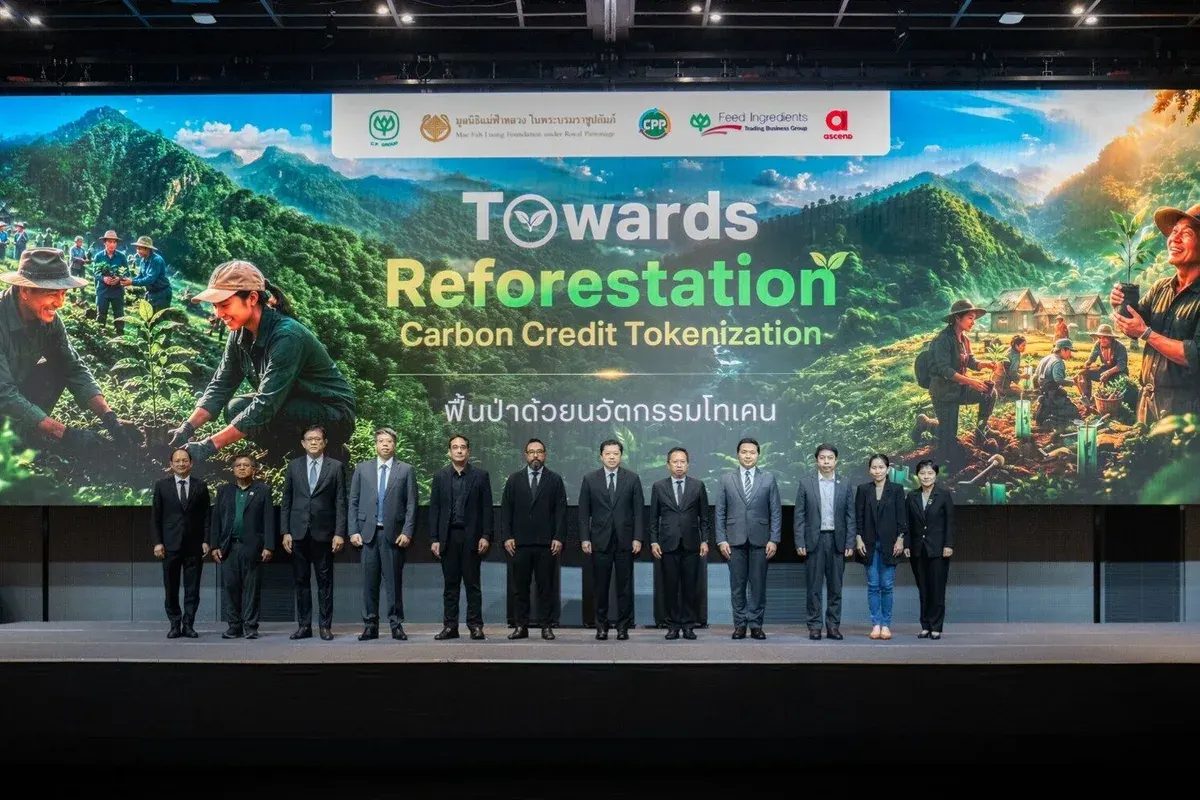
Bangkok, July 8, 2026 – CP Group has unveiled Reforest Tokenization, a green economy model designed to elevate Thailand's "natural capital" into the digital economic system by using technology to transparently and verifiably connect the value generated from forest restoration and conservation to economic mechanisms. The company is piloting the initiative with the Mae Fah Luang Foundation under Royal Patronage as its first partner, covering over 10,000 rai in Chiang Mai, Chiang Rai, and Tak provinces to develop a prototype that generates community income while advancing Thailand's natural capital economy. Carbon credits serve as the starting point before expanding to broader natural capital value creation across ecosystems, biodiversity, water resources, and community contributions to forest stewardship.
Suphachai Chearvanon, Senior Vice President of CP Group, stated: "Future forest conservation requires creating 'economic incentives' so forest communities can earn more from preservation than from resource-destructive activities. This inspired the Reforest Tokenization concept, which elevates forests to digital assets or natural capital, linking conservation with economic mechanisms and enabling all sectors to participate tangibly in natural resource management."
Chearvanon highlighted that forests absorb 31% of human-caused carbon, provide 75% of the world's freshwater, house 80% of terrestrial wildlife, and sustain 90% of the world's poorest populations. Between 1990 and 2025, forest area in the Mekong River basin declined continuously, with Cambodia losing 42%, Laos 9.5%, Myanmar 3.9%, and Thailand 2.9%. While Thailand has preserved forests better than regional neighbors, the goal extends beyond maintenance to forest expansion while addressing wildfire and PM2.5 challenges.
Drawing from fieldwork experience with the Mae Fah Luang Foundation in Nan province, Chearvanon explained that forest conservation's heart lies not merely in tree-planting but in enabling communities to coexist with forests sustainably, with quality livelihoods and stable careers. Without sufficient income, forest pressure persists. While global carbon credits reflect carbon absorption value, forests hold far greater worth—watershed protection, biodiversity, wildfire prevention, and community care. Reforest Tokenization converts these values into economic worth through carbon credit tokenization, incentivizing participation while channeling revenue to forest-steward communities, transforming forests into valuable assets and creating stable livelihoods.
CP Group has begun piloting the model with the Mae Fah Luang Foundation, developing transparent and verifiable systems. If approximately 200 households managing roughly 10,000 rai gain an additional 10,000-15,000 baht monthly from conservation alongside high-value crop cultivation, conservation incentives would replace forest destruction, creating a replicable prototype for nationwide and regional expansion.