Revered Buddhist Monk Luang Pho Pring Honored in Suphan Buri
Luang Pho Pring, a revered Buddhist scholar and former abbot of Wat Vorajun in Suphan Buri, was honored for his exceptional contributions to Buddhist scholarship and temple development after being ordained in 1888.
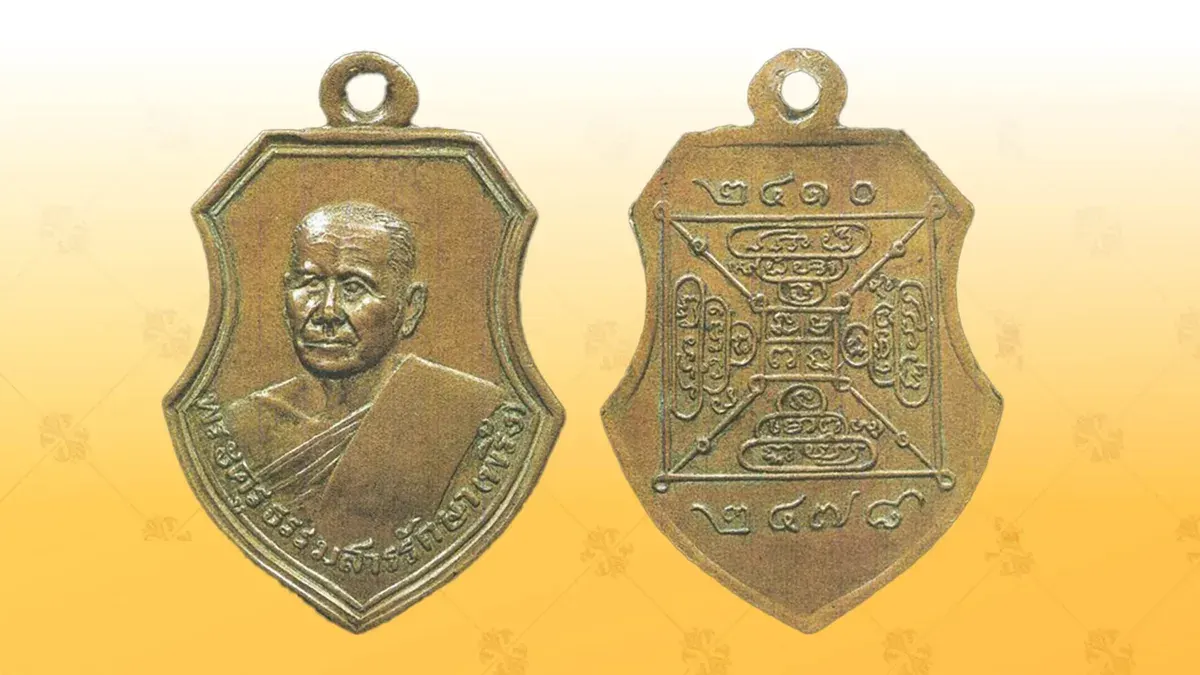
Phra Kru Tham Sarn Raksa, also known as Luang Pho Pring Wachira Suwanno, was the former abbot of Wat Vorajun in Phothipraya subdistrict, Muang district, Suphan Buri province, and served as deputy sangha leader of the province. A renowned and respected Buddhist scholar, he was originally named Pring and was born in 1866 (B.E. 2409) in a house south of Wat Phrao's western water gate. His parents, Nai Tiap and Nang Riean, sent him to study at Wat Phrao at age twelve, where he proved to be an exceptionally intelligent student, quickly mastering Thai script, Khmer script, and Buddhist chants. As a young man, he assisted his parents with rice farming while establishing a secure household with servants. In 1888 (B.E. 2431), at age twenty-one, he was ordained at Wat Phrao's ordination hall, with Luang Pho Kaew serving as his preceptor, Phra Kru Pluem as his instructor in precepts, and Phra Kru In, the provincial sangha leader, as his ceremonial witness. He studied under Phra Kru In at Wat Phrao for one year, then was sent to study at the seminary at Wat Mahathat Yuwarat Rangsrit in Thonburi for approximately seven years before returning to Wat Phrao with expertise in Buddhist scriptural studies.
When ten years had passed since his ordination, a severe drought struck Phothipraya, leaving residents without rice and in great hardship. Because many monks at Wat Phrao received insufficient alms, they moved elsewhere. Luang Pho Pring spent one rainy season studying at Wat Nong Phak Nak in Samchuk district before returning to Wat Phrao for five more years, bringing his total ordination to sixteen years. Subsequently, when Wat Vorajun needed an abbot, the community unanimously requested him to assume the position.
Wat Vorajun, located in northern Phothipraya subdistrict, was established over a hundred years prior to 1834 (B.E. 2377), originally consisting only of two or three wooden and bamboo huts with thatched roofs near an old reservoir under a mango tree. In 1933 (B.E. 2476), the temple was renamed from Wat Chan to Wat Vorajun, with the prefix "Vor" meaning excellent and supreme, at the direction of Phra Ubaligunaupamacharn (Pheuan Tissadatto) of Wat Phra Chetuphonawimaolmankalataram, who held the rank of Phra Thammapit and served as provincial sangha leader of Ratchaburi. He observed that the original name Wat Chan conflicted with Wat Chanyai in Sri Prachuap district, about eight or nine kilometers away, causing frequent government correspondence errors. Upon assuming the position of abbot, Luang Pho Pring undertook major temple restoration work. Before his arrival, the temple had only one well-maintained wooden hall with a thatched roof; he subsequently added and renovated many kutis (monks' residences), a chanting hall, a riverboat pavilion, and other structures.
According to the chedi records, during the reign of King Chulalongkorn (Rama V), the king had ordered Chao Phraya Yommaraj, then serving as Phraya Sukhumnaywinit, provincial commissioner of Nakhon Si Thammarat, to represent Thailand in traveling to India to receive a Buddha relic. Upon its return, the king selected a portion to enshrine at the summit of Khao Thong at Wat Saket. However, a remaining fragment of the relic remained in its container, which the king presented to Chao Phraya Yommaraj, who subsequently presented it to the temple.