Revered Monk Luang Por Maen of Wat Yai Pohak
Luang Por Maen, a revered Buddhist abbot at Wat Yai Pohak in Ratchaburi Province, was born in 1891 and became known for his spiritual teachings, temple restoration efforts, and highly sought-after amulets.
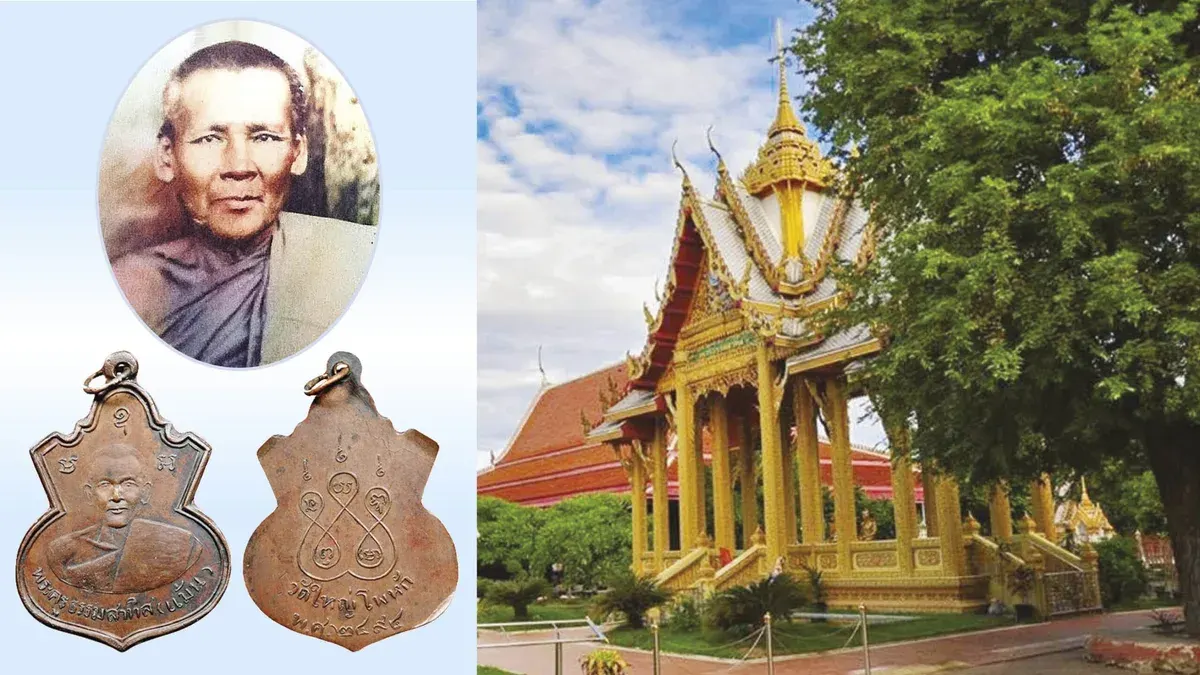
Phra Khru Thammmasathit, or Luang Por Maen Thammmasaro, of Wat Yai Pohak in Bang Pae District, Ratchaburi Province, was a celebrated Buddhist abbot whose amulets are highly sought after for their spiritual potency and authenticity. He was born on April 23, 1891, as a native of Po Hak Subdistrict, the son of Nai Thong and Nang Mong Tim Buthorn. During his youth, he studied Thai and Pali texts with Luang Por Klom at Wat Yai Pohak. At age 21 in 1912, he underwent ordination at Wat Yai Pohak, with Luang Por Daeng of Wat Tham Nop serving as his preceptor, Phra Athikan Dam of Wat Chindaram as his recitation master, and Phra Athikan On as his witness. He received the monastic name Thammmasaro.
He spent his monastic career studying under many revered masters across Ratchaburi, Nakhon Pathom, Samut Sakhon, and Samut Songkhram provinces, including Luang Por Klom of Wat Pohak, Luang Por Daeng of Wat Tham Nob, Luang Por Chaem of Wat Don Seng, Luang Por Dam of Wat Chindaram, and Luang Por Rung of Wat Don Yai Hom. He also studied closely with Luang Por Ngern of Wat Don Yai Hom and Luang Por Sai of Wat Nong Songkhop.
In 1917, when the position of abbot at Wat Yai Pohak became vacant, the monastic community appointed him to lead the temple, a position he held with great dedication and skill. He painstakingly restored the dilapidated temple and served the Buddha's teachings with steadfast commitment. Regarding Wat Yai Pohak itself, it is an ancient temple of Ratchaburi Province. According to local accounts, when the city of Ayutthaya fell, refugees fleeing the war arrived at a settlement with ox-drawn carts laden with their possessions. The oxen became exhausted and could no longer continue, so the villagers unloaded their belongings and hung them from a bodhi tree, which subsequently broke under the weight. This area became known as "Ban Pohak" (Broken Bodhi), and a temple was later established there.
Wat Yai Pohak, originally constructed in 1734 and granted ecclesiastical boundaries in 1950, houses an ancient scripture hall and Buddha image. In 1920, Luang Por Maen was appointed as the abbot of Po Hak Subdistrict despite his relatively short monastic tenure. He received his ecclesiastical rank of Phra Khru Chantha in 1937 and was formally granted the title Phra Khru Thammmasathit in 1949. He was renowned for his compassion and skilled oratory, earning deep respect from the local people. He also promoted education and established a primary school for the community.
Later appointed as a preceptor, he oversaw the ordination of many young men into monkhood. Known for his generous spirit, he would travel by horse to conduct ordination ceremonies wherever invited, never refusing a request. His miraculous knowledge and abilities became legendary among the villagers. There are accounts of him directing villagers during the excavation of the Klongpa Luang canal, instructing them to perform a ritual apology before continuing; when they did, they discovered skeletal remains of an ancient giant standing eight cubits tall. People came to believe he possessed supernatural insight and foreknowledge of events, attributing this to his spiritual power and wisdom. He passed away on May 16, 1955, at the age of 65, having completed 44 years of monastic life.
He is regarded as one of the most sought-after amulet masters in Bang Pae District, with his amulets achieving widespread renown and commanding high respect. Most notably, his first-edition amulets, cast in 1951, featured a water-droplet shape with integral loops, crafted with exceptional quality and spiritual merit.