Samut Songkhram's Ancient Treasures Preserved in Riverside Museum
A private museum in Samut Songkhram's Bang Noi Floating Market preserves roughly 4,000 ancient artifacts—mostly pottery from the 10th to 18th centuries—salvaged from the Mae Klong River over two decades by its owner.
Samut Songkhram is an ancient city with a documented history dating back to the Ayutthaya period. Originally a district of Ratchaburi called 'Suan Nok,' it was later separated during Ayutthaya and established as 'Muang Mae Klong,' eventually becoming Samut Songkhram. The province holds significant historical importance as King Taksin the Great's base for gathering Chinese mercenary forces to reclaim Thai independence, with the camp located in Bang Khun subdistrict, Bang Khunthi district.
Floating markets remain the province's signature attractions. Amphawa Floating Market in Amphawa subdistrict opens Friday through Sunday and on public holidays from 10 a.m. to 9 p.m., with continuous community-tourism events. Tha Kha Floating Market in Tha Kha subdistrict, Amphawa district, operates only on Saturday–Sunday and public holidays from 6 a.m. to 2 p.m., with the morning recommended for the liveliest atmosphere as vendors paddle boats laden with fresh fruits and local food until around 11 a.m. Bang Noi Floating Market in Kradang Nga subdistrict, Bang Khunthi district, opens every Saturday and Sunday from 8 a.m. to 8 p.m., offering a classic market experience in the morning with fresh vegetables and fruits, and lively dining scenes in the evening.
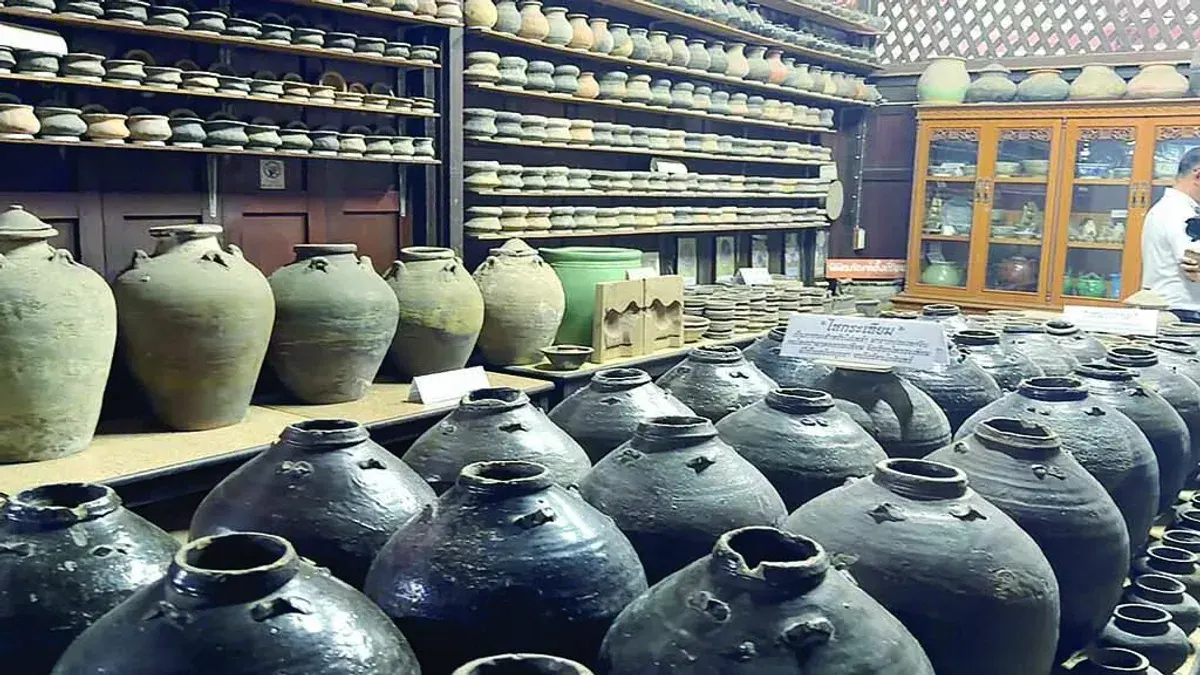
Within Bang Noi Floating Market at house number 90, Moo 8, stands the Tangsiam Ha Museum (Ban Hai Pan Bai), housing a vast collection of ancient artifacts. Museum owner Thawatchai Pisetkosalai, 69, explained that approximately 4,000 artifacts are displayed, with roughly 80 percent salvaged from the Mae Klong River. Most pieces are ancient household pottery such as water jars, palm sugar pots, lime containers, cooking vessels, and garlic mortars, ranging from 100 to 1,000 years old and spanning the Dvaravati, Sukhothai, Ayutthaya, and early Rattanakosin periods.
These artifacts sank because in ancient times there were no dams. When floods occurred or boats capsized during trade, goods fell to the riverbed and were naturally preserved underground. Thawatchai recounted that his collection began in 1983 when he witnessed divers selling Mae Klong artifacts to Bangkok merchants near Wat Koh Kaeo. Moved by the loss of national heritage, he gradually purchased and accumulated items over 20 years before opening the museum in 2001, before Bang Noi Floating Market was established, to educate future generations.
"Previously the museum was open Saturday and Sunday, but my wife Prapee Pisetkosalai, the principal caretaker, passed away, leaving no one to maintain it and making permanent operations inconvenient," Thawatchai said. "However, I'm still willing to open for groups to promote the preservation of Thai wisdom." Interested visitors can arrange tours any day by calling 0-3476-1098 or 08-9666-1214.