Thai Army Briefs ASEAN Observers on Border History, Refugee Aid
The Royal Thai Army hosted ASEAN observers and international media at the Khao I Dang History Learning Center in Sa Kaeo Province to highlight Thailand's historical humanitarian aid to over 160,000 Cambodian refugees. The tour aims to counter narratives from a Cambodian film that portrays Thai soldiers negatively and to assert that long-term residence does not legitimize territorial encroachment. Officials stressed Thailand's adherence to legal mechanisms and called for accurate international understanding of the border situation.
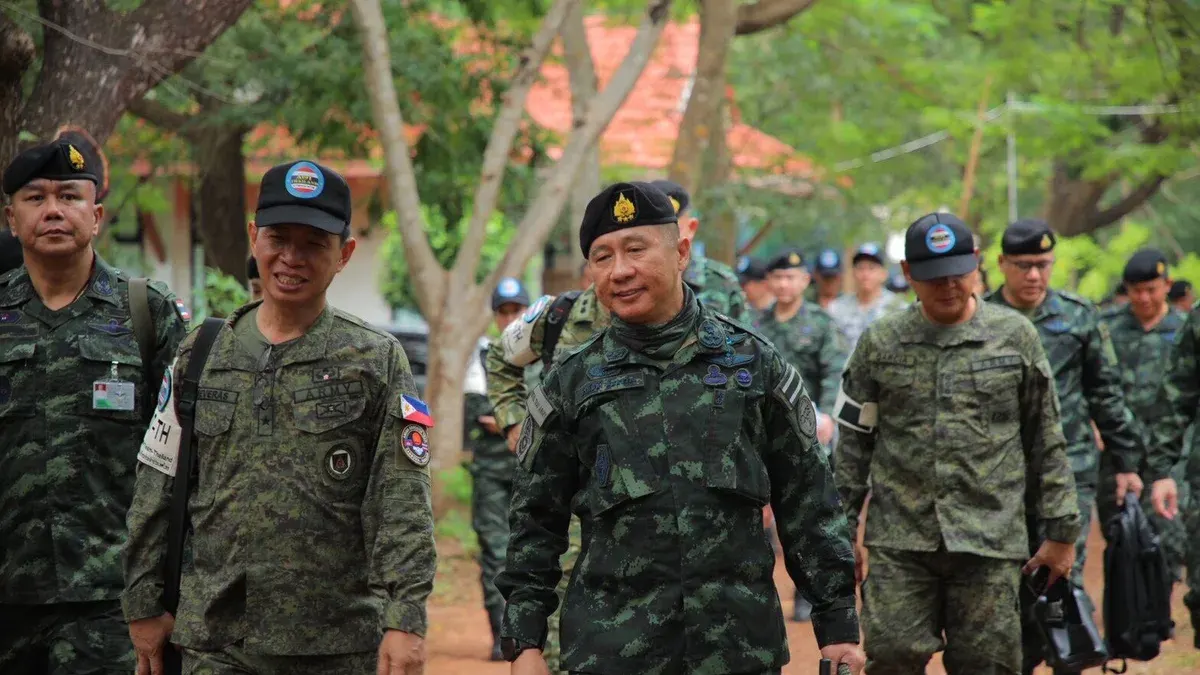
The Royal Thai Army opened the history of Khao I Dang, bringing ASEAN Observers to Thailand (AOT-TH) and foreign media to review the genuine humanitarian role on the ground, emphasizing Thailand helped over 160,000 Cambodians flee danger and stressing that continuous residence does not make encroachment a right. This follows Cambodia's production of the film "Ghost Mountain: Second Killing Field," which presents content about events in the Thai-Cambodian border area and released a poster depicting Thai soldiers negatively. Recently, the Army led AOT-TH along with Thai and foreign media to the field in Khok Sung District, Sa Kaeo Province, to monitor the Thai-Cambodian border situation and present historical information and Thailand's role in providing humanitarian assistance to Cambodians in the past in Sa Kaeo Province.
Lt. Gen. Winthai Suwaree, Army spokesperson, said the field visit follows the policy of Gen. Phana Klaewplodthuk, Army Commander, who assigned Lt. Gen. Theeranan Nantakhwang, Deputy Army Chief, to lead the delegation of AOT-TH and media to observe the situation and operations of the Burapha Force, as well as learn historical facts and background of the area for a comprehensive understanding, while also morale-boosting troops on duty along the border.
The delegation visited the Khao I Dang History Learning Center, which once sheltered over 160,000 Cambodian refugees on more than 400 rai, to hear a briefing on Thailand's role in aiding Cambodians fleeing conflict, war, and famine. At that time, large numbers of civilians abandoned their homes and crossed into Thailand seeking safety. Thailand provided shelter and coordinated with international organizations to supply food, water, medical care, and necessities on humanitarian grounds, while ensuring the safety of refugees and Thai civilians along the border.
The delegation then visited the Nantawong Base at Ban Nong Chan, Non Mak Mun Subdistrict, which the Burapha Force has upgraded for comprehensive area management. The Ban Nong Chan area was originally a temporary refugee center for Cambodians fleeing war before becoming a permanent settlement with expanded agriculture and construction under Thai sovereignty. The briefing compared historical maps and photos with current conditions to illustrate the community's evolution and land-use changes. Thailand has continuously pursued negotiations and problem-solving through cooperation mechanisms and relevant laws but has not received adequate cooperation from the Cambodian side.
Thailand affirms that continuous residence does not legitimize encroachment, and unauthorized occupants must enter the Thai legal process.
Lt. Gen. Winthai said the visit is also crucial for presenting facts to the international community, as Cambodia continues to raise border issues on international stages regarding land status and affected populations. Thailand views such information as inaccurate and potentially misleading regarding humanitarian allegations. Opening the area to ASEAN observers and media allows them to verify facts and inspect actual conditions.