Rare Buddhist amulets created by legendary Thai masters—including 19th-century powder amulets from Chachoengsao and commemorative pieces from spiritual leaders in Ratchaburi and Chanthaburi—command high prices among collectors due to their
A reflection on modern Buddhist practice notes: "Today people worship to gain, to ask, to earn merit for heaven and nirvana, hoping for results in this life and the next—a condition that has become a lasting spiritual affliction." This teaching comes from Luang Pho Cha Subhaddo of Wat Nong Pa Phong in Ubon Ratchathani.
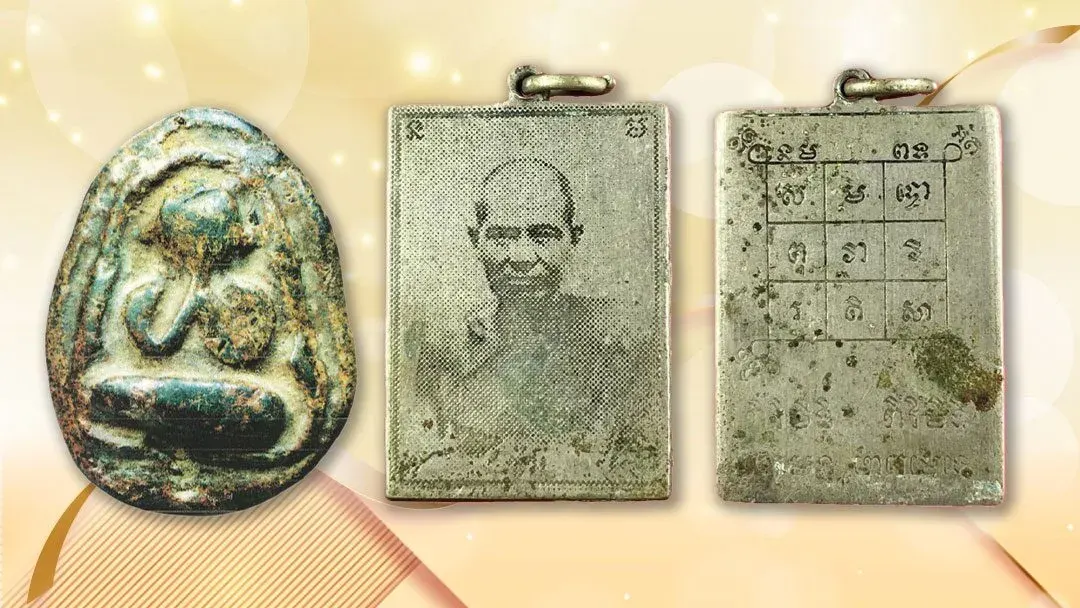
Among the oldest and most renowned "closed-eye" powder amulets in Chachoengsao province is the work of Luang Pu Chin from Wat Tha Lad Nuea, believed created around 1887. These amulets were made from blessed powder mixed with various sacred herbs, bound together and pressed into multiple mold designs including ankle cushion, bead cluster, large and small lotus petal, and cart support patterns. Most feature raised backs styled like roof edges or ridges, with multiple protective layers applied. Production occurred in limited batches over several periods because the manufacturing process was extraordinarily difficult, making authentic examples extremely rare and expensive today. Luang Pu Chin's powder amulets are considered the foundational prototype for this amulet type in the region.
Luang Pho Chum Buddhisaro of Wat Rajakom in Ratchaburi city was a highly respected spiritual master who created various sacred objects including talismans, amulets, and rings—particularly the prized "stamp coins" made in 1941 as commemorative pieces for supporters of the temple. These consisted of two small aluminum sheets featuring his image, embossed and hinged together, manufactured in Japan and commonly called stamp coins or shadow coins. The exact production quantity remains unclear.
The front displays a mesh pattern with his half-length image and four Khmer letters at the corners reading Na Ma Pa Tha (heart element), with "Chum" inscribed below. The back features a nine-cell auspicious yantra grid in the master's distinctive style, with four directional Khmer letters reading Ud, Ad, Pad, Pid along the corners. A Khmer inscription appears below the yantra grid. These are considered rare sacred objects highly sought by amulet collectors and Ratchaburi devotees.
In 2016, Luang Pu Tuan Pussavaro of Wat Chan Khunaram (Wat Pong Yang) in Kaeng Hang Maew, Chanthaburi, a renowned spiritual master, produced "ancient-style cast Sakyamuni amulets" in the Fulfillment edition to raise funds for permanent temple restoration. Created in multiple materials, these amulets feature an unbordered front with a triple-tiered seated Buddha image in glass encasement, a flat unbordered back with a "bell" code stamp and temple code, and Thai numerals identifying each piece—another valuable sacred object.
Returning to 2000, Luang Pu Tee Yanasophanom, former abbot of Wat Luang Rajawas in Udon Thani city, a renowned spiritual master of the Sak Kreng river region who was 88 years old, created "Buddha-image coins" in one edition: 188 silver pieces and 3,000 copper pieces. These large spherical coins lacked ear loops and featured a two-tiered border, with the center containing the Iti Piso 56 Buddhist Powers chant with Buddha imagery. Guardian yantras of Na the Great or Na the Millionaire flanked the Buddha image with Khmer letters below, while Khmer characters of the heart-mantra chant circled the border with temple code beneath the image.
The reverse featured a single-tier border with a five-row Khmer character grid in the center and directional Khmer letters at the four corners, with Thai script below the border reading "Buddha-image coin."