Thailand and China Launch Joint Business Cooperation Framework
Thailand and China launched a joint business cooperation framework through their chambers of commerce to streamline investment coordination and boost Thai business participation in Chinese-funded projects across industrial zones.
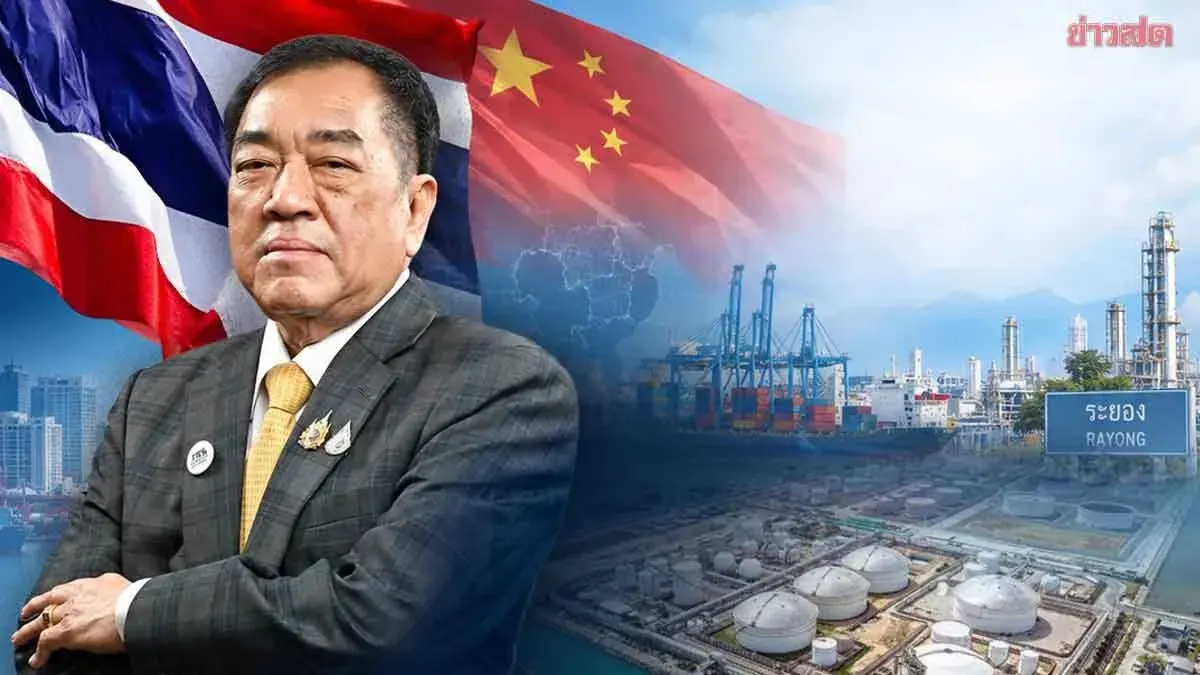
The Thai Chamber of Commerce has partnered with the Chinese Businessmen Association to drive business cooperation between Thailand and China, enhance workforce capabilities, and increase Thai business participation in production. Pol Aramwattananont, chairman of the Thai Chamber of Commerce and the Thai Chamber of Commerce Council, revealed that Chinese investment plays an increasingly important role in Thailand's manufacturing and industrial sectors, particularly in Rayong province and key industrial zones, with growing investment in new industries and technology. Such investments significantly benefit Thailand's economy through employment, domestic procurement of raw materials and components, supply chain development, and research and development.
As investment projects grow in scale and complexity, coordination among investors, government agencies, and Thai businesses is crucial for smooth investment flow and greater Thai business participation. "Today's challenge is not just how to attract investors, but how to ensure that existing investments proceed smoothly and increase their linkage with Thailand—in terms of employment, procurement from Thai businesses, technology, and human development," Aramwattananont said.
The Thai Chamber of Commerce is collaborating with the Thai-China Chamber of Commerce and the Chinese Businessmen Association in Thailand to drive the Thai-China business cooperation mechanism by coordinating with the Chinese Embassy in Thailand, government agencies, and local sectors. This mechanism facilitates coordination between Chinese investors, Thai businesses, and government agencies, providing legal and regulatory information, addressing business concerns, coordinating relevant agencies, and connecting Chinese investors with Thai businesses and suppliers.
On September 11, 2025, all three organizations held a business exchange activity at the Eastpanam Hotel in Rayong province under the concept of "business sector services to promote sustainable investment cooperation." They invited the Board of Investment, the Industrial Estate Authority of Thailand, the Department of Employment, the Department of Industrial Works, and the Immigration Bureau to provide information and answer questions from business operators. More than 100 Chinese business operators invested in Rayong and nearby provinces participated.
Business operators raised concerns about permit processing timeframes, the need for comprehensive one-stop government services, and the necessity for continuous regulatory guidance. Information from this exchange will be coordinated with relevant agencies to facilitate business operations within Thailand's laws and standards.
"This mechanism does not replace government agencies or business operators, but connects relevant parties," Aramwattananont said. "When problems arise, investors need to know who to contact, and government agencies must receive information directly from operators. At the same time, we must give Thai businesses access to investors and the supply chains of Chinese companies."
Aramwattananont noted that Chinese investment is no longer limited to establishing manufacturing bases but is creating linkages with Thailand's economy in multiple areas—employment, domestic procurement, supplier development, and research and development—which are essential foundations for upgrading Thailand's industrial sector. According to the Chinese Embassy in Thailand, citing Board of Investment data from February 2025, Midea employs over 15,000 Thai workers and procures over 32 billion baht worth of components produced in Thailand annually.