Guan Yin, the goddess of compassion revered across Thai and Chinese temples, blends Indian Buddhist origins with the Chinese legend of Princess Miaoshan, a devoted practitioner who achieved enlightenment and selflessly sacrificed her body t
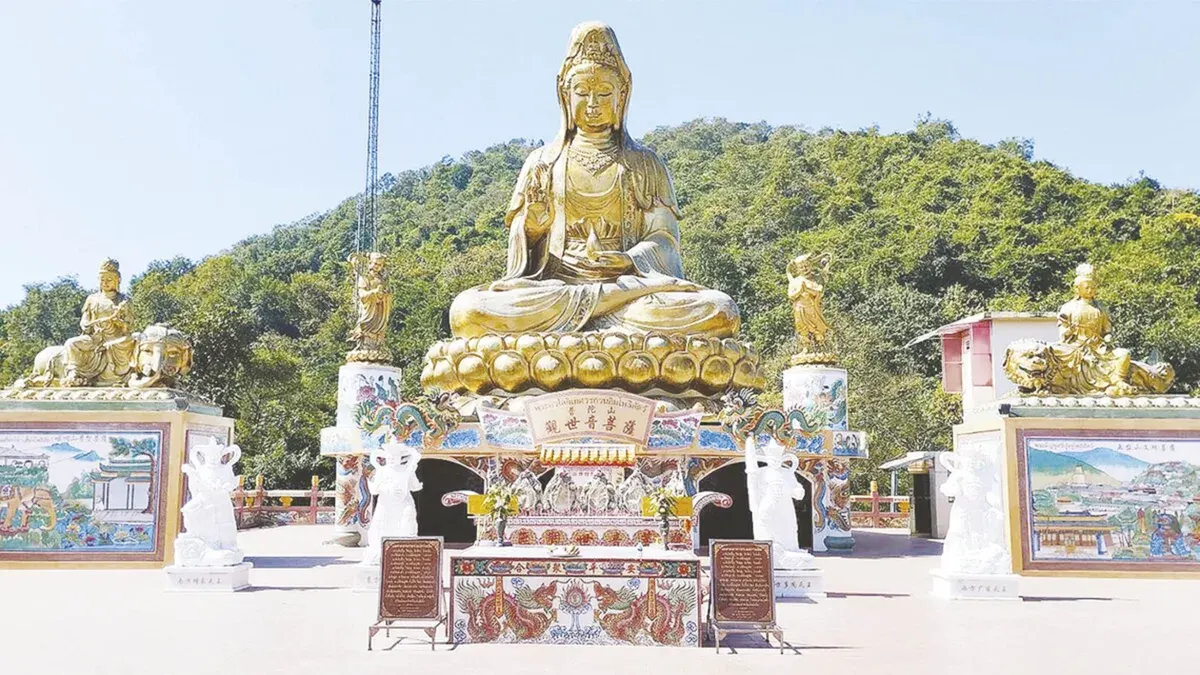
Guan Yin, also known as the Bodhisattva Avalokiteshvara, is a revered Chinese deity enshrined in Thai temples, Chinese temples, and shrines. She is honored as the goddess of compassion by Chinese communities, Thai-Chinese, and Thai Buddhists alike.
In Mahayana Buddhism, Guan Yin is identified with Avalokiteshvara Bodhisattva, whose name comes from Sanskrit. Her origins trace back to Mahayana sutras in India, and when blended with Chinese legend—particularly the story of Princess Miaoshan—she emerged as the feminine embodiment of Guan Yin. This union emphasizes gentleness and motherly compassion in a way that harmonizes beliefs without contradiction.
According to the Avalokiteshvara Sutra, the Bodhisattva can manifest in countless forms, both male and female, to help all beings. It is natural for Mahayana Bodhisattvas to blend with local deities and beliefs when spreading to new lands such as Tibet, China, and Japan.
The legend of Princess Miaoshan recounts how she was originally a celestial being who descended to the human world to relieve suffering. Born as the youngest daughter of King Miao Zhuang and Queen Xiao Lin, she was named Princess Miaoshan. From childhood, she was devoted to Buddhism, understood deep dharma, and resolved to pursue meditation for liberation from the cycle of rebirth.
Her father opposed this and forced her to marry a prince, but she refused. Though scolded harshly, she never grew angry. Her father then commanded her to work in the flower garden as punishment, but tree spirits came to help her. When this failed to change her mind, he ordered the head nun to take her to the White Peacock Temple and assigned her all the convent's work alone. She accepted with unwavering resolve, yet guardian deities secretly aided her tasks as well.
Thinking the nuns were helping her, the king grew furious and ordered soldiers to burn the temple, killing all the nuns, though only Princess Miaoshan survived. He then commanded her execution, but the sword could not harm her. In rage, he ordered the executioner killed and sentenced her to hanging. Yet the rope broke.
A divine tiger then appeared, placed her on its back, and carried her to Mount Xiang Shan. Later, the immortal Tai Bo appeared as an old man in human form and taught her the methods of spiritual practice. She attained enlightenment on the nineteenth day of the sixth month. Soon afterward, the karma her father had created caused him to fall gravely ill with no cure.
When Princess Miaoshan learned of this through divine knowledge, she selflessly sacrificed her eyes and arms to cure her father's illness, moved by filial piety. After becoming an arhat, she regained her eyes and arms and manifested the miraculous form of Guan Yin with a thousand arms. Princess Miaoshan, or Guan Yin, originally a Buddhist figure, later received patronage from the immortal Tai Bo and became venerated in both Buddhist and Daoist traditions simultaneously.
Original depictions of Guan Yin or Avalokiteshvara showed a youthful male form dressed in the ornate style of ancient Indian princes, with many different poses. When Mahayana Buddhism spread from India to China in the early period before the Tang Dynasty, the deity was still depicted as male following Indian Buddhist artistic conventions. Later, Chinese artisans reimagined her as a female figure.